




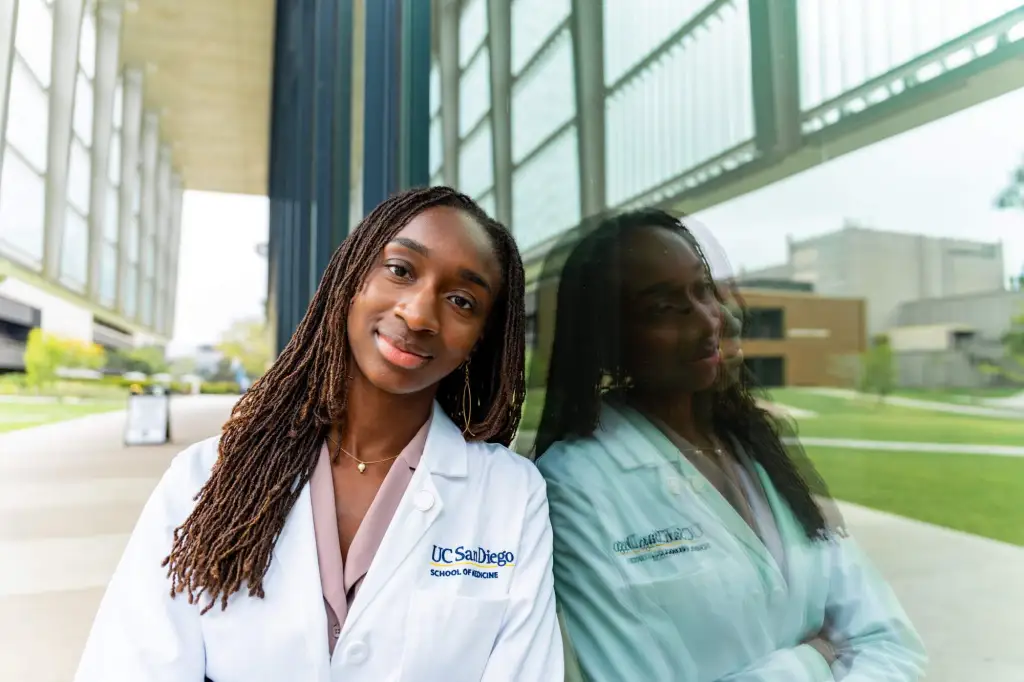
There were stark differences in the historically Black neighborhood where Chioma Ugwonali’s grandparents lived in Fort Worth, Texas — liquor stores, cracked sidewalks, power plants, railway lines — compared to the parks, recreational centers, grocery stores, and boutique shops around nearby Texas Christian University. As a result, she wanted to work toward making people’s lives more equitable and just.
Read more San Diego gas prices still high, but heading lower as July 4 weekend nears
“Even before I started medical school, I knew that I wanted to integrate planetary health into my medical training and my future career as a physician because, in many different ways over the years, I have learned and observed how most of our health and our well-being is not influenced by individual action — what you eat, how much physical activity you get, even genetics — but it’s actually influenced by external factors, or social and environmental determinants of health, like your zip code,” says Ugwonali, who recently completed her first year at the UC San Diego School of Medicine. “With your zip code, (it determines) what kind of infrastructure you have in your apartment building, in your home, in your neighborhood, if you live next to a roadway, if you live next to a landfill, are there grocery stores easily accessible in your neighborhood, et cetera.”
Back in her hometown of Arlington, Texas, she worked with an environmental justice nonprofit called Liveable Arlington, serving as community engagement and partnerships coordinator. She also earned a degree in ecology and evolutionary biology, with a minor in environmental studies, from Princeton University in 2024; secured a $10,000 grant from the Projects for Peace Foundation to organize the Roots Community Festival, an environmental justice workshop for underserved high school students in Fort Worth; and at UC San Diego she volunteers at community health fairs and serves as general manager of the school’s student-run free clinic.
Her current project is the Planetary Health in Medicine summer research fellowship at the City Heights/Weingart Library. With some funding from UC San Diego’s medical school, this free, six-week program for youth 16 to 25 is largely focused on planetary health, environmental justice, and careers in medicine and public health. Planetary health is an interdisciplinary field focused on the inextricable connection between the health of the planet, and the health of the human beings on it. Ugwonali took some time to talk about her summer research program, her interest in planetary health, and how much this field of study owes to Indigenous knowledge and practices that have existed throughout human history. (This interview has been edited for length and clarity. )
Tell us about the Planetary Health in Medicine program.
Over the course of the program, we have several objectives, including learning the science behind climate change and environmental degradation. Examples of environmental degradation are air pollution, extreme flooding, extreme heat; so, they’ll learn the science of these issues and their effects on human health. We are exploring environmental justice and why some communities bear a disproportionate amount of environmental harm and harm that they are not responsible for producing. For example, pollution that comes from AI data centers. I think we were seeing more and more stories where these data centers are popping up in environmental justice communities, and these are communities that have the least access to the technologies that function off the AI.
The fellows will also meet medical students, scientists, community organizers, doctors who are working to address these issues, discover career pathways in medicine, public health, science, and advocacy. One of the main aspects of the fellowship is a group research project and the point of this project is for the fellows to be able to translate observations that they’ve noticed in their communities into an academic piece of work. Giving them the vocabulary to explain what is happening in their communities and giving them the skills to be able to use research and evidence to support their observations, to refine their hypothesis about what’s happening, and then, ultimately, to put it together into a poster that they will be able to share on the final presentation day, July 31, to an audience of family, friends, and some invited guests from the community.
Read more San Diego is shrinking late-night hours at 35 coastal parking lots to reduce crime
This fellowship does not require any prior research experience; rather, it’s for youth who are on the front line of these environmental issues here in San Diego and South County, to be empowered to learn more about environmental issues that they may have noticed in their neighborhoods, and meet people who are doing things to address these issues, and to realize that they can be an advocate to working on climate change and environmental degradation, starting locally, but really on a global scale because these are global issues.
What is planetary health and how were you introduced to this discipline?
People have different definitions of planetary health, but my definition is the recognition that the health and quality of our air, our water, our soils, and other species is interconnected with human health. How I became aware of this discipline is a little convoluted; it was first from a food justice/food apartheid, or a food desert education. Then, learning about environmental justice, and then planetary health. A lot of these terms, I think, are more common in academic spaces rather than general colloquia, but they’re ideas that folks have been talking about for centuries, packaged in a different way.
Planetary health sounds a lot like the Indigenous knowledge practiced for millennia by Native peoples — that human beings and nature are not separate from each other, but that the health of the planet is synonymous with the health of humans. Are you able to talk about this connection between Indigenous knowledge and practices, and the planetary health discipline? Are there ways that this has shown up in your work, or will be included in this research fellowship?
Absolutely, I always try to be intentional about elevating the work that local organizations are doing, that communities are already doing, and where knowledge comes from. A lot of what we find in academia is actually not found, but sometimes even co-opted from communities that haven’t been given the platform or respect that they deserve, and Indigenous communities clearly have been practicing this model of living that recognizes the interconnections between humans, other species, and the environment. And, thinking seven generations ahead is a concept that a lot of indigenous cultures really hold close. Like, ‘OK, yes, we need to eat, and we need places to live today, but we need to make sure that we’re harvesting natural materials, and we’re building our society in a way that’s sustainable for several generations in the future, and sustainable for the local aquatic population or the tree population,’ etc. Is this being included in the fellowship? Yes, absolutely. We have a session in July on Indigenous knowledge systems. We’re going to have folks from Tierras Indigenas Community Land Trust come and chat with us about their work in here in the south part of San Diego, the South Bay. I try to elevate that as best as I can, but I think, sometimes, in the planetary health community, those connections aren’t always illuminated as much as they should be.