




The memory is fuzzy for Luis Alonso Sanchez, which could be said is part of the point. His mother reminded him of the time he was around 4 years old and was taking one of those quintessential childhood springtime photos with the Easter bunny. Then, the bunny took off his head and there was a man inside the body. Sanchez was horrified.
Read more Thousands turn out in Coronado to celebrate nation’s 250th birthday
“I’m very, very scared in the picture. … I remember I was crying a lot and I felt horrible. It was a very creepy costume, something that was intended to be beautiful or happy or joyful,” he says. “I think that was my first interaction of being able to realize that there was a human under this huge, creepy bunny. My mother told me recently about that anecdote, and then I began to remember, and then I had the picture. So, my mom has it very vividly in her mind, and she told me about how I reacted when the bunny took off his head. It was funny, but it was creepy for me, and I was horrified.”
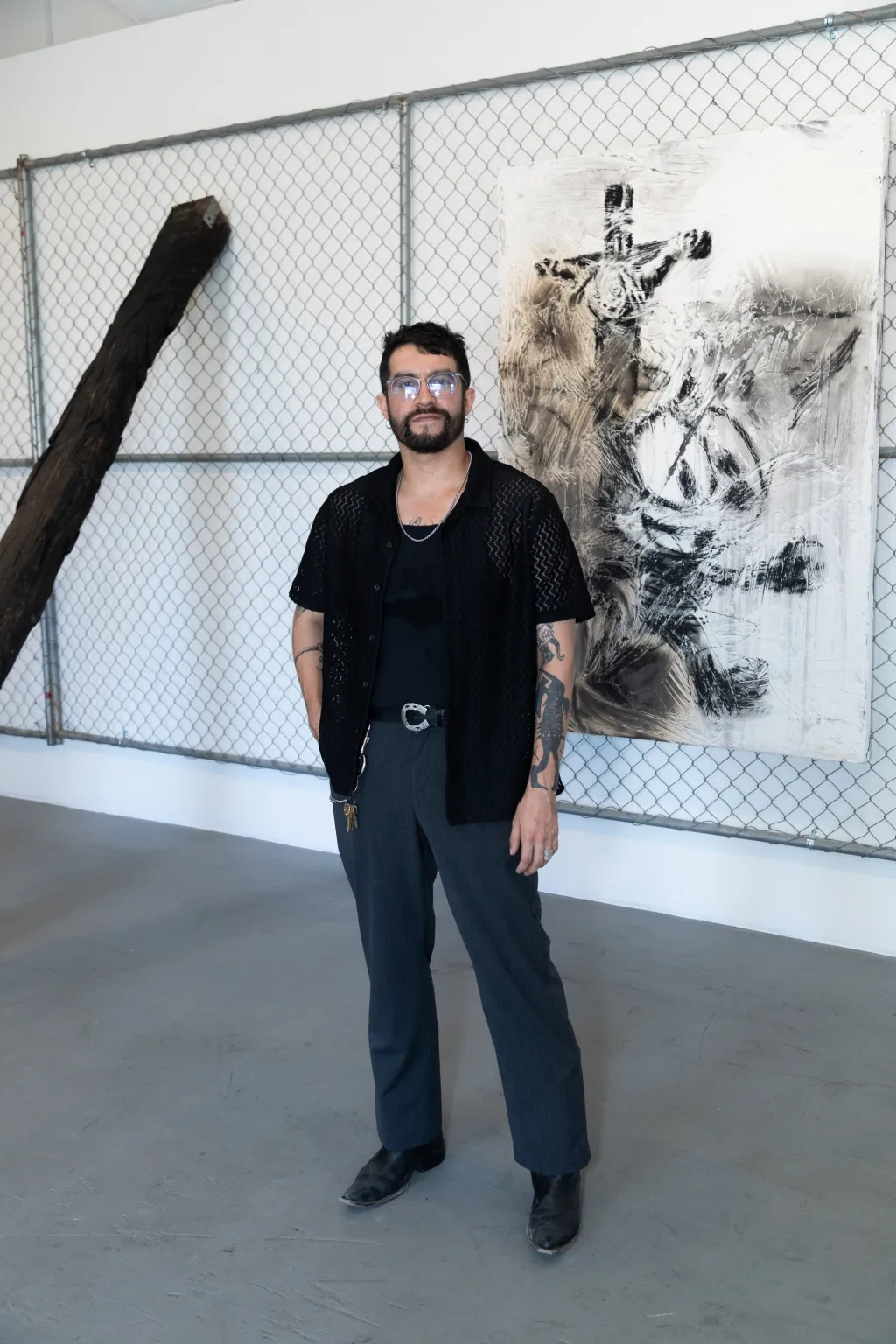
Although he typically thinks and investigates different materials when creating, his current solo exhibition at Bread & Salt, called “Sweet Dreams,” revolves around memory and the idea of “beasts and monsters that have this art history, specifically painting history, and the anthropomorphic aspect of the animalization of humans and the humanization of animals,” he says. Working in painting, sculpture, and installation, the 23 or so pieces in the show include an immersive installation and a video installation, and will be on display through the end of August. People will see the sculptures, paintings, drawings and pixelated artwork, and an installation in various media intended to start a conversation about the geopolitical context that surrounds us at the border.
Sanchez is co-director of Sala de Espera gallery in Tijuana, and chief curator of Encarte Galeria in Mexico City. His work has been exhibited in San Diego, Los Angeles, Mexico City, and the Netherlands, and he was an artist-in-residence at Bread & Salt in 2024. He’ll be at the Logan Heights space for a free artist talk at 7 p.m. Saturday, and took some time to talk about this exhibition and his dreams, nightmares, and memories. (This interview has been edited for length and clarity. )
There’s an image on your Instagram account of you in a bunny costume, holding a cross, with the head of the bunny fixed on top of the cross. Bread & Salt also mentions that this collection is centered around “a recurring memory from the artist’s childhood: posing for a traditional spring photograph with the Easter bunny, only to witness the figure remove its head and reveal a human beneath the bunny costume. What should have been joyful becomes a moment of rupture between illusion and exposure, an image which continues to shape Sánchez’s visual language.” What do you recall about the moment, and how you’ve chosen to build this particular body of work around it?
That was the first anecdote that helped me think of the show, specifically, because mostly I think of materials and I investigate around different materials. I was very young, I don’t remember it that much, that’s why it’s like a sort of a nightmare or a dream. Sometimes memory, I think, is in that place and the show revolves around memory. It started there, and there’s some different characters that appear in different paintings, and in some sculptures. In painting history, there are studies of crucifixions. Since I began the process of moving to Mexico City last year, coming and going from Tijuana to Mexico City, going to churches has always been a very important part of Mexico’s culture. It’s the mix of Mexican heritage and the Spaniard colonization, so that’s when that started. I was born Catholic, but I’m not Catholic anymore, so that has been there. And, the studies of crucifixions started when I moved to Mexico City, so that’s why there’s a bunny and crucifixions, and these archetypes and beasts become these offerings. These are chimerical offerings, in a way. It’s not a show that is talking about religion, it’s not a show that is talking about Catholicism, it’s a show that is talking about something that has been in my specific history that I wanted this show to be very personal in some way. Religion is around everyone, and not specifically Christianity or Catholicism, so it’s an element that’s in the show and that is very heavy. Then, that relates to the characters in the show that are bunnies, sometimes old cartoons like Felix the Cat, or Lola Bunny, and different representations of this beast, or anthropomorphic representations. They are represented in pop culture, mainly, because of the weight of the images that can almost be religious. It doesn’t matter if you’re in L.A. or New York or Mexico City or Madrid, you see these visual elements repeat, so those are some of the ideas that go into what the bunny turned into. It started with the bunny, and then it became the anthropomorphic representation of peace and desire and joy. Then, then it turned into a mix of doing crucifixion studies, and political and religious context, and what’s going on in the show is a mix of that.
You were a 2024 Bread & Salt IMPACT artist-in-residence. Can you talk about what you did during this residency and whether that work has had any influence on what we see in “Sweet Dreams”?
Read more Ham on Wry: The Big Apple — I’ll take an avocado, instead
That has a lot to do with the show. We have one of the sculptures that I produced back in 2024 in the show, that it’s another study of what I was thinking back then. It was a Greek study of this very famous painting made by Edvard Munch, the Norwegian artist, that is famously known as “The Scream.” Back then, I did this sort of a reference of the study with the movie “Scream,” so it’s directly connected. One of the directors of the “Scream” movies, of course, saw this painting by Edvard Munk. Some of the quotes about why that painting exists say that Edvard Munk was a very paranoid artist. He was depressed and paranoid, and he was in a beautiful sunset in Norway, near the ocean, and he said that he was deeply horrified by the immense silence of nature. So, in a beautiful sunset, there was this thing in his mind that could not let him be OK. I think that is deeply connected to the idea of “Sweet Dreams” because “Sweet Dreams” is very related to nightmares. It’s like the approach, or the way you handle very tough situations. Like, when something in life is against you, how do you handle it? How does that get into your mind and your dreams? That can be very connected to geopolitical context, political situations, and whatever anybody feels in this current moment in life that is haunting them. That could be personal, political, financial, whatever it is. That’s why the show is called “Sweet Dreams” because it revolves around a very intense moment in life, but at the same time, how do we handle it? If you’re going through a personal struggle, but at the end you try to be more positive and powerful. That’s the reason why the show is called “Sweet Dreams.”
What did you come to learn about this tension between dreams and nightmares?
What I intend to do in the paintings, or the show in general, is there are some elements to the show that are stronger, that are very visible. I put a chain link fence around the show. When you ask about the tension between dreams and nightmares, my mind takes me to this aspect of the show that I don’t talk a lot about in my work — that is the border. The idea of division that I’ve been constantly, not avoiding, but I think that everything I do seems to be from TJ and it is related, even if it isn’t talked about. The thing in the middle, where the dreams and the nightmares are, is this invisible line sometimes. What I’ve learned is to go through it, be patient, and analyze what is going on in between the dreams and the nightmares. To grab strength from it, and work in another way to beat the nightmare. That’s what I’m trying to do right now, specifically, and that’s what I’ve learned about living between dreams and nightmares.
You collaborated with curator Jairo Antonio Hoyos; can you talk a bit about your process for conceptualizing “Sweet Dreams”? What kinds of conversations were the two of you having? Were there works you were reading, places you were visiting, that helped inform this show?
Jairo has been working with me for the last year and a half on two different shows, so we are talking constantly. I always talk to him about the idea, conceptually, that the border doesn’t start in Tijuana. Our project, Sala de Espera, it’s a project that’s installed in the border, but we don’t do border shows, so that was one of the main ideas, conceptually. Where the fence ends is not where the idea of the division starts, so that was one of the ideas that we were talking about all the time. In more of a pop culture reference, we were talking about the movie “A Nightmare on Elm Street 4: The Dream Master,” the fourth Freddy Krueger movie. And, we were listening to “Crawling” by Linkin Park, so we were into ’90s and 2000s rock music, talking about the show, and a lot of different references around horror movies and that specific kind of music. And, the visual elements were Felix the Cat, or Bugs Bunny or Lola Bunny, and we were revisiting certain lectures mainly around 2000s pop culture.
This collection is also described as “exploring the tension between dreams and nightmares” and that “Rooted in the psychological and emotional conditions of inherited border histories, Sánchez’s practice approaches the border not as a fixed line, but as an atmosphere shaped by memory, desire, restriction, and imagination.” Can you talk about where you grew up and what this idea of an inherited border history has looked like, and what it has meant, for you?
I don’t exactly remember the first time that I acknowledged the border, but it’s something that has always been there, of course. Through time, it has been getting more intense. I remember it wasn’t that intense at the beginning, or at least the visuality of the border. I’m sure that there has always been a lot of problems around that division, but growing up, I was born going to San Ysidro all my life. My mother is a Tijuana native, and I always had the privilege of being able to cross the border with a passport, being born in Tijuana. Later on, when you get older, you begin to see all of the social and political problems around it. I think that since I moved to Mexico City, you begin to see your hometown in a different way. You realize a lot of different stuff around culture, around what it is to be from Tijuana, what it is to be from San Diego, San Ysidro. You understand way better some things that are going on, and you feel way more proud about some stuff, and some stuff seems more stupid. One of the stupid things that I saw that was very impressive was the visuality of the walking entrance to Mexico. It’s brutal — the lighting, you have these huge fences all around. It looks like hell, to be honest. It has the big name that says “MEXICO” and it sounds like you’re going to prison or somewhere because you have the sound of the revolving door. It’s very, very, very dramatic. The first time I came back after being in Mexico City for almost a year, I went to that to that gate and I was like, “Wow, this is so crazy. How didn’t I realize this?” That’s why the chain link is in the show. It’s not to talk about the division, it’s about this physical element that is around. When people learn I’m from Tijuana, all they think about is the fence. It’s not all that we are, but it is something that’s in their minds. We have the chain link in different scenarios, dividing territories in general; it’s not only about borders. The show is not about giving the importance to the chain link, it’s about having it there, and paintings are hanging on the chain link. So, I don’t think it looks as strong as intended, and that’s why it’s there. You have to go into an enclosed area in some moment in the show, and you have to sit there and watch a video. You go in there, you feel enclosed, but at the same time, I think that the chain link has the importance that the context gives it, and the person seeing it puts there. That’s why the chain link is there; it’s not that I want to talk about the border, that’s inevitable. It’s there, it’s part of my life, and it’s part of who I am, but it’s not what defines me or what defines the people that live in the border city. So, that’s why it’s there.
Read more Court rulings force San Diego to halt vendor crackdown. Will chaos return to downtown, beaches?