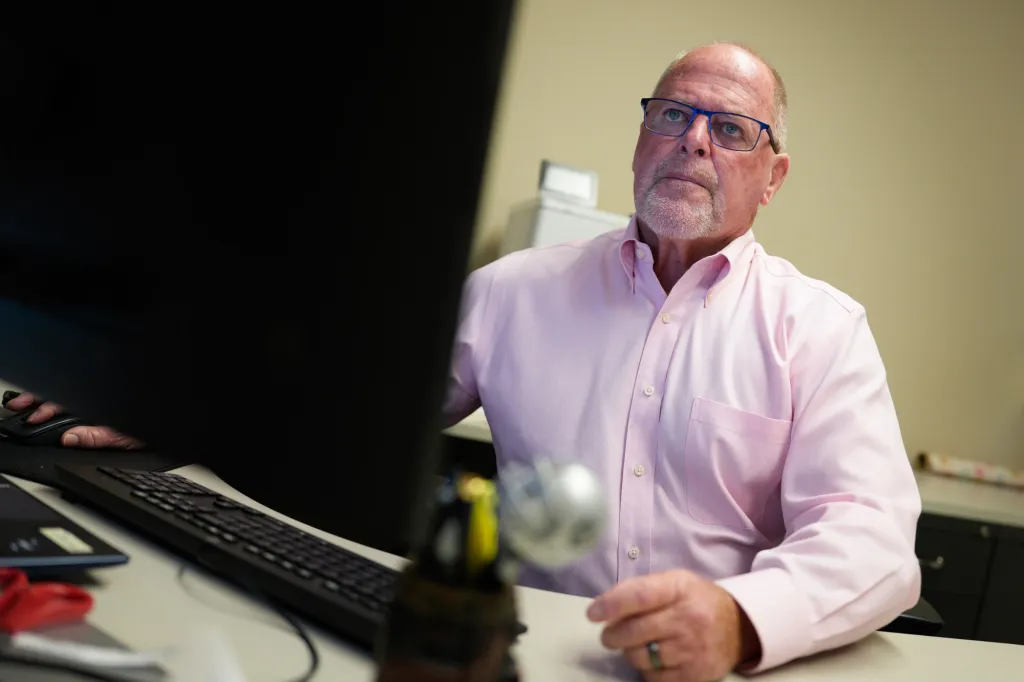
For 26 years, Joe Davis has been a one-man support system for people who work daily with death.
He was a volunteer chaplain in the county Medical Examiner’s Office, providing help for staffers and grieving families.
Over the years, the position grew from two days a week to a full-time presence. It became a calling. He comforted those who needed it. He prayed with those who wanted it.
He also picked up a rather unexpected duty. He uses saws and scalpels to remove brains to be donated for science after being trained by a pathologist two decades ago. By his count, he’s removed around 800 of them.
When he finally leaves the volunteer job this month – retiring at 70 – Davis leaves a legacy of compassionate care and big shoes to fill.
Paul Parker, a former supervising investigator who left in 2010, said Davis was a steady presence, always asking how people were doing, always willing to talk.
“It was like an employee assistance program that was there for you all the time. Every single day, right down the hall. Or in the car with you,” Parker said.
“He was there, and so he was seeing what you were seeing. He was smelling what you were smelling. He was hearing the cries of the family that you were hearing. And that went a long way to building trust.”
Helping staffers and families alike
Despite never taking a pathology course, Davis ended up removing brains for research after a chief deputy medical examiner, Dr. Christina Stanley, invited him to observe an autopsy and noted his keen interest.
“She taught me everything I needed to know, gave me books on brain anatomy. She’d ask me questions and I just loved it,” he recalled. He picked it up so quickly Stanley questioned whether he had gone to medical school. At a certain point, she decided he could do the work himself.
That unlikely skill eventually helped him expand his volunteer hours. Davis’ bosses saw the value of having a chaplain around and asked him to work more days. But Davis, who ran a pressure-washing business to pay the bills, said he couldn’t remain unpaid. “I had to feed my wife,” he said.
According to Davis, then-Medical Examiner Dr. Glenn Wagner offered to try to create a budgeted position. But the chaplain said he had to pray on it, and told Wagner he didn’t think that would work. He needed to remain independent, and felt it would be a conflict of interest if he was under the organization’s leadership.
Wagner came up with a unique arrangement – making Davis the department’s donor liaison and having him paid by outside research groups.
“So in 26 years, I’ve never taken a penny from the county or the medical examiner’s office, but I was a liaison for the brain research,” Davis said. “It only took maybe 20% of my time. It opened up doors to be there full-time and I still got to do something I loved.”
Over the years, he would get consent from families and then procure brains for researchers at various universities and research organizations, most recently the Henry M. Jackson Foundation for the Advancement of Military Medicine, which is looking at blast injuries.
For several years, Davis ran a program called “Beyond the Caution Tape” that targeted at-risk youths and adults by showing them how unsafe behaviors could send them or others to the morgue. Class participants were shown graphic photos, videos and up-close looks at the autopsy and body-refrigeration rooms.
Fees paid by class participants were used to help provide more than 400 cremations for families in need, administered by a nonprofit organization that Davis launched. But the program ended during the pandemic, and with it went the funding to pay for cremations for families in need.
Read more Residents of unincorporated areas continue to push for short-term rental regulations
While those who are indigent can be cremated through a county program, their ashes are scattered at sea. Through Davis’ program, families could keep the ashes.
Davis also created a comprehensive bereavement program that provided grief counseling, financial aid and connected families with volunteer chaplains from several religions. He drafted a booklet on grieving that’s full of practical advice; 75,000 free copies have been handed out.
After hearing people were paying high prices for cremation, he created a list of mortuary and cremation services in the county that is given to families. It shows direct cremation prices, which range from $695 to nearly $3,000. The list is updated every six months.
Over the years, Davis and his work have won accolades from various organizations. In 2012-2013, the county grand jury commended the bereavement center Davis founded for providing needed services to those going through the grieving process. Davis was twice recognized by a San Diego TV station for his leadership, and by the National Association of Counties in 2017.
‘Part of the fabric’
Colleagues say Davis has been a constant, supportive presence in the office, always checking in on the staff. They talked of his dedication and his compassion, and how he eased the load on investigators by helping with death notifications.
“Notifying somebody of a death in the family is, by far, the worst part of the job. It’s horrific,” Davis said. “It’s tough on me, too.”
Davis said one experience in his life made him understand his job on a personal level – his father committed suicide in 2013 when he drowned in Santee Lakes.
Although Davis is a chaplain, with a bachelor’s degree in biblical ministry, he also is a certified trauma services specialist.
The bereavement booklets handed out by the office are printed in English and Spanish, and there is a version that includes scripture quotations for those who want them.
One of the first things Davis tells those he works with is that he’s there to help them and the families they serve, said medical examiner investigator Sandra Joseph.
“This is just literally something that he was volunteering his time to do, and that really resonated with me,” she said. “I’m not a religious person. I’m not a spiritual person. But for this man to open his heart and essentially his soul to help somebody… you don’t see that a lot.”
She said she will miss having Davis in the office. She always greeted him with a hug, adding “I don’t hug anybody.”
“He gets me. He understands what I’m about,” she added.
For now, the Medical Examiner’s Office is looking for another volunteer to serve as its chaplain. However, some of the other jobs Davis held – like brain removal – will need to be backfilled by others, said Medical Examiner Dr. Jonathan Lucas.
“There’s just really no way of quantifying how much support, directly and indirectly, that Joe has provided this department over the decades that he’s been with us,” Lucas said. “He’s really part of the fabric of this department.”
As for Davis, he said he’ll keep volunteering with the Sheriff’s Department, working with staff at the El Cajon courthouse and assisting them with evictions. He said his future may include some travel and spending time with his wife.
Read more Carlsbad asks Coastal Commission to tighten land uses near Palomar airport