






Today’s column is the fourth in a series about the birds and animals that visit Secret Spring, a small waterhole in the oak and pine forest of Palomar Mountain.
Read more 36-year-old pedestrian dies after being hit by vehicle in Kearny Mesa
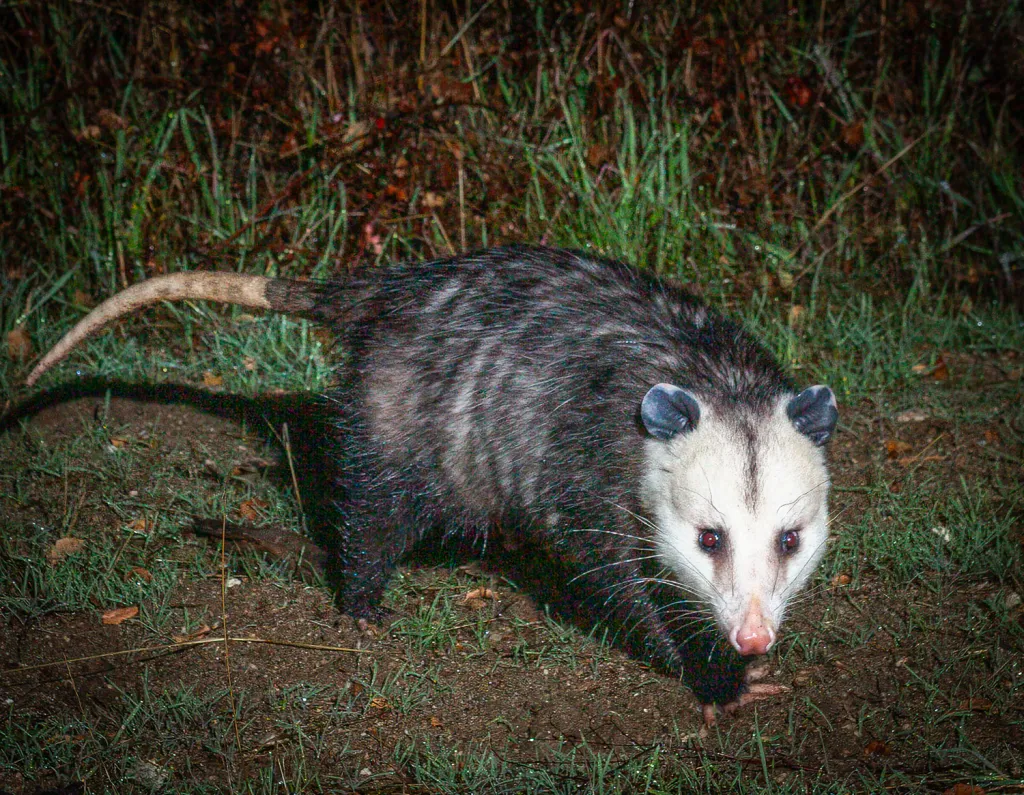
There’s a pudgy little wildlife visitor to Palomar Mountain’s Secret Spring who might have an identity crisis.
They are either loved or hated, and to top it off, most people don’t even call them by their right name.
I mean, would you be happy if you were called by the wrong name?
Most of us mistakenly call this animal a possum and only a few call them opossums.
You might be surprised to learn that possums and opossums are not the same animal.
Few have seen this animal in the wild.
Most frequently seen skulking about at night in our urban neighborhoods, most of us have always called them possums. With their long, bare tail and low profile, it’s easy to mistake them for rats in the dim light at night.
Due to their rodent-like resemblance, penchant to feast on discarded garbage and move around in the shadows, you can see why they suffer from a bad image that contributes to their unpopularity.
On the other hand, they have faces that resemble panda bears with a pink nose and little mouse-like ears, which is hard to resist.
Let’s clear up the name thing.
The possum is actually a native of Australia, while its all-American cousin found throughout North America is officially known as the Virginia opossum.
Possums in Australia are smaller than the opossum, brownish in color with furry tails, while the opossum is larger with a hairless tail, salt-and-pepper body color and white face.
Both are marsupials that give birth to young that continue to mature in the mother’s stomach pouch, which has 13 teats providing milk.
The young opossums are called joeys and as they get larger, they can often be seen riding on their mother’s back as she forages for food. Joey litters can range from seven to 20.
In the wild, opossums act quite differently than city opossums that generally have dependable food sources, including discarded food waste, urban fruit trees, bird seed and pet food.
This series about wildlife visitors to Secret Spring began with birds, which are the most frequent and varied visitors. The next most frequent visitors were skunks and foxes with somewhat regular routines, followed by the opossum, who shows up more randomly.
As a smaller mammal only about 15 to 20 inches long with a 9- to 20-inch tail, I thought it would behave more like a skunk in the wild.
But, unlike the skunk, which is a creature of habit with a diet that requires it to drink fresh water, the opossum gets much of its water from the snails, slugs, beetles, fruit and small rodents they eat.
Read more For years, this chaplain helped people cope with death. He also removed brains
This small mammal also preys on rattlesnakes, thanks to its unique blood chemistry that neutralizes snake venom, making it resistant to bites that would likely kill other animals.
Opossums are also semi-nomadic in the wild and depend on stealth to survive. They don’t remain in a defined territory, instead, they drift about, even using different dens as they wander.
The neighborhood skunks view Secret Spring as their regular waterhole, while the opossum will simply drop in when wandering by looking for food.
The opossum’s nomadic adaptation might also be part of its survival strategy, since it has little defense from preying coyotes, foxes, bobcats, owls, hawks, eagles and domestic dogs.
A regular schedule would easily expose them to predators.
Skunks seem to boldly own the night, since their ability to project a powerful chemical spray makes them far less desirable to predators.
Opossums avoid routines and move cautiously since their only defense is the ability to climb, hiss, growl or play dead, which is probably not a great way to avoid a hungry predator.
They can appear quite formidable when growling and exposing their mouth full of 50 teeth, but when seriously threatened they react involuntarily by collapsing, foaming at the mouth and emitting a bad odor as if they are dead.
This condition can last for some time and is likely the source of the phrase “playing possum.”
Because of their urban reputation, many consider opossums to be vermin. But they are good neighbors, helping rid gardens of insect, snail and slug pests, dispersing seeds, cleaning up the remains of dead animals, and performing this same service in the wild.
Unlike many other mammals, opossums have very low body temperatures, which also makes them resistant to rabies.
There is a myth that opossums eat massive amounts of ticks, but current research that studied the stomach contents of over 1,000 opossums found no evidence of ticks in their digestive system.
This stealthy forest creature is a beneficial member in our ecosystem, and just for the record, I think they are very cute.
I’m going to start calling them by the correct name to help build their self-esteem.
Next you will meet the bobcat, the most curious visitor to Secret Spring.
Cowan is a freelance columnist. Email [email protected] or visit erniecowan.substack.com.