








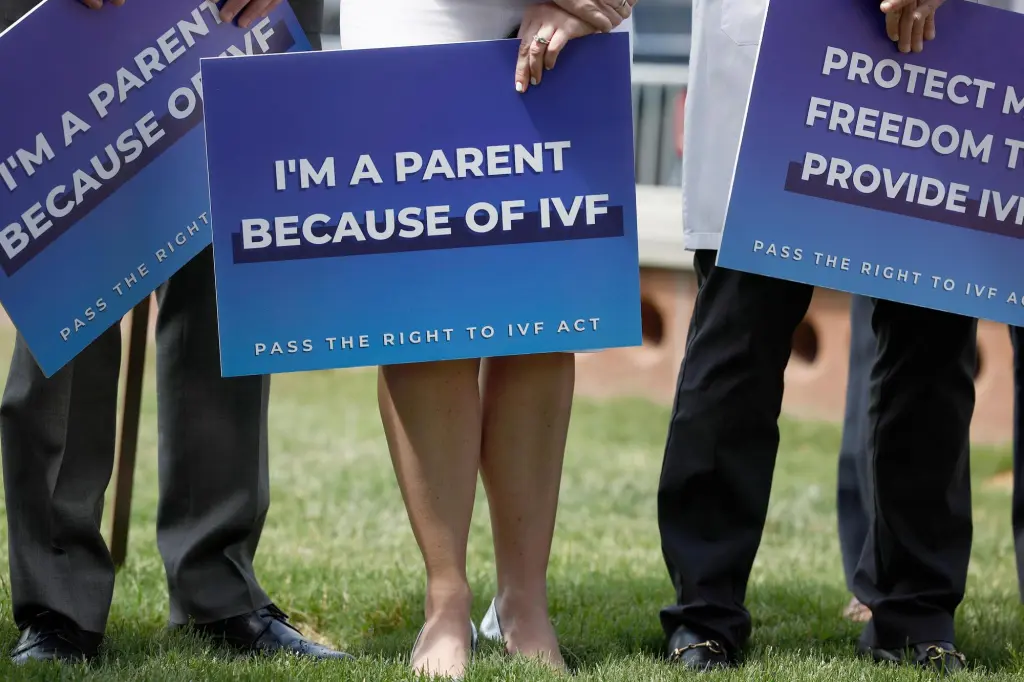
Inspired by the recent experiences of a La Mesa family, U.S. Rep. Mike Levin introduced legislation in Washington on Thursday that would waive the standard 10% retirement account early withdrawal penalty for Americans seeking fertility treatment.
Read more Trump administration caps how long international students can stay in the US
As written, the Fertility Cost Relief Act would allow individuals to withdraw up to $20,000 from tax-advantaged savings plans, such as 401(k) and IRA accounts, to help pay for a range of “qualified fertility treatment expenses,” such as in vitro fertilization (IVF), embryo genetic testing and fertility medications, without incurring the monetary penalties that make tapping such funds an expensive proposal.
Generally, withdrawals cannot be made before age 59 1/2, though there is a significant list of exceptions including, according to the U.S. Internal Revenue Service, the death, terminal illness or “total and permanent disability” of the account holder, disaster recovery, domestic abuse, emergency personal expenses and qualified educational expenses.
Birth or adoption is also already on the list of early-withdrawal penalty exemptions, allowing distributions of up to $5,000 per child. And, families can withdraw up to $10,000 penalty-free to buy their first home.
Given this extensive list, Walt Bishop, director of government affairs at the City of San Diego and a La Mesa resident, wrote an op-ed piece published by The San Diego Union-Tribune in June, arguing that fertility treatment should get equal billing.
This treatment, as he and his wife, Lea, experienced over a three-year period, generated more than $15,000 in upfront expenses. While the couple did manage to achieve their goal, Lea giving birth to their son, Walter, and leading to a first Father’s Day last month, Bishop, 35, said that he was left feeling like it should not have been necessary to ask family members for help when there was cash available, just locked in a retirement account.
“I’m going to be working for another 35 years; I’m going to be able to put that money back into my retirement account, but, you know, we have a very limited amount of time to be able to have a child, based on the biological clock,” Bishop said.
The argument resonated with Levin, who represents California’s 49th Congressional District, including coastal North County and southern Orange County.
Levin said that a recent procedural vote opened a window for the introduction of new bills for the first time in a month, and the fertility penalty proposal seemed like the kind of legislation that could get bipartisan support.
“We have a lot on our plate right now, and we’re trying to find whatever bipartisan wins we can in this crazy environment,” Levin said.
A Democrat living in San Juan Capistrano, Levin is co-sponsoring the bill with Rep. Mike Carey, a Republican representing Ohio’s 15th District.
Read more Brazil calls Trump’s 25% tariff unjustifiable, vows to impose reciprocal tariffs
It remains to be seen whether legislation supporting easier funding for fertility treatment will face opposition. Some religious organizations, such as the Catholic Church, have taken stances against IVF, declaring such procreative techniques “morally unacceptable” because it “entrusts the life and identity of the embryo into the power of doctors and biologists and establishes the domination of technology over the origin and destiny of the human person.”
IVF also faces religious objections around the fact that the technique often creates more fertilized eggs than can be used in a single pregnancy, leading to objections that fertilized embryos may be frozen or discarded.
But these concerns appear to have a limited reach among the general public. A 2024 poll by the Pew Research Center found that “more than two-thirds of Americans say having access to IVF is a good thing.”
Levin said that while he is not sure whether the bill will face significant opposition, it seemed clear that families face stark financial headwinds when trying to overcome fertility hurdles, even in a state where such medical services must be covered at least partially by health insurance policies, according to a new law, SB729, which took effect in January.
“We looked into it, the average is $24,000 out-of-pocket for Californians for IVF,” Levin said.
What about those who may note that pulling thousands out of savings in one’s 20s or 30s misses a valuable chance for the compound interest that ultimately will deliver a financially sound retirement?
“The counterpoint would be that folks are going into debt to pay for IVF, and they’re having to pay back interest that far exceeds the retirement fee, (especially) if they put it on a credit card or take out a loan,” Levin said.
As the first American born of IVF in 1981, Elizabeth Carr is uniquely suited to appreciate any attempt to increase access to fertility treatment. In San Diego last week for a conference convened by Families Out Loud, an organization that promotes multiple routes to parenthood, Carr said that while being able to tap one’s retirement account to cover fertility costs would certainly constitute progress, the national advocacy focus centers on health insurance coverage.
California is ahead of other states in requiring that fertility treatments be covered as standard benefits, but more can still be done, especially in other states without any such requirements.
“In theory, it’s a good idea, in some ways, but in other ways, it feels like a Band-Aid,” Carr said. “I believe everybody should have access to treatment, and it should be covered by insurance. Period. End of sentence.”
Read more Trump’s teleprompter operator on unpaid leave for alleged prediction market bets on Trump speeches