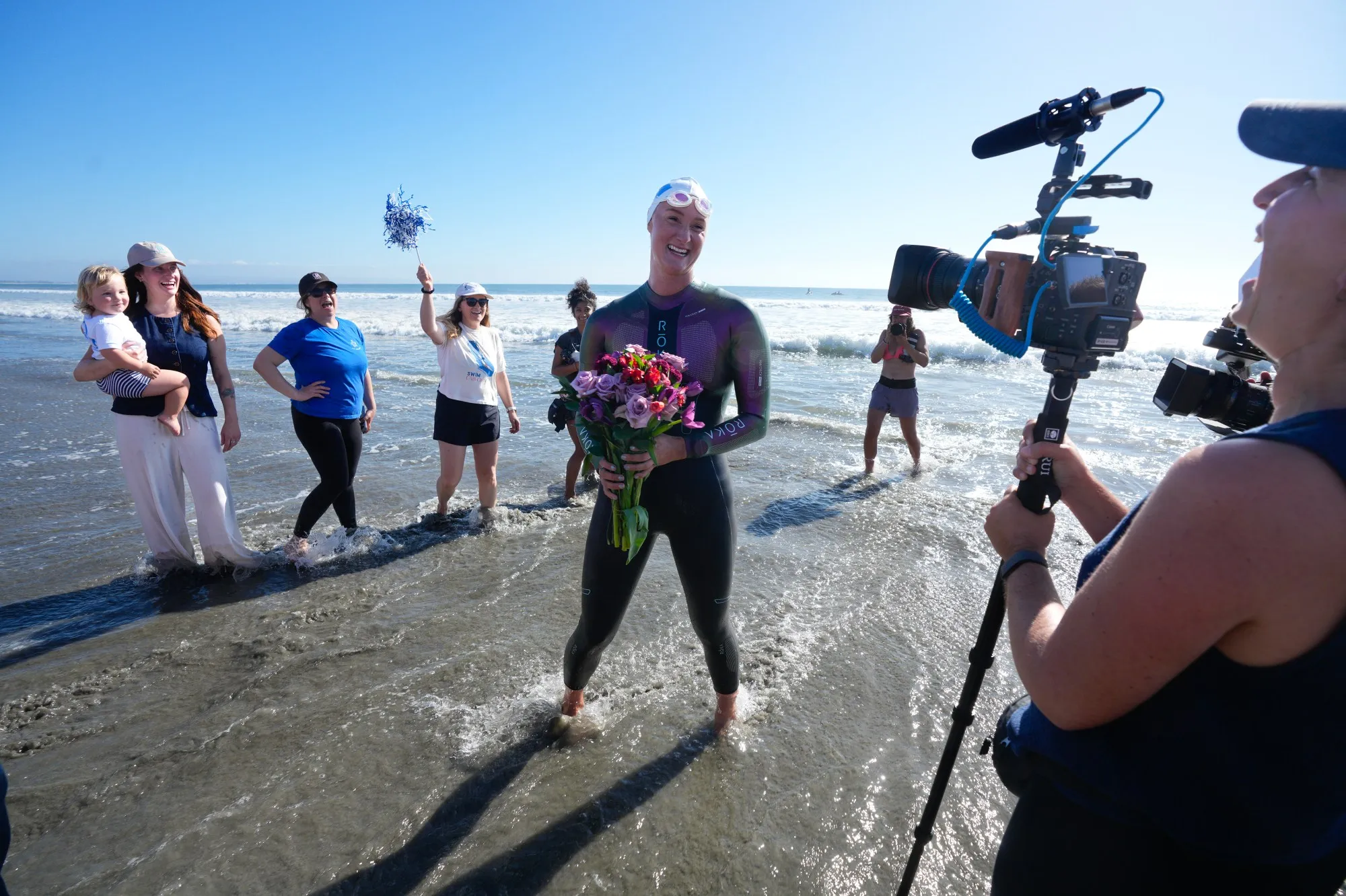



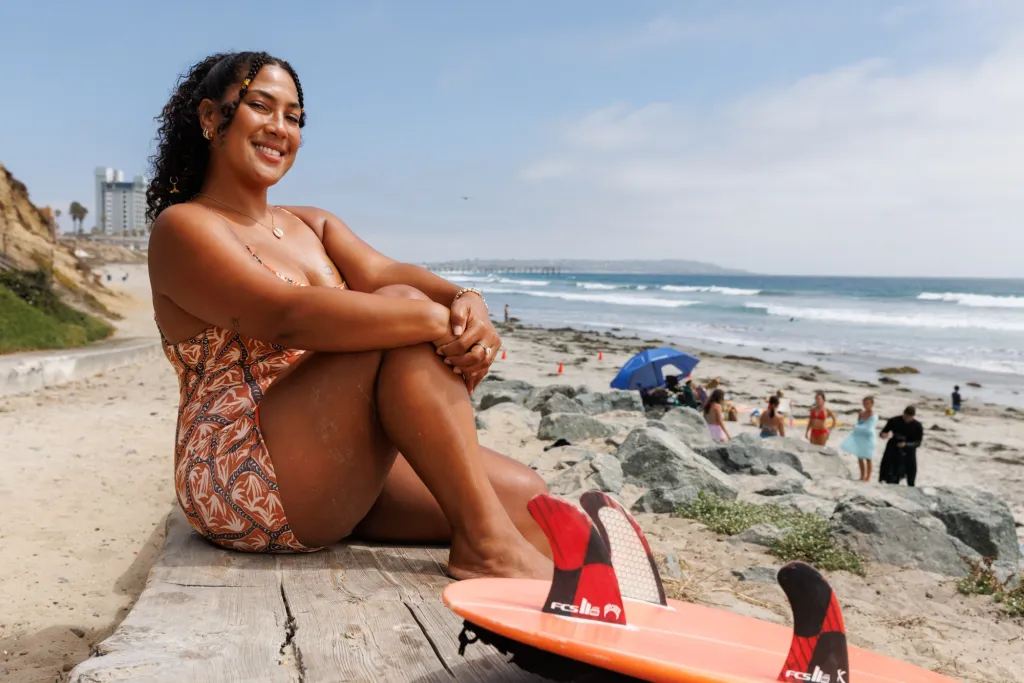
It started in 2020 as a one-time paddle out to honor George Floyd, a Black man in Minneapolis killed by a White police officer that year after he knelt on Floyd’s neck for more than nine minutes. Floyd’s death sparked global protests against police brutality and racism, and Risa Bell wanted to bring the community together locally.
Read more Seven years after A3 charter fraud scandal, California enacts some school accountability reforms
“What I thought would be a small gathering, ended up being thousands of people at the beach,” she says. “One of the things I realized when I was looking around is that, as beautiful as it was, there were people from my community that were missing. There weren’t a lot of people of color there, so I just started to think, ‘Wow, they’re really missing out on healing in community, healing at the coast.’”
That one day turned into posts on her Instagram, giving people of color free surf lessons, and eventually her nonprofit, Paddle for Peace. Her organization offers various programs designed to get folks of color and inner-city communities to the beach to learn about ocean safety, using nature to heal, and going to Title I schools to teach kids marine science, Indigenous stewardship, and increase the numbers of people of color in marine science and ocean conservation spaces. Bell grew up in Guam and always felt connected to the water, but didn’t start surfing (longboard; her preferred spots include La Jolla Shores and Tourmaline Surfing Park) until almost nine years ago, and it was kind of lonely in the beginning. Her mom is Chamorro and her dad is Black, and she didn’t see many other surfers who looked like her. Paddle for Peace has been her opportunity to change that.
Today, she lives in North Park and runs her nonprofit full time, though she previously worked as a clinical director in the health care space. She took some time to talk about her work to change the narrative around Black people and the ocean and surfing, and how the waves helped her heal.
Why was it important to you to address that narrative about Black people and the ocean and the beach?
Because the ocean changed my life. I grew up in foster care, and even though I grew up on an island, I was very disconnected from the water. Even living here in San Diego, I didn’t see anyone that looked like me, surfing. The first time I took a surf lesson was in Hawaii, where I saw a bunch of Black and Brown people surfing, and it was the first time that I saw a bunch of people of color surfing. I tried it and absolutely fell in love with it and, over the years, it’s just become a place of healing, a place to learn, a place to be in community. There have been multiple studies done showing that blue spaces have a significant impact on our mental and physical well-being, and there’s a history of our community and our cultures not getting to the water. This is because of historic racism, redlining, segregation, slavery. Our ancestors were not allowed in pools, they weren’t allowed to own places by the coast, and when they did try, it was taken from them. This trauma has been passed on, and even though this is no longer a thing that’s occurring, the generational impact still exists. That’s why you don’t see a lot of Black people at the beach, so it was important for me, in 2020, to think about why is this still a thing? Not just, ‘Why aren’t Black people going to the beach?’ but mental health and therapy are very taboo in our culture. Again, multiple studies have been done showing that time in nature impacts our mental health, so when I think of our community and all of the suffering we go through, all of the racism we face, and microaggressions and disconnection, we live in a place where there’s so much water, so why aren’t our people going and what’s the barrier to connection for them? What’s holding us back from connecting to the water? There’s a multitude of reasons that I’ve uncovered and been able to create programs around.
One, the historical trauma that’s been passed down, the stereotype that Black people don’t swim, and the fear that our parents put on us of going near the water: “Don’t go into the water; you’ll drown.” Or, they don’t know how to swim, therefore they don’t teach their kids how to swim. Then, we have the socioeconomic barriers. When you go there and you don’t see people that look like you; getting to the beach takes two-and-a-half hours on a bus; when you get there, it’s about $50 to rent a surfboard and a wetsuit, $120 for a surf lesson. Nine-point-five times out of 10, it’s going to be someone that doesn’t look like you just pushing you into waves because that’s their job, instead of helping you work through any fears that you may have. And, let’s say you do take a surf lesson and you love it, a surfboard is $300 minimum, a wetsuit is $120, and then do you have the ocean education? It’s an expensive thing, and just affording it-gas, resources, parking-and then you have the lack of education component to it. How do you safely get in the ocean, and can you swim? Can you identify rip currents? Can you get out of them? Even if you do learn all that, are you going to be the only Black or Brown person there? Are you going to be harassed? Are you going to be stared at? So, there’s a multitude of reasons that prevent our communities from getting to the ocean, and a big thing is the lack of representation, as well.
What I love about North Park…
I love the walkability of it, and I like how it’s more mature. One of the things that I really enjoy about it is North Park used to not be the North Park of today. I used to be around North Park and it’s very gentrified now. I like walking around and remembering what it used to be. People ask me all the time, and I don’t give specifics. I’m like, “Ah, you had to be there,” but it’s nice to still have that nostalgia, that connection to my past. Also, living there and just sitting in my accomplishments. I never thought I would be living in one of the top neighborhoods now; I used to run these streets back then, and it was nothing like it is now, so it’s just a reminder of how far I’ve come.
Where did you grow up and what kind of role did the ocean have in your childhood and in your family?
My mom is Chamorro, from the island of Guam, and my dad’s African American, from Sacramento. I was born in Germany and then I grew up in Guam, and I left when I was 16. While I was in Guam, I was in foster care and it wasn’t a great situation. My foster parents didn’t take me to the beaches or anything, but me and my siblings would play in the jungle and we had these underwater caves that were secret; you only knew if you lived there, so we would go and play in the jungle and dive in the caves. So, for my whole life, I’ve always felt pulled to the water. There’s always been a whisper in the back of my mind.
When I moved to San Diego, I discovered Mission Beach, and I thought that was the only beach in San Diego up until about, maybe, 10 years ago. So, for a long time, I would only go to Mission Beach and I would not see anyone that looked like me surfing and just hanging out on the sand. It wasn’t until about eight years ago, when I went to Hawaii and did my first surf lesson where I fell in love with it, and I started to be in the water in different ways. I wasn’t just swimming in it or sitting by it, I became a surfer. I would do open ocean swims. I’m a certified diver now. I’m ocean safety- and lifeguard-trained, and I’ve devoted my life to bringing kids of color to the ocean. My relationship is a lot stronger with the ocean now. It’s like my church, I can’t live without it and I feel very connected to it. And, I feel very connected to my culture because of it.
How would you describe your experience as a biracial woman in the surfing community?
My experience was very lonely to begin with. I didn’t really have any surf friends and I didn’t really have community, at the time. The friends that I had, none of them were ocean people and none of them surfed, so it was very lonely in the beginning. After I did the paddle-out, I started to meet more people and realized that I wasn’t the only one. I found a surf break that was a little bit more diverse, but still only a handful of Black surfers; a lot of them were Filipino, Mexican, Hawaiian. So, I just started to meet more friends of all different backgrounds. One of the things that stood out is when I told people I surf, they seemed very shocked. They were like, “You surf? You don’t look like a surfer,” which is true because a lot of the media portrays blonde-haired White girls or White men as the posterchild surfer. That is just ironic to me, and very funny, because melanated people discovered surfing. A lot of people think that surfing originated in Hawaii, but Africa is the birthplace of humanity, and the only reason why Hawaii is kind of mainstream in discovering surfing is because that’s where the colonizers went first and started documenting it. But, there’s something called wave riding that existed in Africa long before, so surfing originated in Africa. It was called wave riding, and it’s very much a part of African culture, just like it is Polynesian culture, which is our kin. (According to an excerpt from “Afrosurf,” a book exploring African surf culture by African surf brand Mami Wata, UC Merced history professor Kevin Dawson, also the author of “Undercurrents of Power: Aquatic Culture in the African Diaspora,” notes that some of the first accounts of surfing were documented in the 1640s in what is now Ghana.) So, when I go out there, I try not to focus on the disparities; I just focus on how proud I am to be doing something that my ancestors were not allowed to do, and how proud I am to show that Black people do surf. On the other side, I’m very proud to be in the water, as my people on the island are born to be in. We’re island people, and even though I was disconnected from it, it’s still a way of life on Guam. People of color all over the world surf-in Mexico, Brazil, Samoa-people are water people, and it’s not until they’re brought over to the U.S. that their disconnection from water really starts. They’re disconnected from their birthright, but if you go to Mexico, Africa, Polynesia, wherever you go in the world with a majority BIPOC people, they are divers, fishermen, surfers, swimmers, and very connected to the water. It’s something about the American way that makes us feel like we don’t belong.
Have you seen or experienced any improvements or evolution in the kind of reception you and other people of color receive when you paddle out?
Read more Milk prices at an all-time high, but most consumer costs slip in June after months of increases
Yeah, I feel people aren’t as shocked anymore because I have made a name for myself in San Diego, and my organization is Black-run and focuses on predominantly on Black children and youth, so we’ve kind of made a name for ourselves. We’re really starting to see more surfers of color arise.
I do see a change in perception from the community in diversifying the coast. We still have a long way to go, but the reception I get now is very welcoming. Some people even started calling me the Black Mermaid of San Diego, which I find very funny, but it’s becoming more mainstream in the surf culture here in San Diego. Obviously, there’s still some resistance because surf culture is very White male-dominated and there’s a lot of tribalism, so if you didn’t grow up on the beach, or live there, they’re very rude to you. They think that because they grew up by the beach, they own the waves, but it’s a privilege. So, that is still there, but we don’t go to those beaches, so I don’t experience it often.
Walk us through how your organization works. How are you connecting underserved youth to the coast and the ocean?
During my time here, I’ve lived in Chula Vista, southeastern San Diego, and City Heights, which is where most of our kids come from, so I know a lot of people and that’s kind of how we started, just spreading the word that way. Now, we partner with a lot of schools, government agencies, community organizations; that’s how we get our kids, a lot of word of mouth. We haven’t been having them sign up for our programs on the website because as soon as we send it out to our partners, it fills up within a day or two. We have a wait list of over 250 kids.
One of our programs is called Surf and Science, and that’s a four-week program where we take the kids to the beach for four weeks. We teach them about ocean conservation, marine science, ocean safety, and we teach them how to surf. One of the things that I’m really proud of is that at least 50% of our volunteers are people of color with lived experience. As we started to grow Surf and Science, there are more White people who surf than Black people, and they’re our friends and allies, but we needed more people of color as we grew our programs. So, I said, “If we can’t find them, we’ll create them,” and I created Rising Tides, which is a year-long youth leadership program. We meet with our kids for a year, we teach them how to surf, and we teach them leadership skills, mentorship skills, conflict resolution, emotional regulation, and we’re preparing the next generation of leaders. Then, they get a paid internship with Paddle for Peace and they work in our programs.
With that one, it was also growing very quickly, so how do we reach more kids with no funding? We created Coastal Ninja Academy, which is a program where we bring the beach to the classroom. We go into Title I schools for five weeks and teach the kids science, marine biology, ocean animals, Indigenous knowledge and stewardship, and then we take them on a beach field trip. Through that program, we serve hundreds and thousands of kids throughout the year because we just bring the program into the school.
Then, we have Ocean Sprouts, which is our learn-to-swim program for families. Thinking about how, back in the day with segregation and slavery, there are parents out there who don’t know how to swim because their parents didn’t teach them, and their parents didn’t teach them because their great grandparents didn’t teach them. So, this is a program for all ages that teaches people how to swim. This is a six-week program, and all of our programs are culturally competent, meaning they’re run by people of color with lived experiences. We go over swim hair care and skincare, we have swim caps that fit dreads and braids and Afros, we have wetsuits that fit bigger bodies, and we teach the kids the history about why we’re disconnected from the water and how each culture uses the water back in our origin places. There are people of color represented in the program, teaching them, that look like them and understand where they’re coming from.
We currently use something called the Blue Prescription, which is our newest initiative. This is a preventative mental health framework that’s embedded in all of our programs. Even though kids are doing something different in each program, the whole reason we started was healing in nature, healing on our coasts. So, the Blue Prescription is co-managed by our clinical psychologists to validate the outcomes of the work that we’re doing, to show that time in nature does heal anxiety and depression and leads to community bonding. Our work is not clinical; we do not do referrals, we do not diagnose. We bring people in community to heal, and our clinical psychologists make sure that when we’re collecting data, we’re able to show funders that what we’re doing is working because data and stories really paint the picture for them, so that we can continue to sustain the work. Eventually, we want to bring this model into hospitals, mental health clinics, and juvenile justice departments, so that they stop sending our kids to therapy all the time and try nature and community first. All of our programs are 100% free.
Part of your organization’s mission includes connecting young people “to the ocean’s transformative and healing power.” Are you comfortable sharing how the ocean has been transformative for you? What it’s helped you to heal?
Growing up in foster care, (I was) very disconnected, a very angry kid, very confused, and I was just in my environment and mimicking what I learned, what I was around. Once I discovered the ocean, and the freedom and the space to think and process, it changed a lot for me. When you’re out there surfing, you have to be patient. You can’t catch every wave, so that patience and the selectiveness is something you can bring back on land. The perseverance when you fall off a wave and you’re able to get back up teaches you life lessons that when you fall back down, you get back up. It gives you the space to be away from technology and people and just process what you’re thinking and feeling. When you’re out there, you’re not worried about what’s beneath you. My love for surfing is greater than my fear of anything beneath me, so it teaches you to let go of that fear of the unknown. Then, the people that you meet while you’re surfing—the community—it’s a new space to just be and dream. I’ve had a lot of hardships in my life, and every hard point in my life always brought me to the ocean to be able to just sit and write, and think and process, and learn something different. It’s very quiet, especially as a diver. When you’re underwater, you have no sound but your heartbeat, and you’re able to just sit with your thoughts without a distraction. And, it’s good exercise. The movement of it is releasing dopamine and endorphins. Overall, it’s my church, it’s my place of reprieve, and it’s taught me so many life lessons that I hold near and dear to my heart.
What is the best advice you’ve ever received?
I think the best advice I’ve ever received probably would be that community is very messy, and it’s very important to be able to distinguish that when you get your button pushed, the person pushing it did not install it, so it’s our duty to figure out why we’re triggered in that way and to lean in with curiosity to figure out where the other person is coming from, as well as the feelings that we’re feeling, and take accountability for working through it.
What is one thing people would be surprised to find out about you?
That I’m very sensitive. I’m very strong-presenting and getting (stuff) done, and I talk very loudly and bluntly, but I’m a sensitive dreamer, for sure.
Please describe your ideal San Diego weekend.
My ideal weekend would start off by walking my dog in North Park to get a coffee at James Coffee Co. After that, I’ll grab some lunch at Tacotarian because I’m vegetarian, and then I’ll head to the beach. I’ll get a little surf session in, I’ll sit down after and eat my food, and write. Then, I’ll probably go to Sunset Cliffs, catch a sunset, and then I’ll do a hot yoga session at Yoga Box to end the night. Just being outside and being at the beach, for sure.
Read more Wildfire smoke from Canada and Minnesota pushes farther into the US and engulfs DC in haze