




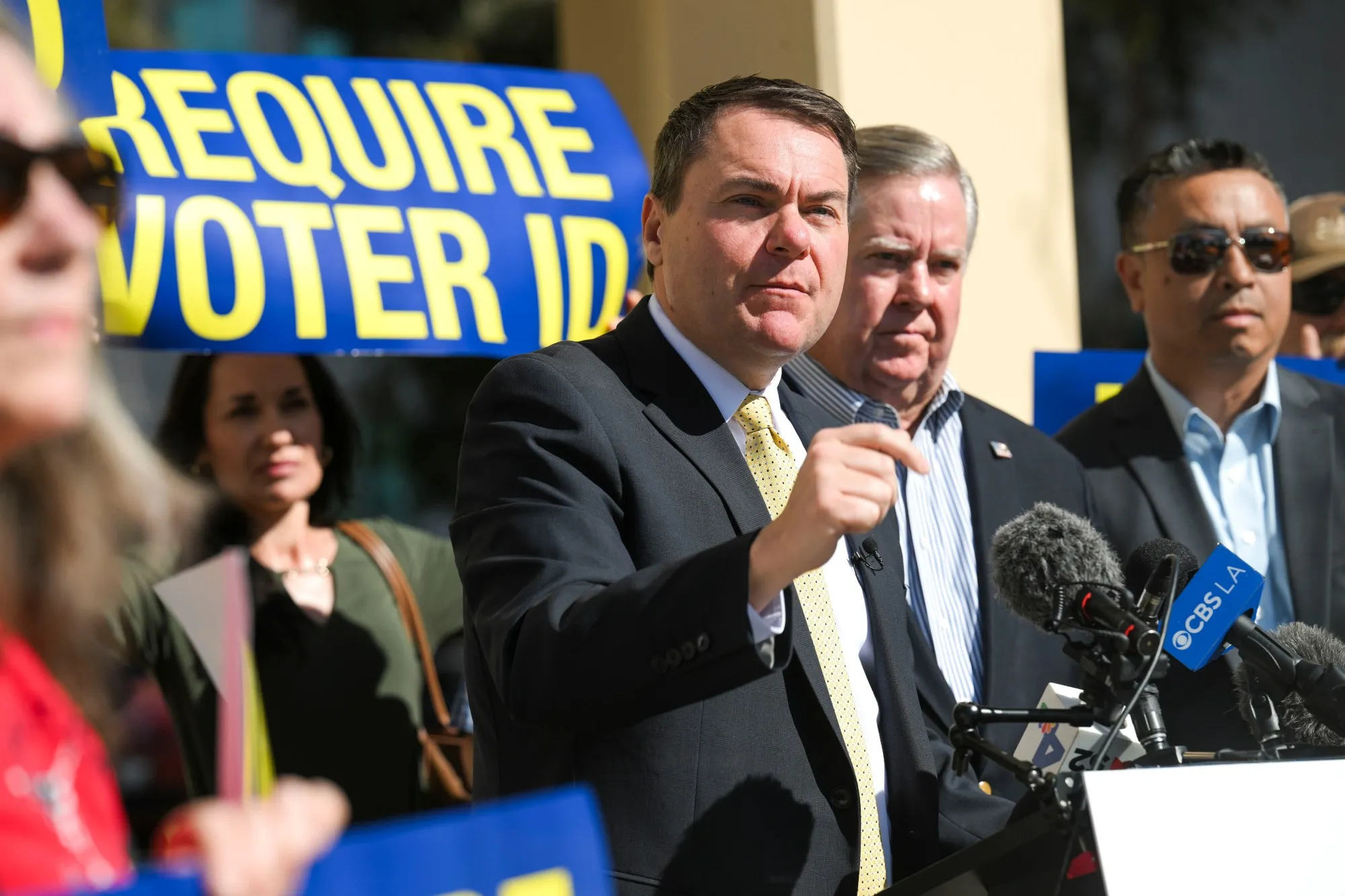
A legal fight is on over the language that will appear on the November ballot alongside the California voter ID measure being pushed by San Diego-area Assemblymember Carl DeMaio.
Read more The US military says it’s thwarted an Iranian missile attack on American troops
The committee backing the ballot measure, known as Proposition 39, filed a lawsuit Monday alleging Attorney General Rob Bonta weakened the ballot measure’s language in a way that’s inaccurate and biased.
The Attorney General’s Office routinely alters ballot measure language and changed the language for all of the nine measures California voters will decide on this fall.
Originally, the submitted ballot measure language read that it “establishes additional voter identification and citizenship verification requirements.” Under Bonta’s rewrite, the measure says it “prohibits citizens from voting unless they present government-issued identification.”
The lawsuit argues the ballot measure does not technically prevent people from casting votes but rather mandates election officials verify a voter’s identity before counting them.
In a statement, DeMaio accused Bonta of trying to “rig the vote” on voter ID. “California voters deserve a fair election, and that’s why our coalition is suing,” he said.
DeMaio said he was traveling on Tuesday and not available for comment.
The lawsuit, filed in Sacramento court, asks for a decision by Aug. 10. After that date, the state begins printing ballot materials.
In a statement, Bonta’s office said it was confident the courts would side with its version of the ballot measure.
“California DOJ takes seriously its responsibility to provide accurate and impartial information to inform voters,” Bonta said in a social media post last week after the new language was first released.
Voter ID landed on California’s November ballot following a well-financed campaign backed by wealthy Republican donors and Reform California, the powerful conservative group controlled by DeMaio.
The committee backing it had raised $13.3 million as of late April, according to campaign disclosures most recently filed. Of that, $3 million came from Reform California. Billionaire Richard Uihlein, an influential donor to conservative causes, donated $4 million.
Other top donors include investors Cameron and Tyler Winklevoss, who together gave $500,000, and Nicole Shanahan, running mate for Robert F. Kennedy Jr.’s 2024 presidential bid, who donated $370,000.
About 8% of the committee’s fundraising came from donors who gave $1,000 or less.
Read more Trains delayed by high surf, erosion between San Diego and Orange County
Supporters argue voter ID prevents voter fraud. But actual cases of voter fraud are rare, and critics say voter ID laws suppress the votes of people of color, the elderly, military voters and students.
California is one of 14 states that do not require voters to present an ID to vote. But voters may be asked to present an ID if they’re voting for the first time, according to the secretary of state’s website.
Still, stricter identification requirements for voting do have support in California.
According to a recent poll from UC Berkeley’s Institute of Governmental Studies, 71% of Californians support requiring voters to prove their citizenship if they’re voting for the first time. Another 54% support proving citizenship every election, according to the poll.
If passed, the ballot measure would require voters to present a government-issued ID every time they vote in person. To vote by mail, voters would have to include the last four digits of that ID, or request a proposed voter-identification card from the state.
A nascent effort from Democrats has begun to oppose the ballot measure. Democratic donors have launched a group called No on Proposition 39 to oppose what they see as a voter suppression effort.
The group has not yet filed campaign disclosures but lists among its top donors the ACLU of Northern California. Democratic gubernatorial candidate Xavier Becerra has also vowed to raise money to defeat the measure.
Tenoch Flores, a spokesperson for the group, said in a statement the measure was being fueled by unfounded theories about election fraud.
“The problem with seeing conspiracy theories under every rock is that you see conspiracy theories under every rock,” Flores said. “The Attorney General has a constitutional duty, after careful review, to prepare title and summary for ballot initiatives.”
The California effort comes as President Donald Trump makes a similar push in Washington.
This week, he has pressured Senate Republican leaders to pass stalled legislation to require voter ID and curb mail voting nationwide. And on Monday his administration asked the Supreme Court to clear the way for an executive order that could dramatically restrict mail voting.
Read more Some schools are extending admissions for students unenrolled by Howard University