






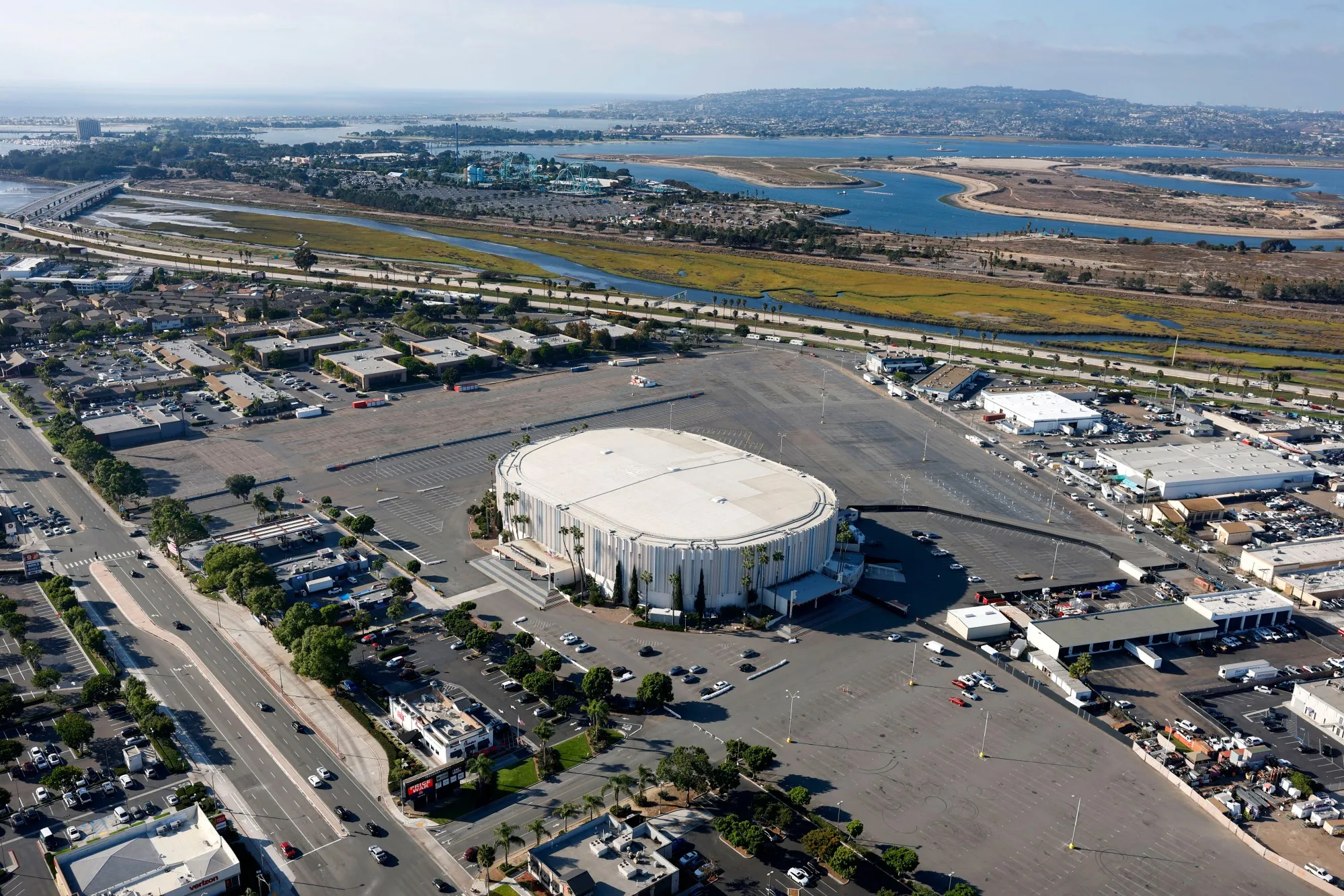
An inactive bill on human remains has been revived in the final stretch of the state Legislature’s regular session and entirely refashioned to add a level of certainty to the Midway Rising mega project.
Read more Del Sur Elementary parents confront Poway Unified officials on campus’ mold situation
In a gut-and-amend process, Senate Bill 344 is being rewritten by its author, state Sen. Akilah Weber Pierson, D-La Mesa, to establish that the project has fully satisfied the requirements of California’s Environmental Quality Act, or CEQA.
The bill, which was first introduced in 2025 and concerned the scattering of ashes at sea, was last week moved from the Assembly’s inactive file to the floor where it awaits a final reading in the chamber. If the amended bill is approved by a super majority, it will return to the Senate, its house of origin, for a concurrence vote.
The 2026 legislative session ends on Aug. 31 with lawmakers in a final dash to approve bills to send to the governor’s desk. The new version of SB 344 includes an urgency clause, meaning its protections will take effect immediately if signed into law.
“As amended, SB 344 would deem the Midway Rising Specific Plan Subsequent Environmental Impact Report to be in full compliance with the California Environmental Quality Act, or CEQA,” Weber Pierson wrote in an Aug. 13 memo to the Assembly’s Rules Committee. “In order to promote the swift and deliberate development of affordable housing in the city of San Diego, an urgency clause is needed for this measure.”
Weber Pierson, through spokesperson Albert Parnell, declined to be interviewed for this story. The senator has also declined repeated requests to discuss SB 958, another Midway Rising-related statute that would prohibit the environmental impacts associated with increased building height from being considered significant impacts under CEQA .
SB 344 is co-sponsored by San Diego Mayor Todd Gloria. State Sen. Steve Padilla, D-Chula Vista, and state Assemblymember Chris Ward, D-San Diego, are listed as co-authors. Voice of San Diego first reported on the amended bill.
“As San Diego’s housing mayor, (Gloria) believes we have to match the urgency of our housing crisis with action,” Joya Patel, Gloria’s director of communications, said in an emailed statement to the Union-Tribune. “SB 344 is intended to provide legal finality to the project-specific environmental review the city has already completed for Midway Rising.”
The bill’s co-sponsors are the California State Building & Construction Trades Council, the California Council of Carpenters and the California State Council of Laborers, Patel said.
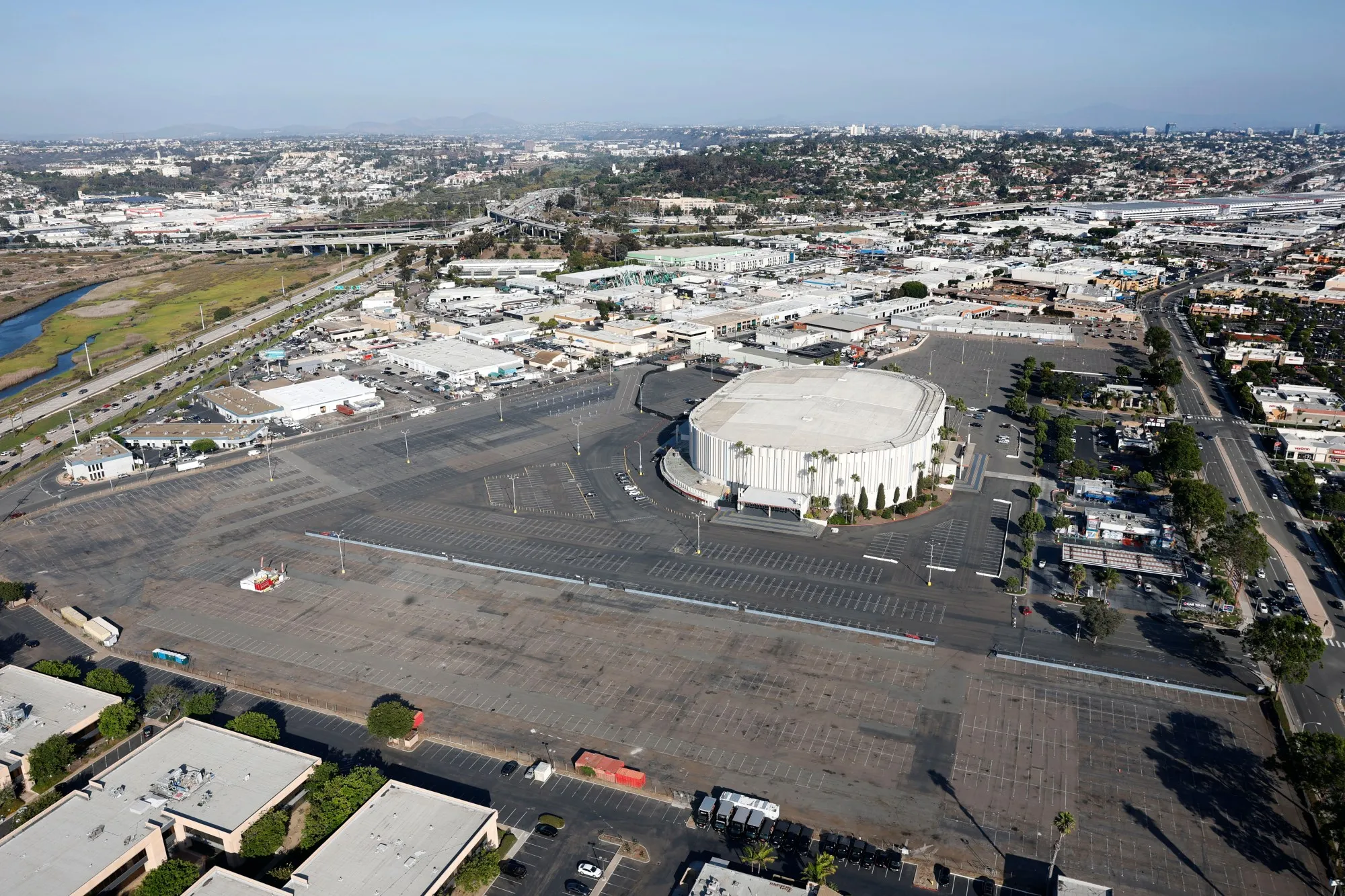
In September 2022, San Diego City Council members selected the Midway Rising development team to lease and redevelop the city’s real estate at 3220, 3240, 3250 and 3500 Sports Arena Blvd. in the Midway District. The team is composed of market-rate housing developer Zephyr, affordable housing builder Chelsea Investment Corp., and sports-and-entertainment venue operator Legends. The Kroenke Group, a subsidiary of billionaire Stan Kroenke’s real estate firm, is the entity’s lead investor and limited partner.
The city and the developer are nearing the end of a lengthy negotiating process that is expected to culminate with a long-term ground lease, although deal terms have not been made public.
The development plan for the 49.2-acre property, or what’s known as the Midway Rising Specific Plan, calls for 4,254 total residential units, a 16,000-seat replacement arena, 130,000 square feet of commercial space, 8.1 acres of parks, and an additional 6.4 acres of plazas and public space. It memorializes the team’s commitment to build 2,000 residential units for households earning 80% or less of the area median income, or what’s considered affordable housing.
The city of San Diego completed an environmental analysis of the specific plan, or what’s called the final subsequent environmental impact report, or FSEIR. It is awaiting certification by the City Council.
Earlier this year, Weber Pierson, at the request of Gloria, introduced SB 958 to insulate Midway Rising from legal challenges linked to the state’s environmental law in light of a court order reinstating the 30-foot height limit in the Midway District. The bill has since been amended to apply to other infill developments. It now focuses singularly on prohibiting increased building heights from being considered significant impacts under the state environmental law. It is currently on the Assembly floor, awaiting its third and final reading.
Read more Trump keeps embracing data centers even as they become toxic in midterm races
SB 344, by comparison, seeks to provide blanket protection from legal threats challenging the sufficiency of the project’s environmental impact report.
“The city of San Diego’s Final Subsequent Environmental Impact Report … shall be final and conclusive for purposes of the implementation of the Midway Rising project,” the proposed bill language states.
The special statute would appear to stop in its tracks opposition efforts like the one telegraphed by Chatten-Brown Law Group. The firm sent a letter to San Diego leaders outlining several ways in which the environmental analysis for the Midway Rising project is said to be substantially deficient, particularly in the report’s handling of combined impacts with the anticipated redevelopment of the Navy’s nearby NAVWAR property.
Brad Termini, Zephyr CEO and project leader, said the proposed law is needed to make sure the project can break ground shortly after City Council approval.
“The Midway District has waited too long, and I think our local delegation has realized that,” he said. “If the Legislature decides to act, this bill will ensure Midway Rising has a path to start construction next year.”
Termini could not provide an explanation as to why proponents opted to revive an unrelated, inactive bill.
The gut-and-amend tactic is not a new one.
Legislators often introduce obscure bills, like the original SB 344 bill on human remains, to run them through the process and get them through both houses without objection, said Lori Saldaña, a former Assembly member and critic of Midway Rising. These bills then become “poker chips” to be used later, she said.
Last year, SB 344, in its original form, passed out of the Senate and advanced to its third reading in the Assembly before being placed on the inactive file. On Aug. 12, Ward, the bill’s co-author, provided notice of the intention to move the measure off the inactive file. Now, the bill can move forward where the previous version left off.
“My concern with this process … is that you’re allowing a very substantial change to take place without any prior committee hearings or analysis or ability for the general public to weigh in,” Saldaña said.
Saldaña said the bill’s attempt to make CEQA legal challenges more difficult is troubling, in part, because the project site will be subject to frequent flooding.
“You can’t legislate sea level rise,” she said. “This is a massive watershed. … They will be struggling, just as the convention center does, to pump out groundwater 24 hours a day.”
Both state bills will be decided by the time Midway Rising returns to City Council. Although not formally docketed, the proposed real estate deal between the city and the development team is expected to be taken up by San Diego’s Land Use & Housing Committee on Oct. 8, Councilmember Kent Lee, who chairs the committee, told the Union-Tribune.
Read more US ramps up Cuba sanctions and detentions of Americans returning from the island