





Mainly Mozart, a longtime San Diego classical music nonprofit, knows that collaborating can be a key to success. Years ago, its youth orchestra merged with another, and it has closely worked for decades with an arts nonprofit in Tijuana.
Read more Man killed in Bay Ho hatchet attack identified
So when Nancy Laturno, Mainly Mozart’s founding CEO and artistic director, learned about a new — and new to San Diego — program created to help nonprofits team up for greater impact and effectiveness, for long-term success, and in some cases perhaps for survival, she was thrilled.
“It sounded like it was meant for us,” Laturno said. “We were gratified to see that the funders see the importance of these significant and sustained collaborations.”
Laturno was referring to The Nonprofit Sustainability Initiative San Diego, launched this week, funded by seven foundations and run by Catalyst of San Diego and Imperial Counties. The program aims to make it easier for nonprofits in this region to pool resources or partner in various other ways. Nonprofits across the U.S. have faced two giant funding crises roughly five years apart: the COVID-19 pandemic and the current shift of federal funding from nonprofits to other priorities.
A study published early this year by The Nonprofit Institute at University of San Diego details the effect on San Diego’s nonprofits. As a result of more than 50 executive orders and actions, and hundreds of pieces of federal legislation introduced that concern nonprofits, 81 percent of San Diego’s nonprofit leaders said they experienced a decrease in funding from at least one major revenue source. In parallel, 13% of the surveyed nonprofits said their financial health was very strong, down from 18% a year earlier.
Connie Archbold Robinson, the San Diego initiative’s director, said funders wanted to come together to help nonprofits broaden their impact at a time when demand has grown and resources have fallen.
“We’re in a moment right now where many of our local nonprofits, because of the national shift in policy and funding priorities, their ability to raise money and sustain their services has shifted, at the same time that there’s a lot more demand and community need for the types of services that they are providing,” she said. Local foundations, she added, “are at this table because they’re seeing day to day how much the need and the demand actually is, beyond their capacity as philanthropy to fill those gaps.”
A number of nonprofits here, she added, “are really facing tough decisions around — whether it’s decreasing their capacity around program delivery (or) rethinking and cutting back on staffing. In some cases, nonprofits may still have funding, but they can see on the horizon that a funding stream they’ve relied on from the federal level is not going to be coming again. Unless they’re able to fill that gap, it’s going to have a really significant impact on their organization.”
Beyond the fiscal landscape, the institute’s leaders say nonprofits can learn from one another and share resources in order to be more effective.
The program gives San Diego area nonprofits financial backing in two formats: one is grant money for exploring collaboration options — by hiring a consultant, checking compatibility and doing due diligence between potential partners. If a collaboration is the way to go, a second grant is available to help make that partnership happen. The grants, which come from local foundations, range from $10,000 to $50,000.
The initiative is new to San Diego but part of a larger trend of nonprofit collaboration funds. Similar programs exist in Arizona, Illinois, Texas, the Pacific Northwest and parts of New England. A fund in Los Angeles established in 2012 serves as a model for others, including San Diego’s.
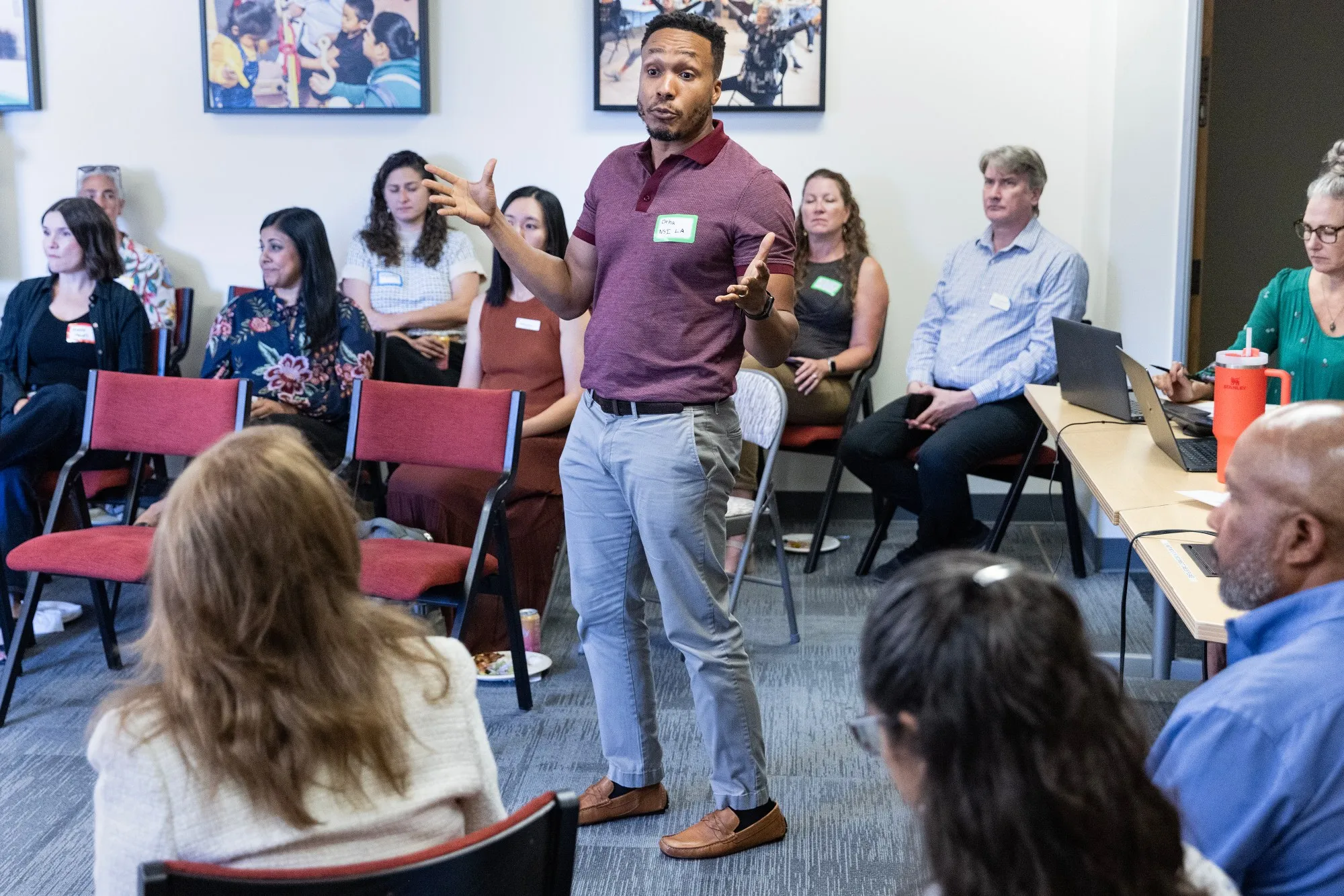
At a kick-off event Wednesday at Catalyst’s University City offices and over Zoom, around 80 nonprofit leaders came to learn about the initiative. They work in many fields, including education, arts, refugee support and workforce issues.
Otha Cole, a nonprofit development expert who helps lead the Los Angeles initiative, outlined about a dozen ways nonprofits can collaborate, from creating loose networks and coalitions, to sharing resources, space or staff, to a deeper integration of organizations through mergers or joint-venture partnerships.
He noted that teaming up not a sign of weakness and advised the nonprofits to use the program to explore these options as part of long-term strategic planning. Other reasons to team up — outside revenue loss — include executive transition, demand exceeding capacity, implementing policy changes and a desire to scale up.
Arnali Ray told the audience how the food rescue nonprofit she leads went through the Los Angeles program and found three other nonprofits to collaborate with. They now share warehouse space. To get there, they talked about what they could share.
“We need equipment, we need space, we need staffing. We don’t need it all the time,” she recounted. The initial question for her nonprofit, Ray said, was “How can we find ways to reduce our cost but not lose the impact?”
Megan Thomas, Catalyst’s CEO and president, said the ideas around collaboration had been circulating in her sector and took flight given recent pressures.
“We are excited about this fund because it is something that the community of funders and nonprofits — and really anybody interested in the social change ecosystem — has been talking about for a very long time. But the moment we’re in seems to have created the sense of urgency and the coming together of folks that makes it possible to actually put it into action.”
For Mainly Mozart, the initiative popped up right as Laturno was in talks with another organization, in the health space, about a collaboration. It would be a way to share different strengths.
“It was almost as if somebody was listening to our conversations and answering our needs. Like, the timing couldn’t have ben more fortuitous for us,” she said. Past experience has shown her that partnering is a way to grow. “We’re accustomed to these strategic alliances, and it’s very much how we build our business.”
Both grants, exploration and implementation, are valuable, Laturno said. But the chance to hire a consultant, as part of the first grant, is an unusual privilege.
“It’s easy to underestimate how valuable a really talented consultant is,” she said. “Because we don’t — and most of us don’t have — the money to invest in that. So on the one hand, I would say that the implementation money is going to be most valuable to us, because I can look at that and know how I would envision it being applied. But I think I’m most excited by the opportunity to work deeply with a consultant.”
At Wednesday’s event, Cole talked about setting up a successful collaboration. Have enough runway. Involve your board. Hiring a good third party consultant is “really really important,” he said.
Laturno, later, offered this advice: “I think making sure it’s the right partner, and the right chemistry between boards and leadership, is key. If it’s not, it shouldn’t be pursued.”
Read more SeaWorld San Diego’s rescued belugas have yet to meet the park’s resident whales
Read more From the Archives: Chicken court