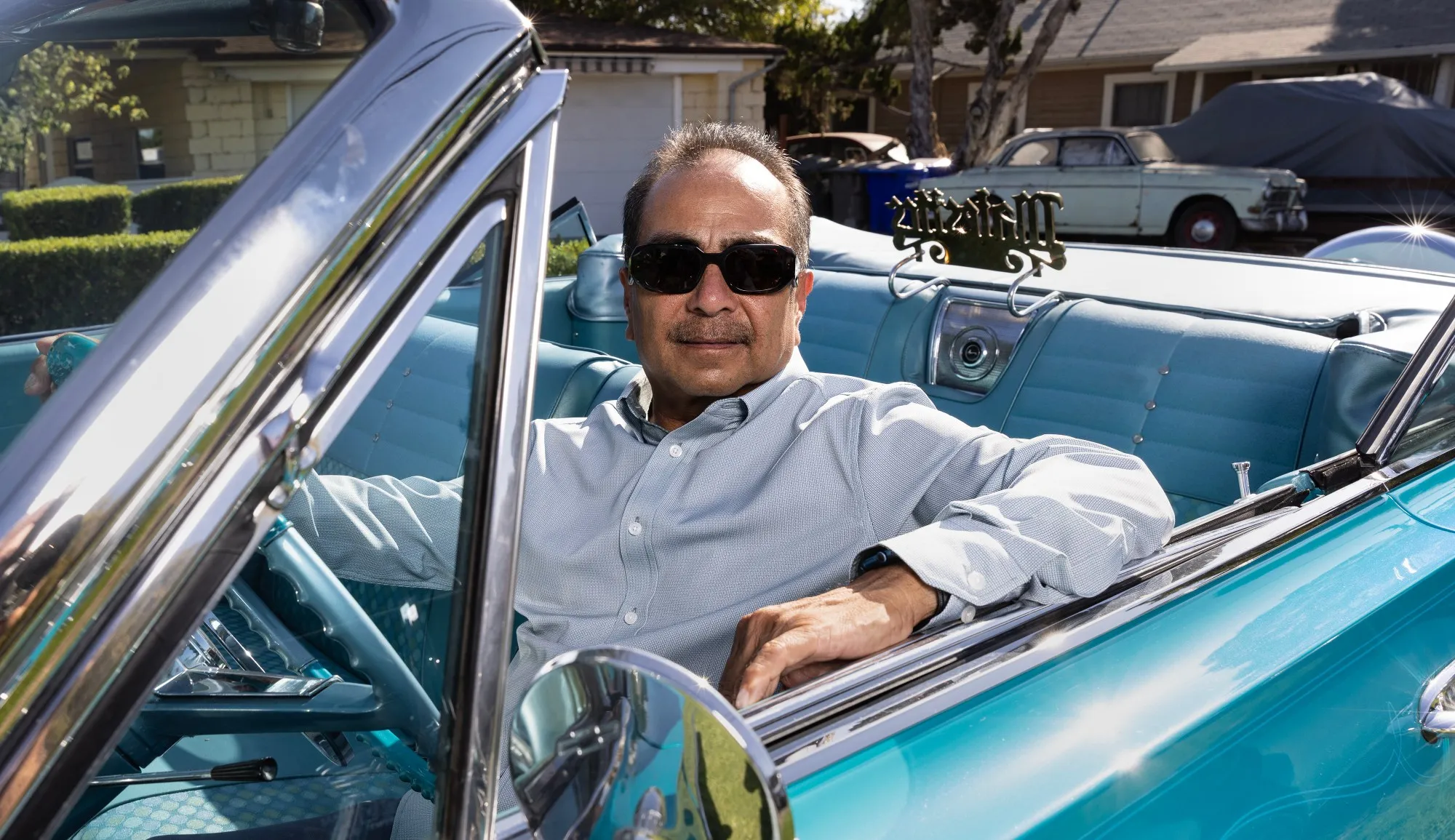
It was 1976 in his Logan Heights neighborhood and a 12-year-old Norman Paraiso had his first lowrider bicycle with a custom candy blue paint job—a 1966 Schwinn he had spent six to eight months building out.
Read more ‘Elevate this issue’: Juvenile justice advocates fight to reinstate support from Superior Court
“It was sparkly. It had different colors. It was just bright and caught my eye. I wanted to do something similar to what I saw (around me), and over the years, that led me to doing the same thing on cars,” he says. “It’s kind of a lifestyle versus just a fad.”
Lowrider bicycles started in Chicano neighborhoods in California in the 1960s as an outgrowth of lowrider car culture, according to outlets like Tracer Bikes and the “Lowrider Bikes: Familia y Cultura” exhibition at the SFO Museum at the San Francisco airport. The customized bikes are designed to match the style of lowrider cars, being lower to the ground and riding them at cruising speeds. Creating one, much like the cars they’re inspired by, reflects the unique creativity and self-expression of the friends and family members typically working on them together. Lowrider culture is considered a form of Chicano cultural heritage and it is in this spirit that it’s being celebrated in the upcoming exhibition, “Chrome and Candy Dreams: A Rite of Passage,” opening Sept. 12 at the Chicano Park Museum and Cultural Center, with a reception taking place from 1 to 5 p.m. Curated by Paraiso, Juan “Wicho” Flores, and Ariana Arroyo, the exhibition features a display of lowrider bicycles, works by contemporary artists and photographers, and archival photo collections from local bike clubs.
“Lowrider bikes are often the first vehicle through which youth express their individuality, cultural pride, and sense of belonging,” organizers said in a released statement. “Each bike carries with it the legacy of those who built, rode, and shared it, embodying the values that continue to sustain lowrider culture today.”
Paraiso, now 62, lives in Lemon Grove with his wife, Dora, and daughter, Natasha. He’s the program director for La Maestra Foundation’s Generations Center for Youth, Adults & Seniors, and took some time to talk about the significance of lowrider culture in his community. (This interview has been edited for length and clarity. )
How did “Chrome and Candy Dreams” come together?
Myself and the other curators were talking about what kinds of things would inspire the kids and what kind of exhibits have not been put in the museum, and would be good to put in the museum. I’ve been in the lowrider scene since 1979, and for the past 15 years, I’ve been part of a team called Sic Productions. We travel all up and down California, Arizona, Texas, to Atlanta—all over the place. We just came back from Indianapolis, we’ve been in Minneapolis, in Portland. We are a team of judges, and we just judge shows; anything from lowrider shows to classic car shows. Both cars and bikes.
I would say part of (how this exhibition came together) is I’m known in the community to do these kinds of things, I think that’s where my name came up. The museum came to me and a big part of the reason I want to do it is to educate and inspire the next generation. I really believe that if we know where we come from, we know who we are, so I think that educating the up-and-coming generation will give them a picture of, ‘OK, where did all this start and why did it start?’
As you, Juan “Wicho” Flores, and Ariana Arroyo were curating this exhibition, what kinds of conversations did you have about what you wanted to include? What you wanted to say through this show? What you wanted people to see, learn, and experience?
We wanted to include longstanding clubs that have been in existence, we wanted to include Black and Brown and White clubs, any and everybody that is doing this kind of stuff with lowriders and lowrider bikes. We wanted to include cross-border folks, so those are the kinds of things we talked about.
For my part, I have been working in youth and family services for close to 40 years. I wanted to highlight how getting into building and being a part of lowrider culture, lowrider bikes, helps us keep kids off the streets.
We were looking for people and families—dads, uncles, cousins, and even moms—that have involved their kids into building and walking side-by-side through the process, to show how the builders’ creativity and artistic forms are an expression of who they are and where they come from. In my opinion, I think this translates into in-house, grassroots gang intervention and prevention. It’s us keeping our kids and the youngsters close to us and focused on building, focused on you know staying away from trouble. You have to have a little side hustle, a little job, to be able to afford building a bike. It can be expensive, so by us keeping them close to us and keeping them focused and integrated into lowrider culture, it kind of keeps them away from all the negativity that they could get involved in.
Read more Former El Cajon bishop to stand trial on embezzlement, money laundering charges
And, you said lowrider bikes were you entry to lowrider cars?
I used to drive my car to high school, and I used to work on it in the auto shop class, and that kind of kept me in school. I would go to school to work on the car, which kept me interested in school and, eventually, graduating. Looking back on it, my whole focus was, ‘Oh, I’m gonna go to school today because I’m gonna work on the car,’ versus going to school because I wanted to be in PE class or whatever. It kept me engaged, it kept me going to school.
I’m going to say I had four lowrider bikes over the years, before I got into cars. Back then, there were not a lot of man-made like forks (the part of a bicycle that holds the front wheel to the bike frame) and handlebars and stuff like that, so we used to have to make them on our own. There was a muffler shop a couple of blocks from my grandmother’s house, and I took my first bike over and had them heat up the forks so that I could bend them to kind of make them closer to the ground, kind of make it chopper style. Eventually, I ended up painting it and tricking it out with chrome wheels and stuff like that. It was a ’66 Schwinn. It was rusty, and then I painted it a candy blue. Back then, it was not that expensive, and you did a lot of work on your own. I want to say it was a couple hundred bucks, and I was working at a local grocery store to pay for everything.
What was the reaction to that first bike when you finished it and other people saw it?
From what I remember, people were wondering how I got the forks to do that, and if I painted it on my own, stuff like that. They were positive. They made me feel very accomplished, like my dream came true because this is what I wanted to build, and this is how it came out. I’ve since built probably around 20 or 30 cars. My first lowrider car was a 1964 (Chevy Impala) Super Sport. It was light blue with a white top, and this was in 1979. Now, I have a 1964 convertible and the name of the car is Moving Violation. That one took me two years to finish.
Can you share some of the history of lowrider bikes?
I’m going to say they got started in the ’70s and ’80s, and I think it was an offshoot of fathers and uncles who were already low riding cars. So, they were helping their kids build (the bikes) to stay close to their lifestyle and what they were doing. There was a family component of, ‘OK, I’m building my car, and my son is building the bike, and we’re gonna do this lowrider club stuff together.’ One of my uncles had a car that I was really impressed with, but he passed away really early on.
What do you think has sustained its popularity in Chicano culture, specifically?
I think it catches the kids’ eyes. I think that, not only the cars and what we do, but I think that it’s a form of expression for the kids. They come up with their own creativity, their own ideas of what they want to build their bikes to look like-this color, these parts on it.
Can you also talk about the folk art elements of lowrider bikes? How the bikes connect to Chicano history and serve as a rite of passage?
Everyone has different visions, everyone’s form of expression is different. I think a lot of the history is handed down from uncles, dads, even moms and cousins. I think that, as we’re growing up, everybody wants to be a part of something, and once they see this, they want to be a part of that. It’s cool. As a rite of passage, it would be handed down through generational traditions. You’re going from helping your mom and dad out, cleaning a car, to crossing a bridge and fixing up your own bike, to crossing a bridge again to getting a job and getting your own car, and continuing that whole rite of passage by sticking to the lowrider scene.
How would you describe your history and role in the culture?
My role in the culture is letting people know that we are all on common ground, we all share the same goals and passions. In my opinion, that makes us not strangers, no matter that you come from a different neighborhood, you are no longer are a stranger. I no longer have to look at you like the person from the other side of town. I preach on unity and it kind of brings together everyone that is doing the same thing.
Read more Former county behavioral health director evaluating ‘legal options’ after public dismissal