






They have no office space, no letterhead and no phone number or government email address.
Read more Former El Cajon bishop to stand trial on embezzlement, money laundering charges
When the San Diego County Juvenile Justice Commission wants to convene a community meeting to present findings to the public, the oversight board must secure its own space through the goodwill of supporters.
But the volunteer commissioners still feel a deep commitment to young people at risk.
They demonstrated that Friday on the steps outside the San Diego County courthouse, where they held a press conference to encourage people to contact their public officials and urge them to reinstate the administrative support that was withdrawn earlier this summer.
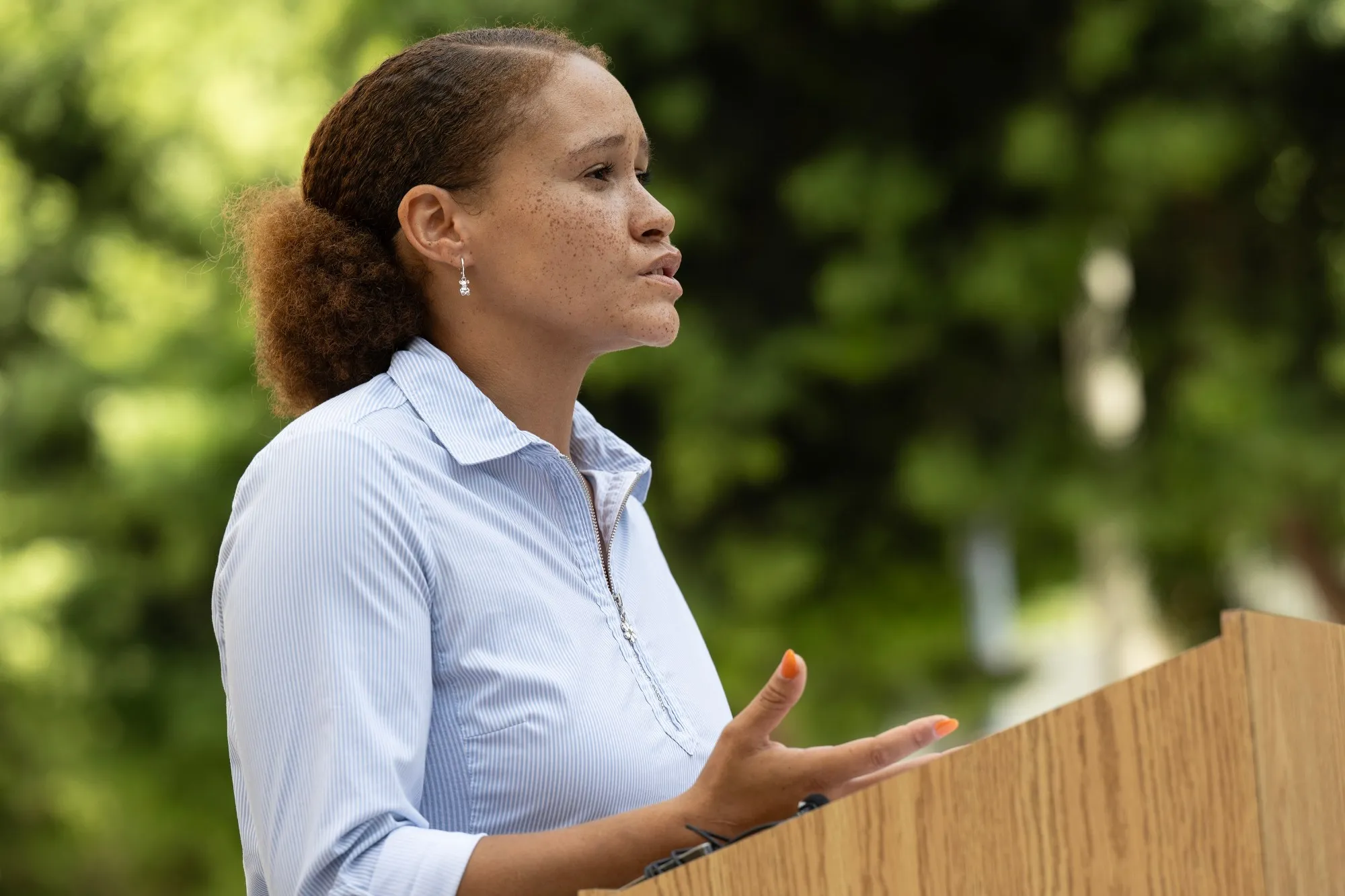
“We know that those who are watching the system should also be independent of the system,” said Caitlin Radigan, the commission chair, who spent time as a teenager in the San Diego County juvenile justice system.
“We are really calling on the community to support our position,” she said, standing behind a borrowed lectern. “We ask you to elevate this issue to the San Diego Superior Court, the Board of Supervisors and the Probation Department — and let them know that you value independent oversight.”
The commission was stripped of its administrative support by the Superior Court on July 1, when the court suspended funding and removed Juvenile Justice Commission reports, facility inspection findings and other material from its website.
The decision was made as San Diego County defends hundreds of lawsuits filed by plaintiffs who say they were sexually abused years ago while housed in juvenile halls or the county’s temporary shelter for at-risk children, the Polinsky Center.
It also comes as the California Attorney General’s Office moves forward with an investigation into allegations of civil rights abuses inside the county’s juvenile detention facilities.
A San Diego Superior Court spokesperson said Friday that the court evaluated its legal obligation and determined that it could not assume the ethical and liability risk of continuing to support the commission without stricter controls.
“Based on the statutory framework and the court’s legal analysis, the court concluded the JJC is a county entity and that it is prohibited from using court operations funds to fund the JJC’s activities,” spokesperson Emily Cox said by email.
Cox said the court informed the commission of its decision more than a year ago.
“The court has made every effort to collaboratively enable a smooth transition for administrative support to be taken over by the commission’s volunteer members,” she said.
San Diego County did not respond Friday to questions about the commission press conference.
A county spokesperson told the Union-Tribune that officials have been meeting with court leaders to resolve the dispute over which agency will provide the tools the commission needs to meet its mandate.
“The county’s position is not a withdrawal of support for the JJC’s mission,” spokesperson Chuck Westerheide said by email. “Rather, it merely concerns which government entity is obliged under state law to provide administrative support and funding.”
Read more Former county behavioral health director evaluating ‘legal options’ after public dismissal
Earlier this month, The San Diego Union-Tribune reported that court officials had sought to intervene in commission business practices months before they pulled funding and other support from the oversight board.
The Juvenile Justice Commission is charged with overseeing the juvenile court, the county Probation Department and temporary youth shelters and schools. Its volunteers inspect facilities, interview officials and issue reports detailing their findings.
Such oversight panels are required by state law, but counties are given latitude in how the bodies are organized and funded.
In San Diego County, the commission has been supported by the superior court for more than a decade. But last year, court officials sought to rewrite the commission bylaws in ways that Radigan and others thought would undermine its work.
Commissioners resisted the proposed changes, and the court withdrew its financial and administrative support.
The 10-member panel already has lost its meeting space and other amenities, and years of work product have disappeared from the court website.
Commissioners are also poised to lose their liability insurance by the end of September, meaning they will no longer be legally protected from civil lawsuits related to their their public service.
At that point, they plan to resign en masse, leaving San Diego County with no oversight mechanism for its troubled juvenile justice system.
“Accountability is under attack,” Radigan said before introducing other speakers at the Friday event. “We are volunteers. We are not paid for this work.”
Nikhil Plettner Booker is the youth commissioner serving on the oversight panel. He criticized the court and county for excluding young voices from discussions over how the commission should be run.
“The most sacred principle of government is to protect the most vulnerable in society,” said the San Diego High School senior. “Rendering the Juvenile Justice Commission dysfunctional inherently contradicts this basic virtue.”
Alejandro Martinez is an organizer at the Mid-City Community Action Network, or Mid-City CAN, a nonprofit that promotes empowerment. He said he is disappointed in the court and county for allowing the Juvenile Justice Commission to lapse.
“It is perpetuating trauma across the community,” Martinez said. “This is a question of what we value.”
Radigan urged anyone who is interested in helping the Juvenile Justice Commission to press court and county officials to resolve the dispute. She said the commission can be reached by email at [email protected].