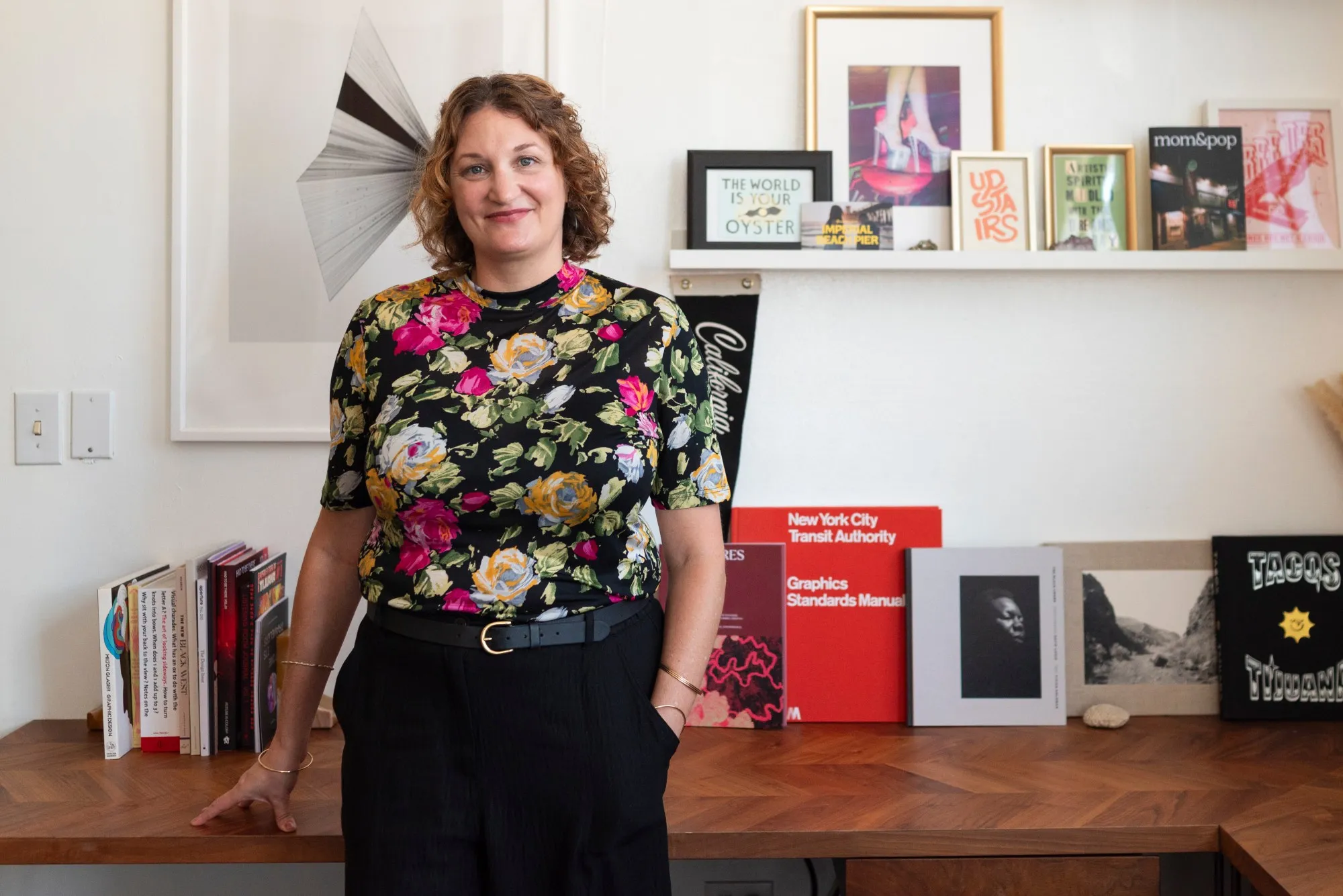
A few years ago, if you’d asked Stacey Edelstein whether she considered herself an artist, her answer would’ve been no. That’s different now. With a career as a creative director and graphic designer, she had spent plenty of time creating work for clients, but she was feeling an urge toward creating her own work.
Read more Man convicted in Midway District robbery killing re-sentenced to life in prison
“I was thinking, ‘Well, what else can I make? What else can I do that’s not driven by someone else’s vision, but driven by my own?’ I remembered that when I turned 40, I asked myself what I would make if I thought of myself as an artist, so I think all of these things started to converge,” she says. “I’m in my 40s, there’s all of this upheaval going on, so what do I want to do? As Mary Oliver said, ‘What is it you plan to do with your one wild and precious life?’ That kind of became the foundation for me to think about myself as an artist, my community, and what it needs.”
She built Hi-Res magazine on that foundation. After launching with an eight-page ‘zine in 2024, she’s grown the project into a full-color, 44-page publication that shares the stories of a range of creators from San Diego and Tijuana, highlighting their work through essays and features. Her background in community organizing helped her expand the project into the Hi-Res First Thursdays series, a live storytelling event at San Diego Made in Logan Heights. Each month, a collective of independent artists and small businesses gather to listen to the stories behind the work from local artists. The series continues with this month’s installment from 6 to 8 p.m. tonight at San Diego Made, featuring a DJ, cocktails, tacos, a curated art exhibition, and the live stories from playwright Miki Vale, event producer Loren Cobbs, and ink artist Anna Strong. (Issues of her self-funded magazine can currently be purchased for $12 at these in-person events.)
Edelstein, 42, is also co-founder and creative director at Raygun Design, an adviser for CreativeMornings San Diego and for Tijuana Design Week. She lives in North Park with her husband, Dalton Rooney, and their 10-year-old daughter. She took some time to talk about the inspiration for Hi-Res, and how it’s taught her about herself and her community.
Tell us about Hi-Res.
Hi-Res started with a printed magazine. My goal from the beginning was always to highlight the arts and creative culture here in San Diego, which I feel can be a little bit underground or a little bit spread out, so my hope was to pull some of those pieces together to showcase the different projects and people that I have been interacting with years.
I remember sitting at my kitchen counter one day and looking over a stack of printed ephemera I had collected over the years. I collect postcards and flyers from events and ‘zines, and I was looking at everything and saying, ‘Wow, I should really do something with this. Maybe put it into some sort of collection or a scrapbook because there is so much going on in San Diego,’ and that was kind of the genesis for the magazine. I put together two issues the first year—both 44 pages, full color—and they feature all sorts of visual art from different artists and creatives from San Diego and Tijuana. After that, I launched the live storytelling series, High Res First Thursdays, in partnership with San Diego Made. That series happens once a month and is a live version of the magazine. It’s meant to bring people together around these artist stories to really showcase the people and projects that I think make San Diego and Tijuana really unique and vibrant. So, it’s both a printed magazine, as well as in-person, live storytelling events.
What I love about North Park…
I love the creative energy here. I think that we have a lot of great mom-and-pop independent stores that really care about what products they’re carrying. The farmers’ market, too, I think is one of my favorites here in North Park. There’s always a pop-up fair happening on 30th and University, on North Park Way, and I just love that it’s all driven by local businesses and local business owners. It definitely has this very neighborhood feel, but really intentional in terms of what you can find, what you can shop for, and eat here, as well.
What was happening for you in 2024 that precipitated Hi-Res?
Yeah, 2024 was a difficult year—politically, socially, watching everything going on, local elections, national elections. It’s tough to see our communities suffering and to be at the mercy of poor leadership. To see that come to fruition in 2024 after the presidential election, I really started to think about what is the role of artists and what is the role of creatives in times like these? We’re witnessing so much fracturing within our communities. We’re witnessing so much turmoil, so what is it that we have the power to do that can help to heal, but also to hopefully change the narrative? To shape discourse? What does community safety look like and feel like for all of us? So, in response to everything going on politically in 2024, that was the first iteration of Hi-Res; I put out an eight-page ‘zine that I printed at a mom-and-pop copy shop in Chula Vista. My thought was, ‘If there’s so much ugliness in the world, what can I do to put out some beauty and share love?’ At the end of the day, I think that’s what drives me, is how can we create conditions for love? So, the ‘zine was this physical embodiment of art and creativity. I wanted to take those channels and modes of beauty and love and put that out into the world, so I showed up at Creative Morning San Diego that December, right after the election, with 50 copies of the ‘zine in hand and just handed it out for free to all of the attendees. I’m just observing the crowd and seeing this little blue ‘zine in different people’s hands and watching them open it, look at it, smile, show a page to a friend standing next to them, point to what’s on the pages—I just remember feeling so proud and so full of purpose at that moment, to have created something that could make people smile in a moment that felt very dark and very uncertain. I think that’s what propelled me to go forward to say that the more that we can publish and platform artists and what they’re doing, I think the better our community will be for it.
What was the initial response to that first eight-page zine, and how did that grow into where Hi-Res is now?
It was self-funded, so I initially treated it as an experiment: What does it take to create an original publication? What does it take to fill the pages? What does it take to layout and design and print and bind it? Are people interested? Not only did I learn about myself in the process, I think I learned what the community wants, as well. For me, I learned in the process that this is my passion-I want to make printed publications that record and preserve the culture that’s happening right now, the works of artists that they’re producing right now. I want to make sure that the painting that Eva Struble created, or the mural that Josué Baltézar painted, the poem Kelsey Daniels wrote, that when all of these things are brought together into a publication, it really helps record it for the future. It tells more people about it because this printed piece is so much easier to distribute. It reinforced for me the power of print and why it’s so important to do it. I kind of learned my purpose and the process, and then seeing people’s reactions to it was really positive. For the folks featured in the pages of the magazines, it’s very affirming to them; their work has value, their work is meaningful and it deserves to be preserved and shared. I think when you look at something that represents your city and represents the art scene, you start to realize there is so much going on. There is a lot happening here, and it’s worth taking the time away from your phone, away from your computer, away from the distractions, to really immerse yourself in it. With an eight-page ‘zine, it’s not a big publication, but what it represented to me was a little bit larger than life. Once that was done and I handed everything out, I started asking myself, what’s next? What else can I make? I really just went back to my roots of design; I’m a graphic designer and creative director by trade, and I asked myself what is the piece I’ve always wanted to make that I didn’t have a chance to yet? The first thing that came to mind was to do a full color magazine, so I set off in 2025 to transform that ‘zine into a full-color, 44-page A4 format magazine that could really come alive. The ‘zine was like the appetizer, and then the magazine was the full meal, the full course.
How is it structured and funded?
Currently, it’s a fully self-funded project. I have funded the printing and the translations for the magazine because it’s bilingual, in English and Spanish, so I’ve put in my own resources to get it off the ground. I’ve partnered with friends and family to help fill in the gaps where they’ve volunteered their time to help me get the magazine off the ground. It’s edited by my childhood best friend, Melanie Burchby, who volunteers her time to help me put the publication out. Then, the first Hi-Res First Thursdays was purposely organized as a collective, so it’s a collective of independent creatives and small business owners who are all volunteering their time and talent to help the events run each month. It’s very much powered by this independent collective of people who want to have community events that they feel are welcoming and accessible and reliable for the community.
I serve as the editor in chief, and the creative director, as well, so I’m both sourcing submissions from different artists and writers within the community based on a theme each issue. Melanie is the copy editor and creates new content as we need it. We also have a translator, Tirsa Mercado, who helps us translate everything from English into Spanish. We have a photographer, Maya Kerey, who photographs all of our Hi-Res First Thursdays events, and she has done some editorial photography for us, some original photography for the magazine. We provide stipends to Tirsa and Maya.
Read more CBP opens designated entrance for motorcycles at the San Ysidro border crossing
Would you say you were someone who enjoyed a lot of magazines as a kid/teen? Which ones do you remember being particularly drawn to? What did they do well that made you a fan?
I adored magazines growing up. I collected stacks and stacks of them, I had several subscriptions when I was in elementary and middle school to magazines like Sassy and Seventeen. Eventually, as I got into high school, I moved into more music magazines like Spin and Rolling Stone. I also was really influenced by Ray Gun magazine, which was a little bit before my time, but became an influence for me later on. My client services business is actually called Raygun, and a lot of people ask if we were inspired by the magazine, and the answer is yes. So, I remember fashion and music is where print influenced those things for me growing up. And, I absolutely loved to go to the newsstands, especially when I was living in New York after college and they still had all of the newsstands at every corner. Then, I got into more interior and architecture magazines, and just continued to prioritize reading print. To this day, I don’t even have a Kindle; I still get actual books from the library because I love that tactile feeling, so I think that absolutely influenced me. Graphic design, as well. I made a career out of it because being able to pull these narratives together in a visual way is really exciting. It feels really powerful to be able to, not only collect the story and have that point of view, but how do you make it feel and look relevant and exciting for your audience to read? So, print has always influenced me, both as a person and professionally.
What they did well was that it’s tangible, it’s something that you hold in your hand and feel the paper, the cover stock, the interior pages. It’s something that’s so tactile, it kind of envelops all of your senses. It asks you for all of your attention in order to experience what’s on the pages. To me, as someone growing up without social media, and with one computer in the house that we all had to take turns using with dial-up internet, it was something where I could fully immerse in this world created by a group of people. I could really explore new ideas, read perspectives that I didn’t have access to in the suburbs; it really was a full experience that you cannot replicate online. Being able to sit down on the carpet and go through the pages of this magazine, it’s an experience like nothing else. Second to that would be that I absolutely adore thinking about why the designers made the choice they did in typefaces, in color, in layout and visual style because it makes the words the photos that much more impactful when they’re paired with typefaces that really have character, no pun intended. Colors help create the mood and that emotional context within the pages, and I just absolutely adore thinking about why those decisions were made and what I would do the same, what I would do differently. I just love design, so publications that put design at the heart of their publication makes me feel like it’s such a unique experience and worth my time to spend to read every last caption, every last footnote, everything in the glossary. I love to give my time to things that have been made with care and intention, and magazines with fantastic content that also put an emphasis on the design and the visual presentation, speaks volumes to me about how they care for their audience and care for what they’re preserving.
Can you talk about your Hi-Res First Thursdays series?
It’s a free, live storytelling series for the creative community. I love the medium of storytelling and I think that when we get to hear from artists about their process, about their practice, about really what goes into their work, it feels very inspirational and creates a sense of community in the process. When we sit and listen to each other’s stories, and we make the time to hear each other, it can really be a very healing and inspirational experience. So, I approached San Diego Made in Logan Heights, where I also have studio space, and told them I’ve been thinking about what a live version of the magazine would look like in a space like San Diego Made. What did they think of me curating some programming specifically for the arts and creative community, that we could host here? With this partnership, I’ve been able to curate programming specifically designed to help connect the creative community and platform artists within our community who have really beautiful stories to share, and not always the space to share them in.
Why did you want to highlight creators talking about the stories behind their work? What do you find that adds, or what kind of difference does that make?
I think, a lot of times, people conflate artistry and creativity with their profession. Or, they think that they have to be paid and full time in order to themselves creative, to call themselves artists, but I just don’t think that’s true. I think that you can you can have a nine-to-five job that’s not related to art or creativity, and still consider yourself an artist and a and a creative who follows their passion. You don’t have to be employed as an artist, as a creative, to call yourself one. I also think there are a lot of people who can sometimes find the art world to be a little bit exclusive, or a little bit intimidating, so I wanted to create a space that was both welcoming, but also very real, very genuine. It’s hard to make a living as a full-time artist, but we should be able to talk about those things, and we should be able to share what we’re learning in the process. So, to create a space where we’re not simply celebrating someone’s finished work, or a full exhibition or an installation of finished work, but rather we’re getting into what is behind the scenes that motivates you, that excites you, that influences you as a as an artist and as a creative? That keeps you going even when things get challenging? I want to hear those stories because, to me, they remind me that at the core of our humanity, is a desire to create, a desire to make. As soon as we start to honor that in ourselves, no matter how big or small, or the scale or even the outcome, if we honor that desire by creating time and space for ourselves to make, I think we really honor our full humanity in the process.
What is the best advice you’ve ever received?
Don’t sell yourself short, which I think is a good one for us creatives who make a living off of our work.
What is one thing people would be surprised to find out about you?
I have a certified butterfly garden from the North American Butterfly Association. I plant pollinators in our backyard for the monarchs and the bees.
Please describe your ideal San Diego weekend.
I love spending time in North Park and South Park. One of my favorite things to do, especially when people are visiting, is start out in North Park and then walk down 30th Street to South Park. I have a bunch of spots that I would recommend in both neighborhoods. In North Park, I start by grabbing coffee at Dark Horse (Coffee Roasters), and then do a little shopping along 30th and University—buy books at Verbatim, shop at Joon and Day to Day Vintage, and then I grab a bagel at Nomad Donuts because I believe they are the best bagels in San Diego, hands down. Then, I walk down 30th Street, over Switzer Canyon into South Park, grab a drink at Fall Brewing, do a little bit more shopping at The Book Catapult and Vinyl Junkies, and Shop Ayi, and then grab happy hour and dinner at The Rose, and close it out at the Whistle Stop.
To suggest a notable San Diegan for the One-on-One series, contact Lisa Deaderick at [email protected].
Read more Hurricane Marie could cause minor coastal flooding this weekend in northern San Diego County