







Konoa Wilson was running for his life after gunshots rang out at the Santa Fe Depot train station early last year when he nearly collided with San Diego police Officer Daniel Gold.
Read more Federal appeals court steers San Diego insurance dispute to California Supreme Court
Gold said he instantly thought Konoa was the gunman and made the split-second decision to open fire, striking the 16-year-old boy twice and killing him.
Months after the victim’s family filed a wrongful-death lawsuit against San Diego, the city agreed to pay $30 million to avoid a trial — one of the largest settlements in a police wrongful-death case ever.
Now, more than a year and a half later, District Attorney Summer Stephan has weighed in. No criminal charges will be filed against Gold.
In a letter released just over a week ago to San Diego Police Chief Scott Wahl, as well as to the Sheriff’s Office, which investigated the shooting, Stephan said there was “not a criminal charge provable beyond a reasonable doubt.”
“The ultimate question in this inquiry is whether Gold violated the law and whether he bears criminal liability for his actions,” the District Attorney’s Office said in a statement announcing the decision.
“In cases where this office does not believe that the available admissible evidence would support a unanimous finding of guilt by a jury, it would be unethical to proceed with a criminal case,” the statement added.
According to the letter, Gold “believed he was in a life-threatening situation.” Stephan’s letter noted that the law requires her office to evaluate his decision to use deadly force from the perspective of a reasonable officer based on the totality of the circumstances, and not with the benefit of hindsight.
“We are not able to make a determination that Gold’s actions are justified, rather we have determined the evidence does not demonstrate beyond reasonable doubt that Gold’s belief was unreasonable,” the letter reads.
The high-profile case outraged people across the community when it happened. Now the decision not to prosecute has done little to assuage the concerns of San Diego police oversight advocates, who continue to believe that the officer should face an involuntary manslaughter charge at the very least.
Tasha Williamson, a longtime San Diego activist fighting for police accountability and reform, said Stephan’s ruling in the Gold case represents a concerning abdication of justice.
“Such decisions routinely undermine public trust and a reckless disregard of jurors’ ability to determine whether a person has committed a crime through criminal court proceedings,” Williamson said.
“True community safety demands uncompromising standards of justice rather than shielding law enforcement personnel from the profound responsibility of accountability,” she added.
‘Shots fired’
Wilson was three months shy of his 17th birthday when he died, and his parents’ only child.
On Jan. 28, 2025, Gold and another officer, who is not identified, were responding separately to a call from a man claiming he had been assaulted by security officers aboard an Amtrak train, the District Attorney’s Office said.
When Gold arrived and parked his police cruiser along Kettner Boulevard, the other officer was already on the train platform talking with an Amtrak police officer.
At the same time, Wilson and two youths were several yards north on the platform. Security footage provided by San Diego police shows one of the youths suddenly pull out a gun and open fire on Wilson, who quickly flees, running through a breezeway that leads outside of the station and onto Kettner.
Gold, the unnamed officer and the Amtrack officer all heard the gunshots. The unnamed San Diego officer grabbed his radio: “I’ve got shots fired. Again, shots fired.”
Gold, still on Kettner, ran toward the gunshots — and the breezeway. According to the letter, Gold told investigators that the sound of the other officer’s voice coupled with that officer’s proximity to the gunfire led Gold to believe the officer had been “injured, shot or ambushed.”
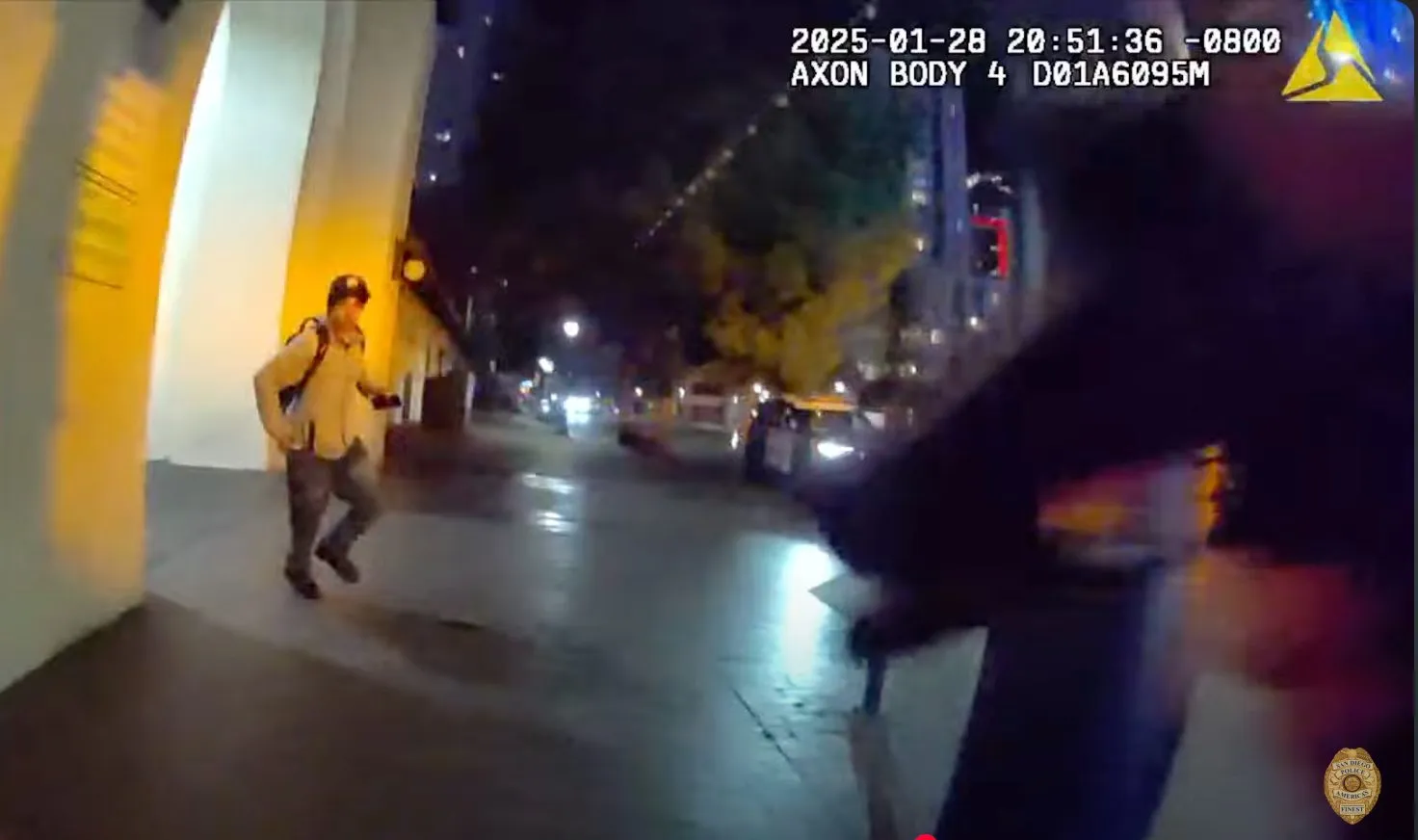
As Gold neared the corridor, gun in hand, Wilson came running out. Gold was wearing a body camera. Footage provided by San Diego police shows that, as Wilson emerged, Gold said, “Whoa,” and opened fire as Wilson ran past.
“Gold explained that he feared for his life and believed (Wilson) had just murdered (the other officer),” the letter states.
He told investigators he saw the youth’s hands at his waistline and reaching for what Gold believed to be a gun, so he opened fire.
Wilson was struck twice. As police administered first aid, they cut off his clothing and found a loaded gun zipped inside the pocket of shorts he was wearing underneath his pants, prosecutors said. An attorney for the boy’s family has said Wilson had the gun because he was being targeted by local gangs.
The District Attorney’s Office said the decision Gold made to use deadly force was influenced by multiple unexpected and rapidly developing factors.
In the letter and in response to subsequent questions from the Union-Tribune, the District Attorney’s Office pointed to the law stating that an evaluation of an officer’s decision to use force must be from the perspective of a reasonable officer in the same situation. The evaluation must be based on the totality of the circumstances known or perceived by the officer at the moment — even in the case of quick decisions about using force.
Read more A New York jeweler has been released from prison in Iran but is banned from leaving war-torn country
The District Attorney’s Office’s evaluation looked at several factors, including the use of the phrase “shots fired” by the unnamed officer.
“San Diego police officers are trained to use the phrase ‘shots fired’ when they or other law enforcement officers are involved in a shooting,” the analysis said. “Alternatively, they are instructed to use the police code ‘11-6’ when they hear suspected gunfire but are not in imminent danger.”
Stephan’s office sought input from two outside experts to review circumstances of the case before issuing her determination. One was a defensive tactics instructor and the other a use-of-force expert. The District Attorney’s Office did not pay either for their work.
The defensive tactics instructor, San Diego police Sgt. Mike Rhoten, who teaches that and other topics to police recruits, told the office that local recruits are taught that “shots fired” means an officer is likely engaged in gunfire or being shot at — which would draw an urgent response — while “11-6” generally is understood to mean an officer is hunting for the source of gunfire.
The use-of-force expert, sheriff’s Lt. Joseph Jarjura, who taught law enforcement recruits at the regional training academy, told prosecutors that even though Gold’s response did not follow traditional training protocol, his actions may be viewed as reasonable by peers facing the same events. He told prosecutors that under California law, “Gold did not need to choose the best option … what matters is whether the chosen one fell within the range of reasonableness.”
When police fatally shoot an unarmed person, the law requires the state attorney general to handle the review. The District Attorney’s Office said that because the gun was not in Wilson’s hand when he was shot, it twice asked Attorney General Rob Bonta’s office to review the case. The state declined both times.
What might a jury think?
Andrea St. Julian is a longtime police accountability advocate who co-chairs the San Diegans for Justice community group.
She said prosecutors are not judges or juries and believes Stephan crossed a line from exercising prosecutorial discretion to deciding the very question the judicial system was designed to consider.
“There is sufficient evidence here to prosecute, and the question of guilt should be decided in court,” said St. Julian, an attorney who helped write the 2020 ballot measure that created the city’s Commission on Police Practices.
“Accountability requires more than asking whether an officer can be criminally prosecuted,” she said. “It requires an independent examination of the incident itself and the policies, practices and training that may have contributed to it.”
According to the legal team that represented Wilson’s family, the San Diego police officer did not meet department rules for employing proper force. They also said Wilson had been observable for one second before he was shot.
“The criminal justice system is often biased and corrupt, especially when it comes to holding its own people accountable. Thankfully, we have our civil justice system to turn to when the criminal justice system fails us,” Wilson family attorney Nick Rowley said.
The district attorney’s review does not contemplate policy violations. It looks at the question of criminal liability.
Professor Aya Gruber with the University of Southern California Gould School of Law viewed the video and 14-page conclusion at the request of the Union-Tribune. She said if the shots were fired as a reaction, that is different than making a decision to use deadly force. “To me, the question would be, all right, was this an accident? Was it negligence? Was it manslaughter?” she said.
Professor Erin Sheley of the University of San Diego School of Law, who also reviewed the items, said that if prosecutors had brought a case, the law governing an officer’s decision to use force would be a defense. “The D.A. has made the determination basically that no jury is going to disbelieve his argument about his reasonable belief,” Sheley said.
Sheley, who teaches criminal law and procedure, with a current research focus on prosecutorial discretion, noted there is evidence that with all that was happening in the heat of the moment, the officer could have reasonably believed that a violent crime had occurred and the youth he encountered had something to do with it. “However, I think that the immediacy with which he shoots and the lack of evidence tying the young man specifically to whatever had happened, I imagine that a jury could find differently.”
Others have been charged
Stephan’s office previously has tried officers for deadly on-duty incidents, most notably former sheriff’s deputy Aaron Russell, who in May 2020 shot an unarmed man in the back as the man, Nicholas Bils, fled from another law enforcement officer near the downtown jail.
Russell was charged with second-degree murder, the first law enforcement officer in the state to be charged after a change in the law raising the bar for police use of force. He subsequently pleaded guilty to manslaughter and was sentenced to a year in jail. He served about five months.
A federal grand jury later indicted Russell on charges of depriving Bils of his rights under color of law and discharging a firearm in relation to a crime of violence. At trial, several other law enforcement officers who were present when Russell shot Bils testified that they never considered pulling out their weapons. After the first jury deadlocked, a second jury found Russell guilty, and in May he was sentenced to 12 years in prison.
Asked why Russell was charged but Gold was not, the District Attorney’s Office said, “No two cases can be evaluated strictly side by side as there are numerous individual factors that carry weight in an analysis.”
More recently, Stephan’s office has charged two local police officers with misdemeanor vehicular manslaughter for unrelated incidents while the officers were on duty. Chula Vista police Officer Johan Jacobo was charged in May with fatally striking a 28-year-old motorcyclist. Prosecutors allege the officer ran a red light. And in June, Escondido police Officer Jason Ingco was arraigned in the death of an e-bike rider he was pursuing. Both officers have pleaded not guilty, and their cases are ongoing.
With Stephan’s investigation into Gold complete, San Diego police’s Internal Affairs Unit will conduct its own investigation, including whether the actions were within police department policy and procedure, according to police spokesperson Ashley Nicholes.
Once that’s done, she said, as per the usual process, that internal investigation will be reviewed by the city’s Commission on Police Practices.
Read more Rep. Lauren Boebert’s son sentenced to 20 days jail for violating probation
Gold remains with the department, working in an administrative capacity.