





Daniel Zhang remembers sitting across the table from his grandma when he was 4 years old, playing mahjong and laughing together. She helped raise him while they lived in China and his parents were working as a post-doctoral researcher and a university professor, picking him up from school, reading to him at bedtime, telling him stories about her life.
Read more Critics question decision not to criminally charge San Diego police officer who fatally shot teen
“She really was the light of my life, my firm foundation. In my most formative years, I truly believe that my grandma was the one who shaped who I am, the values that I have, and even my hobbies,” he says. “That was such a fun time and those are some of my fondest memories growing up.”
By the time he was in the fourth grade, he and his parents were living in the United States, and his grandma was diagnosed with Stage 3 pancreatic cancer. They returned to China that summer to help take care of her, and those six months were the most confusing and scariest times of his young life.
“I just remember this very distinct feeling of helplessness. I would watch my grandma go in and out of the hospital, see her hair falling out from the chemotherapy, watch her feel so exhausted she couldn’t even get out of bed. I just felt so confused and I remember asking myself why the medicine that was supposed to be helping her, seemed to be making her weaker and weaker every single day. I just didn’t know what to do,” he says.
Last year, when his grandfather was diagnosed with bladder cancer, he recognized the same confusion and helplessness on his little sister’s face, and was determined that her experience would be different. He asked all the questions, researched bladder cancer, read his grandfather’s medical reports, peppered his immunologist father with questions about the illness, all so he could explain what was happening to his 7-year-old little sister in a way she could understand. His grandfather made a full recovery, and Zhang realized he could help other kids who were experiencing cancer in their own families so that it didn’t feel “like this big, scary monster that was being mentioned in hushed whispers by parents or adults when they thought I was when I was sleeping.”
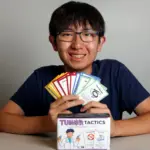
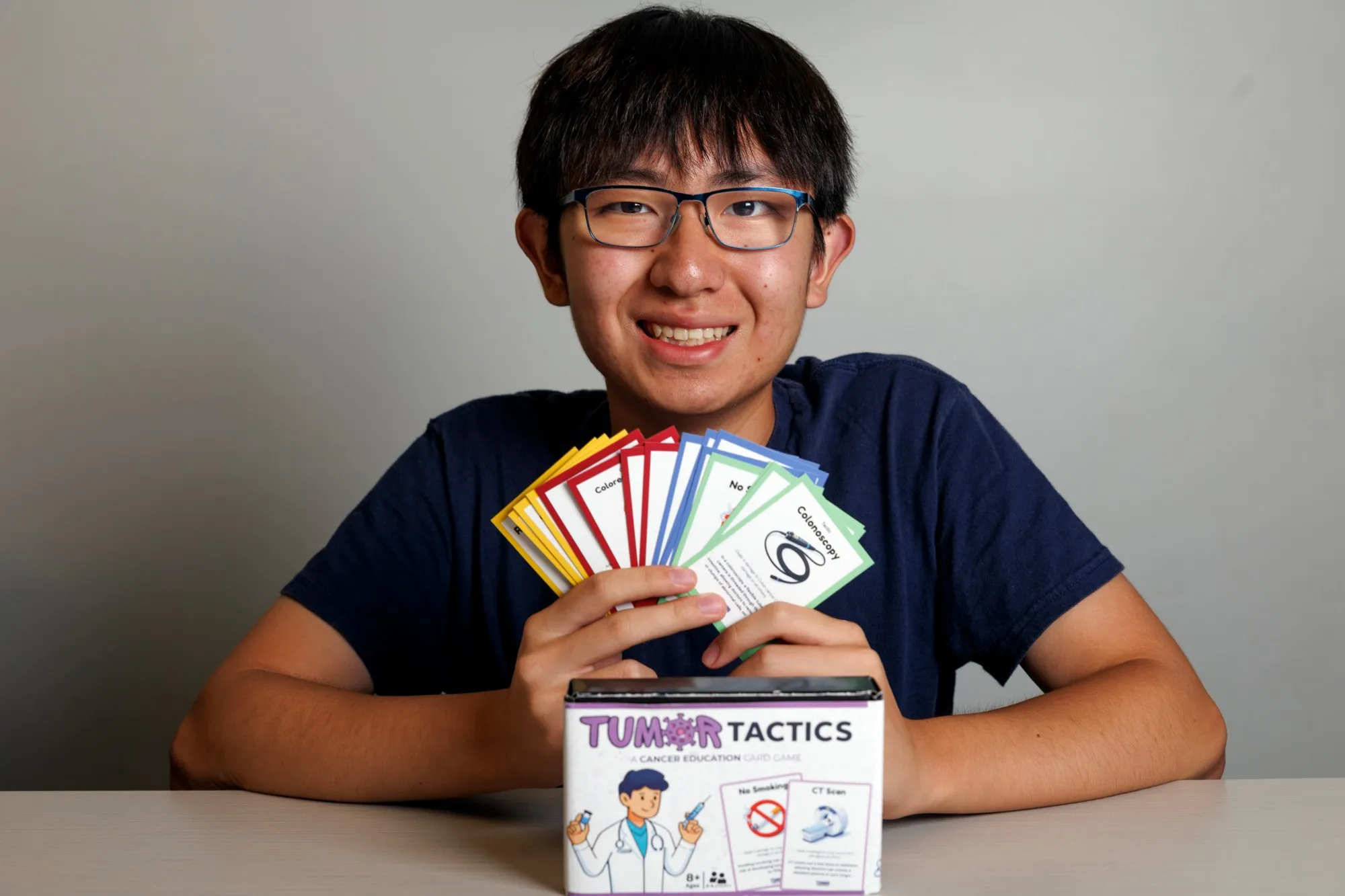
Tumor Tactics is a card game that Zhang and his friends created, teaching kids in kindergarten through eighth grade about cancer, using strategies in which they treat lung, colon, and skin tumors using chemotherapy, immunotherapy, and targeted therapy. Other strategy card games they’d grown up on, like Pokemon and Yu-Gi-Oh!, were huge influences on Tumor Tactics as a way to make learning about cancer engaging while also keeping the science accurate. In the year since they first started brainstorming the game, he and his team have been awarded a grant from the American Society for Cell Biology, allowing them to test the game with 150 students in San Diego, distributing more than 225 of their card decks to Scripps Health and Rady Children’s Hospital, and introducing the game to more than 1,000 students at the San Diego County Fair. They won a 2026 International Serious Play Award for Higher Ed Tabletop game created by students, and they held summer workshops earlier this year at Encanto and Deer Canyon elementary schools, and the Pacific Highlands Ranch Library, where 95% of students improved their scores on a short cancer biology assessment comparing their understanding before playing the game and taking the quiz again after the game. “By the end of both Encanto workshops, the cohort outperformed the series average on the quiz question asking students to explain why tumor staging affects treatment difficulty,” Zhang wrote in an article for ASCB. They’re also scheduled to present their work in a virtual session for a United Nations Science Summit, as finalists at the 14th International Educational Game Competition next month for the 2026 European Conference on Games Based Learning, and as oral presenters at the International Conference on Neurology and Brain Disorders.
Zhang, 17, is a student at Canyon Crest Academy, co-creator and CEO of Tumor Tactics, and founder and executive director of STEAMLabs International, the nonprofit behind Tumor Tactics. He has conducted cancer biology research at the UC Davis Comprehensive Cancer Center and at Cambridge University’s Cancer Research Institute, and lives in Carmel Valley with his parents and younger sister. He took some time to talk about his interest in science, the kind of work that went into creating their card game, and how critical it’s been to his success to have supportive people who share your passion and are committed to the same goals.
Can you briefly walk us through how Tumor Tactics works?
In the game, each player acts as a doctor, so the goal of this game is to play a bunch of different cards in order to, ultimately, treat your own cancer patient. Each player starts with three tumors in front of them—a lung, colon, and skin tumor—and the players will then have to draw different types of cards to be able to target and deal damage to each tumor, essentially. They’ll be able to use tactic cards or utility cards, as well as event cards. Tactic cards represent tumors and cancer-fighting actions, like chemotherapy or surgery. Utility cards include cards that don’t deal direct damage, but would include cards like diagnostic scans or an increase in research funding, which will allow someone to gain more tactic cards to deal direct damage to the tumors. Event cards will introducing things like a new breakthrough discovery just came out, or new results from a clinical trial.
For example, chemotherapy can deal damage to any tumor, but it requires a dice roll because, just like broad treatments in real life, it would be something that doctors don’t know exactly know how it would work out. There’d be some uncertainty in the clinical trials, as well as event cards like a new carcinogen that would introduce new cancer cards into the deck. Or, an IT outage would scramble everyone’s hand, which would represent the real unpredictable nature that doctors would have be able to navigate every day if there was an outage at the hospital, or patients records were scrambled. We’re trying to simulate what happens in real life to try to make it as accurate as possible. Then, utility cards include advanced screenings or a second opinion; these would reward you for planning ahead because you’ll be able to see the next three cards coming up. If you see a tumor card, or you see a very strong tactic card, you’ll be able to plan around that to choose the strongest cards to treat your patient.”
This project came through your STEAMLabs International organization? Tell us about it.
STEAMLabs is a 501(c)(3) nonprofit led by youth, for youth. We aim to bring free experiment kits, fun events, STEM-in-a-box activities, science camps, library events, and school workshops to underserved youth across the United States, and even internationally, to help bridge that STEM access gap that I experienced growing up and seeing how our teachers cared about us, but how overworked they were, how they often didn’t have the most funding or access to the best resources to have the hands-on approach that we strive for in STEAMLabs. At my high school, we’re given those resources for these amazing, rigorous STEM classes, and I’m so grateful that I’m able to have that experience, but I also know that the resources at Title I schools are so much thinner. There are very few after school programs, and reduced time for science classes, very little access to hands-on activities in biology or chemistry. I moved around a lot—from China to Portland to Houston to all of these different cities. We jumped around a lot because my dad was a postdoc, so we had to move whenever there was job instability, but I was able to connect with all of these friends in these cities, so we have chapters for STEAMLabs. We’ve been able to expand to a total of 18 chapters across 11 cities in seven states, and we also have a partnership with Henosis International, based in Nigeria, where we’ve shipped experiment kits to primary school students there. We’ve hosted over 150 events, including summer camps and workshops, and we’re presenting at the Science Summit at the end of this month, educating kids about biology and chemistry, and how they can make an impact in their own communities by starting their own organizations.
What I love about Carmel Valley…
Just the fact that it’s so close to everything. I walk everywhere and if I can’t walk, I take a bike. I can get to my school, to the park, there’s a gym, there’s The Village, the mall is right there, Trader Joe’s is right there. There are a ton of restaurants around, and all of my friends live pretty close, as well. Having everything so close is so awesome because whenever I want, I can just hit my friends up and be like, “Hey, you wanna hang out?” and it takes 10 minutes and we’re hanging out. It’s super convenient.
Can you talk a bit about the process for conceptualizing, designing, and producing this game? It seems like it would take a long time and a lot of research to make sure it was sensitive to the seriousness of cancer while still being something kids would want to play and enjoy playing, while also making sure the complicated science was simple enough to understand and remained accurate.
Oh yeah, it took us a lot of time with iterations, I think we probably went through 10 or 20 different iterations of it. We really started around August of last year. We started with the idea of we love card games, we love teaching about science, so how can we combine that? We came up with this idea to make a card game teaching kids about different cancer treatments. That was our inspiration.
Read more Federal appeals court steers San Diego insurance dispute to California Supreme Court
We started off by doing a ton of research about different cancer treatments. Also, we had a lot of help from Zach’s mom (Tumor Tactics co-creator, Zachary Tou), who’s a physician, as well as our AP Biology teacher, who answered all of our questions. We’re learning about all these different scientific terms in her class, and she was also a club advisor for Tumor Tactics and STEAMLabs, so she really helped us come up with the best way to explain all the different cancer treatments. We really started off with just a giant spreadsheet with all of the colors we wanted in the game, and to keep track of all the cards that we had. Once we had a good draft of that, we made prototypes of it. We literally just designed in on Canva, modeling it, the name of the card and one sentence about what it does in the game, and then we’d go to the local library and book a room after school. We’d bring snacks or buy some pizza for everyone, and then brainstorm over dinner and just play test the game for 30 or 40 minutes, or an hour. We’d just repeat this over and over again. After about a month or two, and constant iterations, we printed it out and cut the cards out, and had a solid prototype. Our official art for the game was designed by Carina Wu, our chief design officer, and she’s such an amazing artist. She designed all the sketches for the art and then we literally modeled it up on Canva. Then, we just started reaching out to a ton of card game manufacturers, pitching our idea. We were very nervous being high schoolers; we were not expecting anyone to really respond. We really just wanted to give kids the explanation that we never really had growing up and experiencing cancer personally, in a way that they would enjoy it, that kids would want to pick up and play, so we really were nervous when we were reaching out. We hopped on calls, we met with a bunch of these manufacturers, and two of them were super amazing supporters and helped us. It was such a blast, but it was also so difficult because we were just building this entire game from scratch. We’re all just teenagers, balancing junior year, very intense extracurriculars, but we grew so much closer during this whole process. Our whole team, we would just hang out, laugh and play the card game, start new strategies, and it was just such a fun process to be able to see a product that we made really come to life after such a long amount of time prototyping it and doing all that. It was so awesome.
Before that, we had no idea if this was going to work. We were super stressed out through the whole prototyping process, we wanted to give up at times. We’d have to start over at ground zero, but Zach and the team were encouraging me, giving pep talks, we gave each other pep talks. If we were feeling discouraged after a long session where we felt no progress, it was like, ‘OK, do we even want to continue with this? Is this even possible? Like, we’re high schoolers, what can we do?’ But, as we saw it really come to life and we got those “aha” moments, it really pushed our confidence so much. Now, I feel like I can like handle anything. I’m so excited for college or for what’s next because I really believe that if you just put your mind to it, no matter what your age is, you can do anything that you put your mind to. Within reason, of course, but that was truly such a life-changing experience. I really would recommend anyone who has an idea for something you want to make, just go for it. You have nothing to lose and everything to gain. I think it truly is such an invaluable experience, I would not trade this for anything. I’m so grateful and I could not have done it without all my friends. It was such a blast throughout the whole process.
How are you defining success at it relates to Tumor Tactics?
I really do think our primary metric of success is just seeing that “aha” moment in these students. For example, this summer when we were hosting workshops at Deer Canyon Elementary School, or going to the San Diego County Fair, we start all of our workshops with a short like quiz that asks them what chemotherapy is, or what they know about cancer. They fill that out and pass it in, and after our lesson and after they played through the game, we’d have a slideshow teaching them more about different cancer treatments in a way that’s accessible. They’d take the same quiz again, and we were able to see huge jumps in their levels of education. I believe our averages for most of our events were around 37% to 43%, and at the end they were scoring 85% to 90%. We were able to see those kids discuss what they were learning, seeing how the game would prompt these very thoughtful questions in these children, where they were asking if they could combine chemotherapy with a surgical scan, or a biopsy to identify tumors before they come up. We’d see them have these conversations with their friends and laughing when they realized how it works, or celebrating when they were able to successfully treat the tumor. We always have open discussions at the end for 10 or 15 minutes where the kids can share any experiences they’ve had with cancer, and we were shocked at how many of them just wanted someone to be there to listen to them and relate to them, to hear their stories of grandparents or parents, aunts or uncles, going through cancer. It was so touching and it made me think that even if Tumor Tactics fell apart tomorrow, which I don’t think it will, I know I made a difference in these kids’ lives. That, truly, is our definition of success.
Also, the kids are so creative. When we were playing and testing the game, we thought we were identifying all the different loopholes or combinations and strategies that someone could come up with. Then, our first workshop back in March at Deer Canyon, the first time the kids played through the game, we were shocked at how many different combinations and loopholes they found, ways to quickly treat their tumors. Honestly? It humbled me a lot because we thought we were going to go in and teach these kids, but they have so much they can teach us, as well. We’re not just pouring into these kids, they’re pouring into us, as well.”
What are your plans after high school and for your career?
I really do want to explore anything. I really want a liberal arts curriculum where I’m exploring and taking classes in every subject. I am interested in science, in writing, business, economics, and I also love biology and chemistry. I really want to be able to pursue a field that would allow me to do scientific research, as well as being able to have face-to-face interactions with students or patients. Right now, my plan would be to go to the healthcare field, being a doctor, but I’ve really been looking at joint programs for MD/PhD programs. Being a physician-scientist would be the goal because I do want to have that ability to do breakthrough discoveries in fields that are able to really make an impact in people’s lives, as well as being able to like help explain those complicated topics to patients. I really just want to be able to do something interdisciplinary. I love just learning about random things, getting lost in rabbit holes or on Wikipedia, or whatever. I would love to be a teacher, as well, especially in elementary school because I do think that teachers can be so influential in kids’ lives.
What other kinds of activities are you involved in, or do you even have time for?
That’s a great question. I definitely have so many other interests. I love playing piano and I’ve been playing for 11 years now. I’ve performed at a bunch of different venues, and I was invited to perform at Carnegie Hall this year, so music has been such an influential part of my life. I also love just hanging with my friends. I love playing sports, I love playing badminton with my dad, and I love running. I love working out, hitting the gym, and I’m also very interested in policy and politics.
I’m part of the Youth Advisory Board for the California Coalition for Youth, which is a nonprofit for youth homelessness and housing insecurity, which is something that I felt very close to growing up on food stamps, and seeing so many of my friends struggle through youth housing insecurity issues. I’ve been able to testify at hearings at the California State Capitol, as well as being able to advocate for new policies and bills. We were actually just able to successfully get a bill passed for the creation of the California Office of Youth Homelessness Prevention. That was an awesome experience that we had.
I’m also the president of the peer tutoring club at my school, as well as HANG (Healing the Aged with Notes and Gratitude). Every month, we perform at senior homes and we bring classical music to these seniors every month. I’m also the executive editor for the Catalyst Science Magazine at my high school, where we publish articles about cancer, about AI, new scientific developments that are happening all the time. I’m so grateful; the only reason I can even handle all of these things is because I have such an amazing, supportive network of my friends and other people who we’re all able to rely on and depend on each other. You can get so much done with a group of three to four core friends.
What is the best advice you’ve ever received?
Figure out what you love to do, and surround yourself with people who are just as motivated and passionate as you are. Having a group of people who share your same interests, share your same motivations and goals, being able to have that support group around you to so they can pour into you and you can pour into them, that is just so helpful. I would not be able to do anything that I have now without the support of the people around me, especially with my parents. I’m so grateful to them, they’ve always been so supportive. So, just surround yourself with a group of people who are just as motivated and passionate as you are, and just go for it.
What is one thing people would be surprised to find out about you?
Obviously, I’m very STEM-y, but I love just goofing around. I know I can be very serious when I’m teaching or doing all this heavy science stuff, but I always saw myself as more of the class clown. I always want to make people laugh. I always want to find ways to make these kids laugh, make them have fun, break the tension. I think that might be something that isn’t as apparent at first because I’m very serious if you don’t know me as well, so I think that’d be pretty surprising—I’m a goofball.
Please describe your ideal San Diego weekend.
Wake up at 9 a.m., get breakfast, go to the gym with my friends, hang out and grab lunch in The Village (at Pacific Highlands Ranch). I love Burger Lounge; their kids’ meal is such a great deal. You get a huge burger, fries, ice cream, and a giant drink, all for only like $9. I’m not sponsored, I promise (laughs). That’s my ideal lunch, I get it every week. After lunch, I’ll go to the park and play with my sister because we’re very close. Since I’m a senior now, I’m working on college applications for a couple hours, even though that’s not an ideal weekend. Plan out any events for Tumor Tactics or clubs at school, meet with my STEAMLabs board of directors on Sunday, getting updates on how our chapters are doing, news from our collaborators. Then, just hang out with my family, watch a movie, chill at home with my parents. Honestly, just very low key.
Read more A New York jeweler has been released from prison in Iran but is banned from leaving war-torn country