






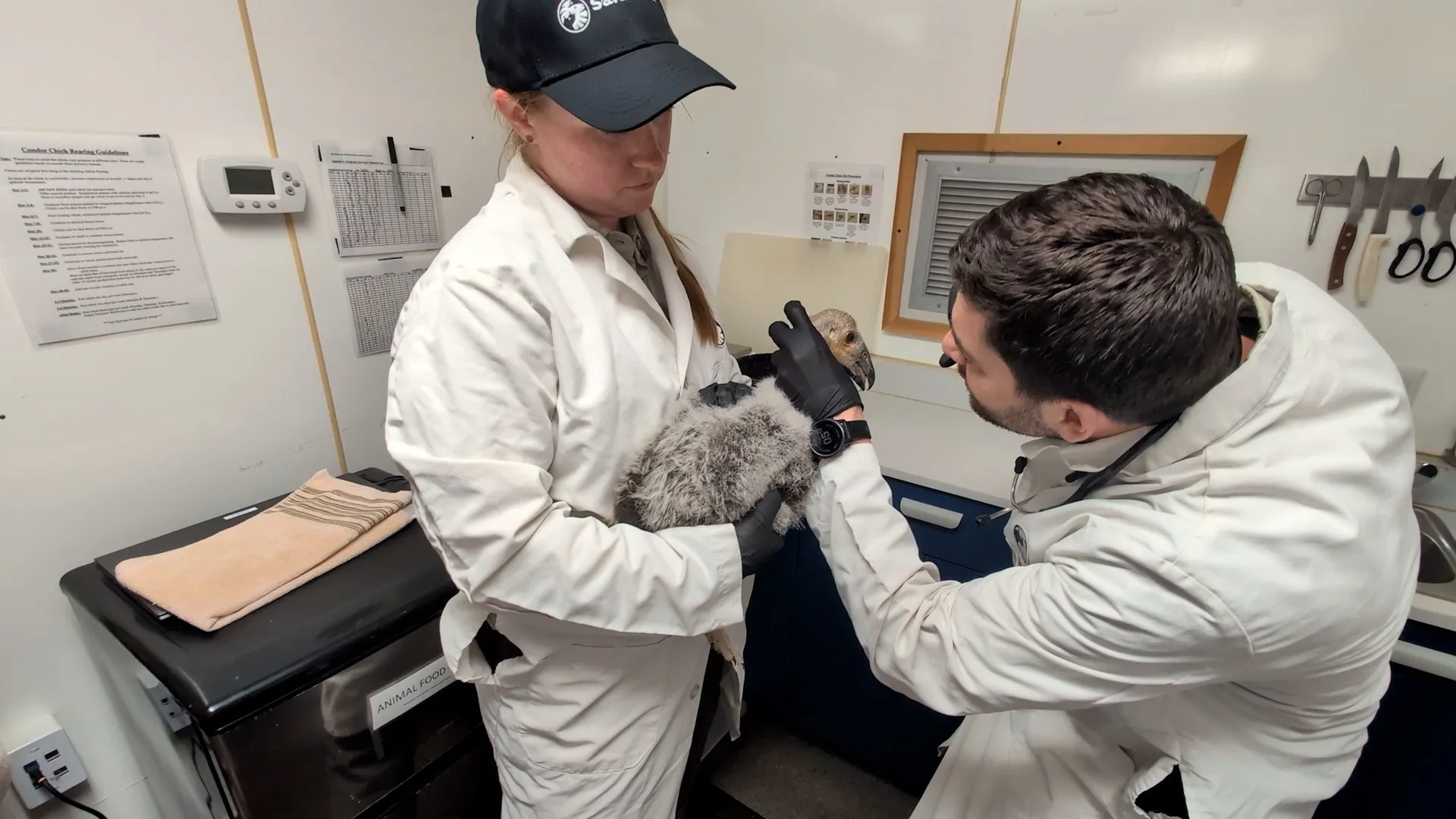
A California condor chick, rescued from a nest in a national park in Central California in May, is being cared for at the San Diego Zoo Safari Park — and officials hope he can be released back to the wild next year.
Read more Engineering study finds Coast Highway bridge in Encinitas in ‘poor’ condition
The 4-month-old bird, named Cayic, ended up in human care after his father died from suspected lead poisoning and biologists determined his mother was unable to properly care for him alone.
Now he is being raised at the park near Escondido, which has long been a key player in the effort to save the critically endangered species from extinction. The Safari Park has been a captive-breeding partner in the California Condor Recovery Program for decades, hatching and rearing more than 290 chicks.
Once he is old enough to fly, the plan calls for the condor to move to a larger socialization pen with other chicks that hatched this year at the park, along with an adult mentor bird, where they’ll live for about a year.
Cayic and two chicks are being puppet-reared, where animal-care staffers wear hand puppets that look like condor heads when they feed the birds to try to minimize their contact with people. Seven other chicks at the park are being raised by their parents.
If all goes well, all 10 could be sent to release sites next year.
A missing father
Cayic’s path to the Safari Park came after a troubled early start.
Cayic’s parents were both hatched in captivity in 2010: His father, known as #589, came from the World Center for Birds of Prey in Idaho, and his mother, known as Phoebe the Forager or #569, is from the Los Angeles Zoo. Before condors are released, they are fitted with wing tags with tracking devices, allowing biologists to monitor their activity.
In the wild, condor parents typically work together to incubate eggs and care for their chicks. The father and mother both sit on the egg until it hatches and take turns feeding the chick for the first six months. Even after the babies learn to fly, at around five months, the parents tend to stay involved, teaching the young birds about the world away from the nest.
Condor parenting is so time-consuming, pairs typically only raise a single chick every two years. “These birds invest so much time and energy into their offspring to give them the best chance of survival,” Pinnacles National Park staff explained in a Facebook post.
After pairing up at Pinnacles, located about 80 miles southeast of San Jose, Cayic’s parents broke “normal condor patterns” by successfully nesting and raising offspring in five consecutive years, rather than the more typical pattern of every other year, the park posted on Instagram.
But the male condor wasn’t able to fulfill his parenting role with his final chick.
About a month before the chick hatched, he died from suspected lead poisoning, leaving the mother to raise him alone.
Biologists tracking the birds recognized that the father was ill and trapped him in late April. They took him to the Los Angeles Zoo to be treated for lead poisoning, a leading cause of condor deaths, but he died on May 21, a spokesperson for the U.S. Fish and Wildlife Service said.
Two days later, Cayic was removed from his nest and brought to the Safari Park.
“Field biologists later noticed (the mother) was returning to the nest less frequently while searching for food,” Safari Park officials said in a statement. “Despite her efforts, the chick needed extra help getting the nutrition he needed to continue growing and developing.”
Read more In the mood for a slasher-horror-romcom movie? How about one set in Kensington?
As of last week, Safari Park staff were caring for 37 condors, including five that are on exhibit at Condor Ridge. The San Diego Zoo has two of the birds on exhibit at Elephant Odyssey. California condors are one of the largest flying birds in the world, weighing up to 25 pounds with a wingspan of almost 10 feet, and can live up to 60 years.
At the Safari Park, the chick was given the name Cayic, pronounced Chai-eech, which means “strong” in the Mutsun language of the Indigenous people of California’s central coast.
So far, he’s living up to his name. Park officials say he has a healthy appetite and is showing normal growth and development. If all goes according to plan, he could be returned to the wild in fall 2027.
Scavenging raptors in the wild ingest lead in the form of bullet fragments in dead animals they eat. The state of California banned lead in hunting ammunition statewide in 2019 to try to lessen the risk to wildlife, but lead poisoning remains a deadly problem.
Hoping to protect condors from lead, those who work with the released birds regularly leave lead-free carcasses at feeding stations for the birds to eat. Despite those efforts, increases in lead exposure and deaths from lead poisoning have been noted.
Researchers at UC Santa Cruz believe that’s because of shifts in behavior by the wild birds. Many condors stop eating the safe food and are foraging farther away from their release sites, finding food outside of areas where lead-ammo restrictions are strictly enforced. They said an increase in the shooting of wild pigs in California may also be fueling the rise.
According to the U.S. Fish and Wildlife Service, there were 161 confirmed deaths from lead poisoning from 1992 through 2025 in the free-flying condor population.
Cayic’s journey is just the latest chapter in the long-running effort to protect and support California condors. The birds were on the verge of extinction, with only 22 condors believed to be remaining in the wild in 1982. Officials moved to capture the wild birds and enlisted zoos to assist with the propagation effort. Safari Park scientists helped pioneer breeding techniques that aid in the species’ recovery.
There are now five field release sites and four captive breeding facilities in the U.S., and one release site and one captive breeding facility in Mexico, according to the U.S. Fish and Wildlife Service.
As of the end of 2025, the population had grown to 607 condors, with 392 flying free in the wild.
The program has notched several significant milestones over the years.
In 1987, the last condor in the wild, called AC9, was captured and brought to the Safari Park, then known as the Wild Animal Park. The first condor bred in captivity hatched in 1988. In 1992, the first zoo-hatched condors were released to their native California habitat.
Just last month, the Safari Park sent its 200th California condor to be released into the wild. It was among seven young condors released in Yurok Country near the California-Oregon border, part of a collaboration between the Yurok Tribe and Redwood National and State Parks.
Read more From boxes to exhibits: the big ambitions of Chula Vista’s new museum