


Leaving her home in Los Angeles to go to college in New York City, being the first in her family to go to college, and not knowing much about how to navigate it all was a lot for Ariela Canizal. It’s a lot to take in and figure out for plenty of first-generation college students — where do I fit in? Do I belong here? What do I do? One of the ways she was able find some of those answers were through the kinds of music, TV shows, and movies she had already naturally gravitated toward.
Read more Good Samaritan saves woman from burning sailboat off Point Loma coast
“I grew up watching TV shows like ‘The Transformers,’ ‘G.I. Joe,’ ‘Care Bears,’ ‘Star Trek,’ and movies like ‘The NeverEnding Story,’ ‘Star Wars,’ ‘Battlestar Galactica,’” she says. “So, associating with and talking about different TV shows and different characters that I grew up with was an opportunity to engage in conversation with people that I had no idea who they were. I was trying to get to know them, especially in college, and it just kind of opened the floodgates … (and) I saw how meaningful that connection was for me.”
Since those earliest days of landing on a way to connect with her peers, Canizal has gone on to write, research, and make conference presentations about using pop culture as a way for first-generation students to find place and identity with each other, and in their engagement in higher education. At 10 a.m. on Sunday in the Shiley Special Events Suite at the Central Library in downtown San Diego, Canizal is part of a San Diego Comic-Con panel discussion, “GeekEd: Is the Juice Worth the Squeeze? When Pop Culture Becomes Pedagogy for First-Gen Students,” inspired by the book “First Gen & Juice: Exploring First Generation College Student Narratives in Pop Culture and Mass Media,” in which she is also a contributing author. They’ll talk about the ways that pop culture has helped them, their students, and its usefulness as a tool in education.
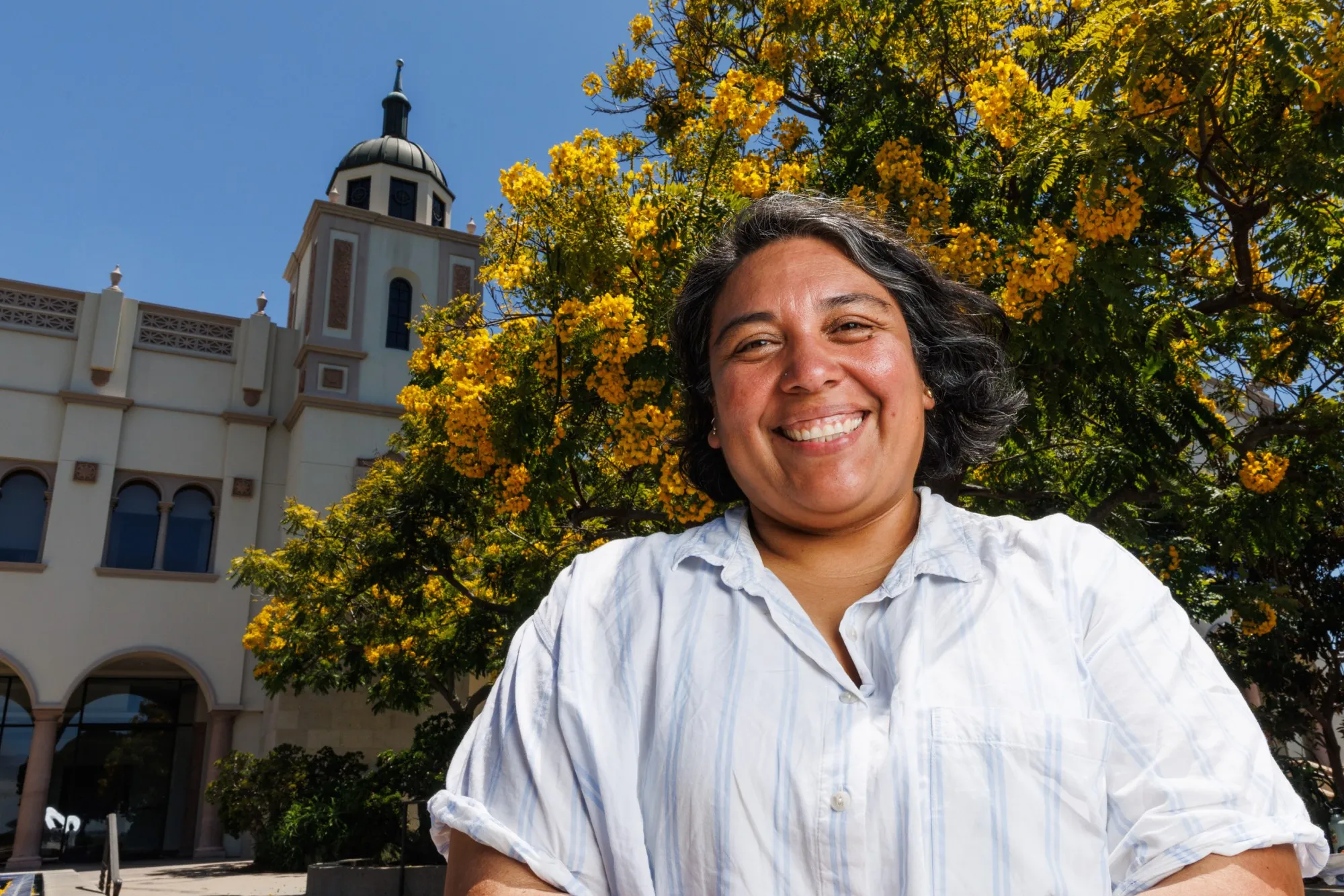
Canizal, 46, lives in North Park and is director of community and leadership development at the University of San Diego where she oversees multiple initiatives at the university, including supporting students who commute to campus, leadership programming, and working with first-generation students. She took some time to talk about her own experience in college, her use of pop culture in her educational work, and how this kind of media continues to enrich her life today.
What did being a first-generation college student mean for you growing up?
I am originally from Boyle Heights, which is east of East L.A., in the heart of L.A. County. My parents are still there. Tt’s a community that’s very close to my heart, and it’s a predominantly Latino and immigrant community. Being first-gen is something pretty common in the neighborhood; a lot of us are children of immigrants, or we are just navigating spaces that are very new to our families. I am the only daughter of two fabulous people who are Latino themselves. My dad is an immigrant, and essentially, since I was born, my parents made it their purpose to really try to teach me how to navigate systems that they didn’t really understand, but they knew that I needed to understand. So, education was their way of trying to get me to understand how to navigate the world outside of our neighborhood, which meant that a lot of times I didn’t know what I was asking because my parents didn’t know what to ask. It was just this foreign journey that I didn’t know. I knew there was something out there in the world, and what that was, was an opportunity to better myself, whether that was gaining knowledge to learn a skill, to figure out something that I wanted to do that I was passionate about. It just so happens that I found myself in higher education. I did leave Boyle Heights to go to school for undergrad, and I went to school in New York City. That opened a lot of doors for me where there were a lot of possibilities that I didn’t know existed. It was really hard for my parents to let me go, but they knew that I needed to leave and they encouraged it, which is very new for parents, especially in a Latino family, to do that. My dad was like, ‘I came here to this country and I wanted you to have that opportunity, so you’ve got to do it. I just don’t know how to help you, but we’ll be here whenever you need it.’ My philosophy in working with students right now, and even before I started working full time at USD, is that there’s a lot of uncertainty out there and a lot of students are looking to people to kind of guide them and help them figure out how to navigate the world of higher education, and also hopefully beyond. I met really great people throughout my endeavors in higher education, and I just want to give back to my community. I am very proud being a first-gen.
What I love about North Park…
I love the fact that there is a blend of old history. I love the fact that I can go to little shops in the area that have been there for decades, and I also can just go into areas that are kind of new. I love the fact that I can walk around North Park. I feel like, sometimes, we’re in such a hustle-and-bustle culture that I just want to take a moment and take a deep breath, and just walk around the neighborhood and listen to the sounds, take in the smells that are around.
What was your experience like first navigating campus life?
Now, I have the jargon of how there’s a hidden curriculum that exists when we think about higher education, and that hidden curriculum is just a lot of things that you would think that parents or friend would typically tell you. Like, ‘Hey, when you get to class, on the first day of class, you need to talk to the professor. When you get your financial aid package, if you have a question, you should call this office.’ For me, especially as someone who navigated those systems and didn’t know who to call or who to ask, I just happened to meet certain people who knew that I had questions based on my nonverbal expressions. So, as a practitioner, educator, and administrator, I really try to just say that if you don’t know something, come up and ask me. If you need to navigate a process that you’re not familiar with, I may not know how to do it, but I can connect you to the right people, and so forth. I think that’s one of the reasons why I really have enjoyed working at USD, specifically. We have some systems here that really help our students to not feel alone; that they have connections, not just inside the classroom, but outside of the classroom. That’s something that I just want students to understand, is that higher education can be daunting-for students who may not know how to do it, but even for students who know what to do because they have the resources. It’s still daunting to be a young adult when you’re navigating so many things, including school, internal emotions, and the emotional intelligence that comes as you’re being challenged to think critically, but also trying to have fun and being young adults. I think it’s important as practitioners and educators to remind ourselves of how we were in those spaces at a different time, and nothing’s really changed. Maybe there’s more social media, maybe students are more vocal, but overall, students still struggle and still need to find success somewhere. They need that sense of belonging and they’re going to look for it.
I think higher education is very complex, especially when you’re the first in the family to do it, and that’s kind of daunting because your family looks at you as the expert. At the same time, you walk into a space and you’re like, ‘I’m no longer the expert here because I don’t know what I’m supposed to be asking,’ and that complicates things where you might feel like, ‘Maybe I should go’ or ‘Maybe I shouldn’t be here.’ I guess you can call it impostor syndrome, but I like to say that sometimes imposter syndrome can be an asset, too. There’s nothing wrong with asking a question because universities are made to where you can ask those questions.
This panel discussion is inspired by the book, “First Gen & Juice: Exploring First Generation College Student Narratives in Pop Culture and Mass Media,” of which you are one of the contributing authors. What does your piece, “The ‘Third Space’ connection: Fandoms and First-Gen Student Success,” say about the relationship between fan groups and achievement?
I’m trying to get people to understand that third spaces can exist anywhere, especially in higher education. What I’m trying to say is that the term “third space” actually exists in the gaming world, where people came together in this virtual space to talk about something. What I’m trying to do with my chapter is to get my colleagues, and even students if they read it, to think about this concept of third space within higher education. So, bring these fandoms-or a TV show, or something that’s related to pop culture-with you because you belong to a community. It may not be scholarly, but it’s fun, it’s engaging, and it gets people to step out of their comfort zone a little bit. It also opens an opportunity for students to share their narratives with each other because using a fandom, using a character, allows them to really open up and try to figure out if this is a safe space, or is this a brave space? Is this a space that I can be myself? If it’s not, it’s OK, at least I tried and I can find something else. From my experience, the third space connection really does exist. I think it’s actually more apparent now with our Gen Z students; they want the connection so bad, and with social media being such a big thing, sharing TikTok trends to being content creators, this is a great way to get people to understand that it’s not just a cheesy thing or for entertainment. Talking about fandoms is actually something very personal. Maybe they relate to a topic regarding a particular fandom. When you ask people about why they’re a fan of “Star Wars,” they can go into explaining that. I just love the fact that when you open that door, a student is able to really break that barrier and say, ‘I can navigate college because they see me as someone that’s just trying to just get through it, and it’s not going to be an awkward thing for me to talk about.’ They can be a future doctor, a future lawyer, a future business person, and can still like these TV shows, or still hold on to these different anime characters. It’s all about just encouraging students to understand that there’s no right or wrong way, and there’s nothing to be embarrassed about in sharing this. At the same time, it’s also an opportunity to show their intersectionality. Fandoms open up a lot of opportunities for students to really express who they are as a person, but also the intersection of being a daughter/son/sister while being someone who’s obsessed with a fandom, and being proud of that. For my chapter, I wanted to integrate that because my research is related to leadership, so I wanted to get people to see characters within TV shows or books as leadership individuals. Maybe they’re not real, but they’re people that you find inspiration from and this is why.
Can you talk about pop culture depictions of first-generation experiences that felt like they did it well, and the ones that didn’t quite work? What the differences were and why they work/didn’t work?
Read more Fallbrook vintage Porsche dealer is sentenced for fraud, ordered to pay $9.9M in restitution
The one that pops into my head right now is the “Blue Beetle” superhero. He’s a first-gen student. They literally showed how he was trying to go to school and apply for college. I think the part that they got right, and I know a lot of my students have spoken about it, is that family tension. That he knows that education is a good opportunity for him, but he has these responsibilities to his family. The part where, “Maybe I shouldn’t go to college because I should be helping you all,” and instead his family is like, “Nope. You’re going to do it.” Sometimes students have said, “But that doesn’t always happen to us. We actually have the opposite. Our parents actually tell us that we need to go to college, but we have to stay local. Go to college, but the moment I call you, I need you to pick up the phone.” But, I think that movie showed both a true depiction of what students, especially here at USD, are navigating in that balance of trying to figure out having as much of a full college experience as possible, but still having these other responsibilities to parents and siblings. I will say that it’s predominantly my Filipino and Latino students that have related more to that.
They’ve been very vocal about the show on (Amazon) Prime, “Off Campus.” It’s pretty popular right now with a lot of our students that I’ve spoken to because it talks about toxic relationships, student athletes, but also students working in federal work study, so they loved how true it is. Then, they also talk about how everyone’s into the hookup culture, that there are a lot of beauty standards on the show that aren’t realistic, and so forth. They’re also asking why one of the main characters is a first-gen student, she has work study, which means that she is a first-gener and she doesn’t say it. She’s navigating emotional distress and people were just wanting her to kind of speak up a bit a little bit more, and I think that’s just the generation that we’re in right now. We just have a lot of Gen Z students that really want to talk about wellness. Wellness is important to them, and I think for them, they were looking at the show like, ‘Why can’t you just say it? There’s nothing wrong with going to go see a therapist.’ What I love is that the shows and the characters may not show something that’s accurate, so it actually brings up good conversations with students. My students talk about “Spider-Man” and they always talk about the fact that “Spider-Man” is a first-gener and how he navigates the world as a superhero, but he doesn’t really know what he’s doing.
Another one right now, they don’t portray first-gen in the traditional sense, but it’s the philosophy and it’s “Avatar: The Last Airbender.” A lot of the students that I’ve been working with love the fact that there are so many intersectional identities being shown in that series, and that these students are just trying to balance everything that they have going on in their lives. For instance, Aang was a 12-year-old kid, and in the movie that’s coming out, he is going to be an adult. He made it, he saved the world, he figured out that he had these superpowers. He didn’t do it perfectly, but now he’s an adult and he is trying to figure out how to still be a superhero. For them, it’s the adulting part and they’ve said, “Now I know what my parents are talking about.” It’s been a great conversation starter for them to engage with their parents about how adulting is just hard, and just because I’m good at something, it may not be what I want to do. Maybe I know I’m good in science, but I don’t think I want to be a doctor. It’s hard to be someone that has certain abilities and skill sets, but may not want to do that. I might want to do something else, and how do I do that?
From your perspective and your work over the years, is this “juice worth the squeeze”? Is the use of popular culture worthwhile as a method for teaching and engaging with first-generation college students?
Yes, I absolutely think it is. This method, this pedagogy is really something that our students are talking about every day, and it’s not just young adults in college. I would say that, for all of us, there’s something that we’re excited about, that influenced us to go in a direction with our career or our education. I think, especially with students coming back from remote learning during COVID, our young adults coming into college are finding it really hard to engage in interpersonal interaction with peers. They really have a hard time talking to each other and just figuring out how to create community because it’s so easy to do it behind a computer screen, on the phone, or just be alone in your room. I think this way of using pop culture as a tool is really an opportunity to get students to use it as an entryway, and then they can talk about mental health, about struggling in class, about not having community here and wanting to make friends.
We’re hoping that the panel will offer an opportunity to people to see this as a different way that we can all use it. It doesn’t have to be perfect, but it is a way that you can use it, and our students remember it. I’m not saying that they need to be like, “That made an impact on me,” it’s more just that they remember us talking about it and it’s a great conversation starter. It’s a great way to get them to open up a little bit more.
What is the best advice you’ve ever received?
The best advice I ever received was from my eighth-grade teacher telling me it is OK to make mistakes because you learn from them, and if you repeat them, now you know that you won’t repeat them again. Basically, she was just trying to encourage me and I live by that because, in working with young adults, there’s this sense of perfectionism. I really want to challenge students, and myself, that it’s OK, we don’t need to be perfect. We’ll learn from it and it’s OK.
What is one thing people would be surprised to find out about you?
That I am an avid concert goer. I go to multiple concerts every month. I pretty much go to between two to five concerts a month. And, I go to a lot of concerts by myself. I don’t know if it’s for everybody, but I like going to concerts with myself.
Please describe your ideal San Diego weekend.
I make the drive from North Park to get Vietnamese coffee in Linda Vista, and I go to Rose Donuts because they make the best Vietnamese coffee. From there, I head over to Liberty Station and just kind of walk around and get some sun. I eventually make my way out to visit one of my favorite taco places in Chula Vista, but I’m blanking out the place. If I don’t go there, then I go to my next favorite, which is Royal Mandarin to get the salt and pepper chicken. Ultimately, I just like to visit local small businesses and support the many people that run these businesses and give back to the community as much as we can. Then, I somehow end up at a coffee shop, either in Convoy or in in North Park, and I just end up doing some grading, and then I end my day watching something related to pop culture. Right now I’m rewatching “Avatar: The Last Airbender,” and I’m watching a lot of K-Dramas.
Read more Trump orders new signs outside Smithsonian saying some exhibits are inaccurate