





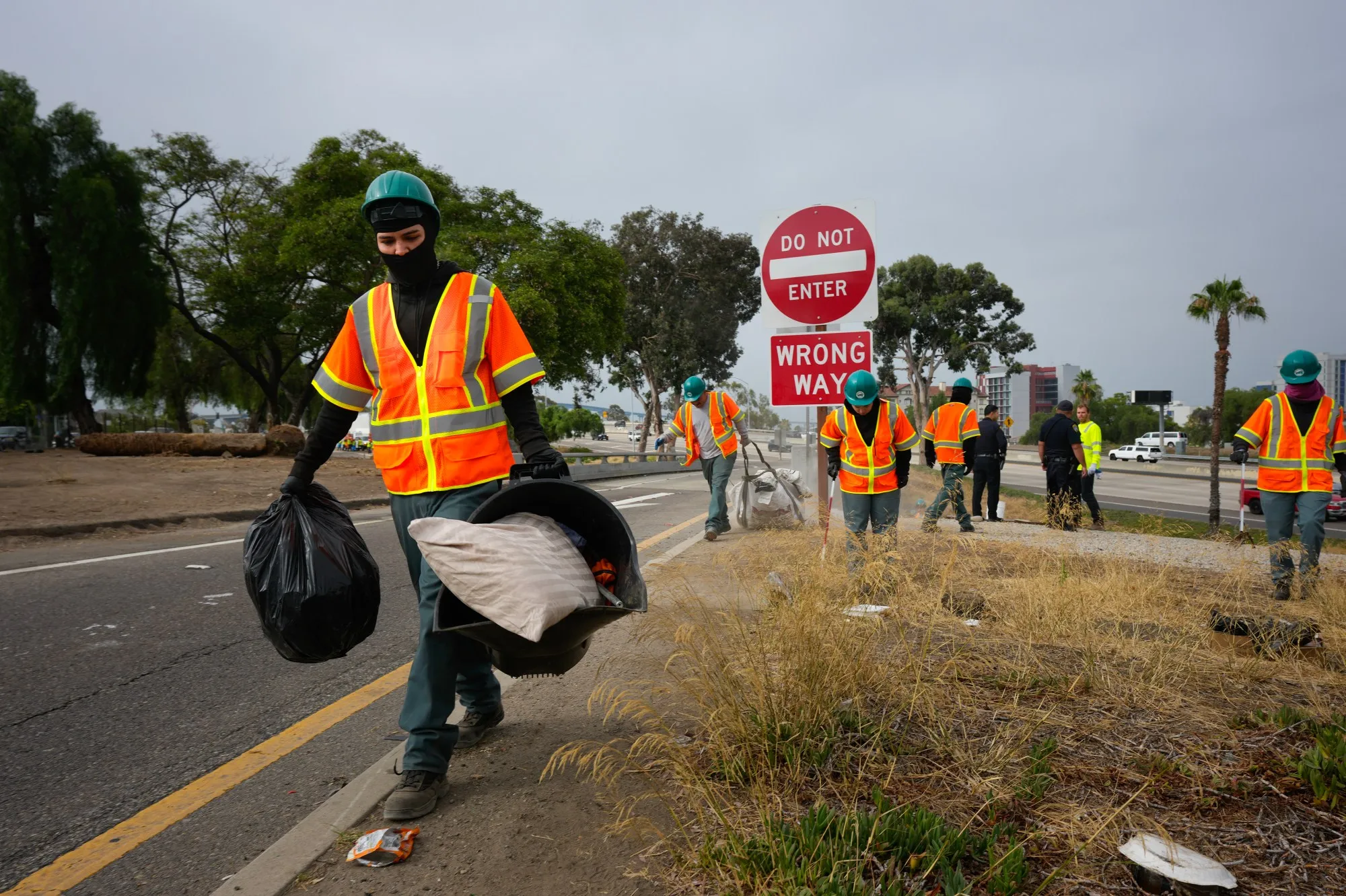
The Chula Vista City Council voted unanimously Tuesday to authorize an agreement with the California Department of Transportation that will allow the city to remove homeless encampments along Interstate 5, with the state reimbursing the city up to $200,000 through June 2027.
Read more Man accused of attacking victim with chainsaw in fight over parking space in Fallbrook
The 5-0 vote approved an Encampment Delegated Maintenance Agreement, or EDMA, covering roughly 3.2 miles of I-5 and its on- and off-ramps between Main Street and E Street. Caltrans has entered 13 such agreements statewide since 2025, including with San Diego, Santa Ana, Riverside and Ontario.
Mayor John McCann, who made the motion to approve the item, cited a 25% decline in the city’s homeless population since the city adopted an encampment ban he authored. He said unhoused residents had moved from city parks and streets onto state property along freeway ramps after that ban took effect.
“This agreement, again, gives us the ability to actually allow our Chula Vista HOT team, Homeless Outreach Team, to go on state property and remove encampments in a timely manner and get reimbursed by the state of California,” McCann said.
Housing and Homeless Services Director Stacy Kurtz told the council Chula Vista first sought an EDMA nearly a year ago. Caltrans headquarters presented a standard template in late April, and the city subsequently negotiated changes to language that would have required a separate service agreement with the California Highway Patrol and required the city to abate graffiti.
Under the agreement, the city gains authority to remove encampments and litter from the state right of way, a power currently limited to outreach only. The city must notify Caltrans and CHP before conducting removals. Reimbursement covers cleanup costs, but not outreach or law enforcement staff time.
Caltrans classifies encampments under a two-tier system. Priority Level 1 sites pose an imminent danger to traffic, safety or infrastructure and are handled primarily by Caltrans. Kurtz said most Chula Vista encampments along I-5 qualify as Priority Level 2, which under the agreement follow a process beginning about two weeks before cleanup, including outreach and a seven-day advance notice to Caltrans and CHP.
Read more No body-worn cameras in San Diego County juvenile halls, Probation Department says
Kurtz said the city is also seeking Encampment Resolution Fund grants, in partnership with San Diego County and National City, to pay for outreach and housing services in the same corridor. She said Caltrans has signaled the fiscal year funding behind the EDMA could be redirected elsewhere if not used.
Kurtz said the number of unsheltered people living between Main Street and E Street along the freeway’s on- and off-ramps varies, but that the city typically uses an estimate of about 50 people for grant applications and other purposes, based on historical counts.
Asked what would happen if cleanup costs exceed $200,000 before the agreement expires, Kurtz said the city would try to stay within the funding but that “we have some commitment here from city management that we are going to ensure that we’re fulfilling our obligations under the contract through June 30th of 2027.”
Councilmember Jose Preciado asked how fire risk factors into encampment classification and how relocation activity would be coordinated to avoid affecting West Chula Vista neighborhoods. Kurtz said fire-related statistics have been incorporated into recent grant applications and that the city works with its emergency services manager on related planning.
Preciado also asked about the appropriate role of council members in engaging directly with unhoused individuals. City Attorney Marco Verdugo advised against it, saying such activity is “best left with city staff,” citing risks to council members and potential agreement violations.
Read more Woman sent to prison for slaying wife, a Cal Fire captain, in Ramona