


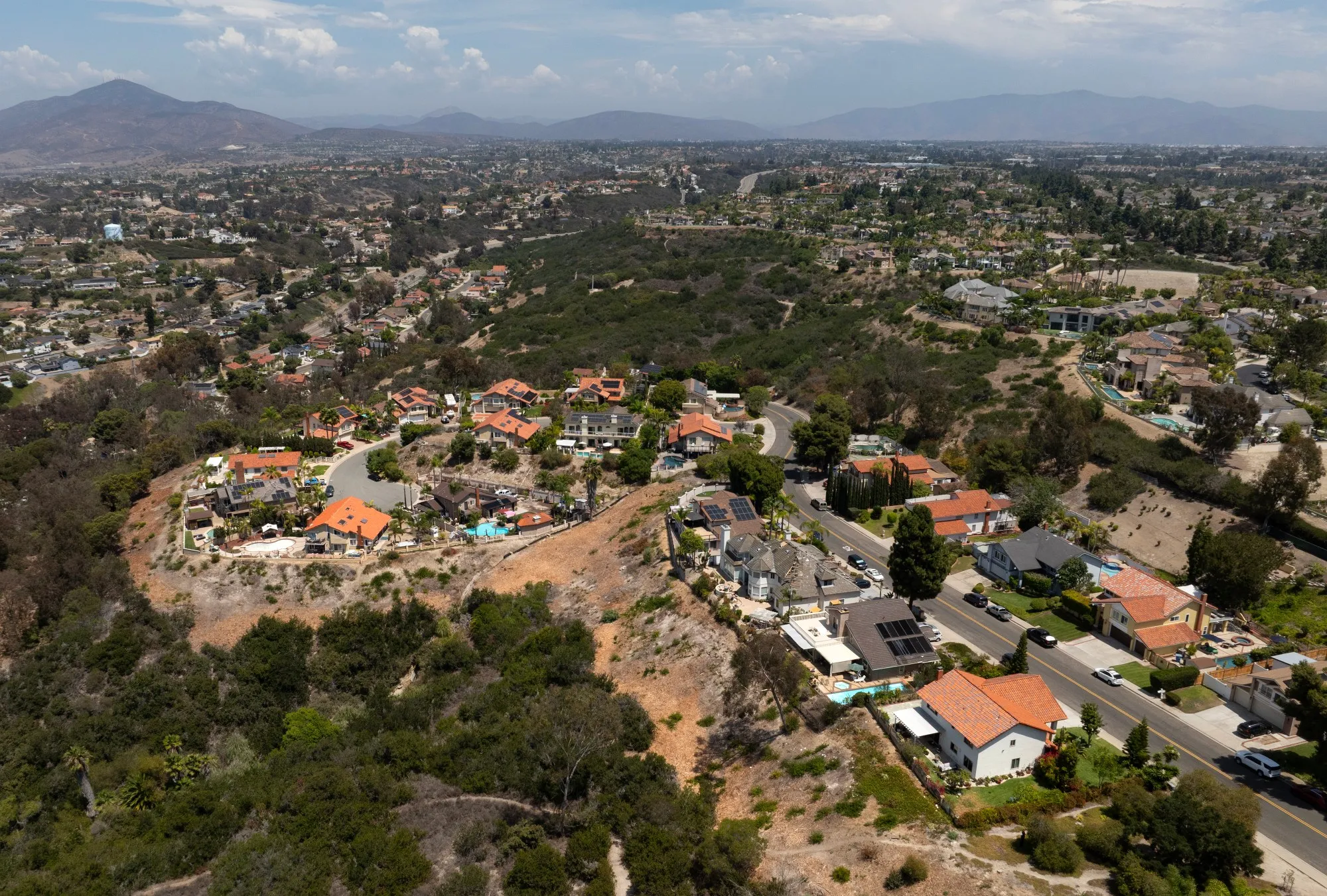
The slope behind the Chula Vista hillside homes was thick with overgrown shrubs, a mix of lemonade berry bushes and eucalyptus trees. Untouched for decades, the plants formed a dense wall of vegetation, blanketing the canyon all the way to the top of the ridge.
Read more Letting people see all of you can be scary, but she stopped hiding years ago
It was the type of plant material that burns hot in a wildfire — and posed a particular risk in the Surrey Ridge area, located on the northern edge of Chula Vista in what is classified as a very high fire hazard severity zone.
After four months of work, a remote-controlled masticator called the Green Climber cleared about 13 acres of the city open space, leaving behind a 100-foot-wide fuel break between the vegetation and the homes. If a wildfire burns in the canyon, that largely bare strip of land should slow the progress of flames and provide firefighters space to make a stand.
Such steep terrain would have been difficult for hand crews to clear since it would have required workers to manually cut the brush and then drag it to a chipper. But the project was no match for the Green Climber, which can handle up to 60-degree inclines.
It is an “all-in-one” machine that cuts and breaks up the plant material in one step, meaning no chipper was needed.
Some local fire departments are turning to remote-controlled machines to address dry, overgrown brush and reduce fuel loads near residential areas. Fire officials say the work can be done fairly quickly by the machines and create much-needed defensible space that gives firefighters a better chance to save homes — much like what helped crews in the recent 347-acre Creelman fire near San Diego Country Estates.
Chula Vista acquired its $180,000 piece of equipment less than a year ago, using city funds and grants from the San Diego River Conservancy and the San Diego Regional Fire Foundation. Since December, it has been used to clear around 30 acres of brush.
“It is absolutely necessary,” said Marlon King, the city’s Emergency Services Manager. “We wouldn’t have anywhere close to that 30 acres that we did without that piece of machinery.”
King said an operator and a spotter work with the machine. It has a handheld controller with two joysticks, which can move the machine horizontally across hillsides as well as vertically.
Cal Fire has been using a rugged little robot known as a Flailbot since 2023 to mow down grass and brush along roads in the East County. The compact blue and yellow track mower, described as being nearly the size of a Mini Cooper, can clear an acre of land in two hours, according to Cal Fire officials.
“It basically does the work of a hand crew, a couple of hand crews,” Cal Fire Capt. Mike Neal said. Work that might take a couple of days for a hand crew, “we can do it in a couple of hours with it,” he said.
The equipment was acquired by the county’s community risk reduction division and has a price tag topping $80,000. Like the Chula Vista machine, it is run by an operator and a safety spotter who has access to a water supply in case the machine hits a rock and inadvertently sparks a fire, Neal said.
Using the robots can sidestep staffing challenges that sometimes pop up with hand crews. Since the same people who work clearing vegetation also can be called upon to fight fires, at times those assigned to vegetation work aren’t able to finish the job.
Read more Michael Smolens: San Diego appears to dodge Colorado River reductions, for now
“There for a while we were having trouble with hand crews, with all the fires going on,” Neal said. “Hand crews have to stop what they are doing to go fight fires… With this, two people can do a job of 15 people.”
This spring, Cal Fire used the Flailbot to clear brush around 20 feet on both sides of roads at the Barona reservation, cutting back medium to heavy brush to around 6 inches off the ground, officials said. The work along about 5 miles of roads was completed in May.
Clearing the brush along the roads should make it safer for people if they have to evacuate because of a fire, said Barona Assistant Fire Chief Todd Nelson.
Nelson said Barona officials have put in for grant funding to buy their own remote-controlled equipment. He said there are 15 to 20 miles of roads that cut through the reservation that the department would like to keep clear of nearby vegetation.
“I think it is the most effective way to deal with fuels,” he said. “We could use 5,000 of these robots in the state of California, and they would be put to work every day.”
King said Chula Vista also is pleased with its machine, a model selected with the city’s steep hillsides in mind.
One issue that has come up, though, is the need to do repairs for what King called a design flaw: the machine’s hydraulic lines aren’t shielded and often end up damaged or cut by branches as the machine does its work.
Robots aren’t the only creative options fire agencies can use to tackle overgrown brush. San Diego County is looking to deploy hundreds of hungry goats to manage vegetation in county parks.
It plans to spend $300,000 in grant funds to launch a goat grazing program over a three-year period. Program details still need to be finalized, although two goat vendors have been selected, said Cal Fire Capt. Mike Cornette.
San Diego Gas & Electric has used goats for such work near transmission lines for several years.
“Using goats for targeted grazing is a cost-effective, eco-friendly, and reliable way to reduce vegetation and fire hazards,” Cornette said in an email. “Goats can reach steep or sensitive areas that heavy equipment cannot access, and they naturally clear grasses, brush, and other flammable plants without harmful herbicides.”