


As a young boy growing up in the small town of Tecolotlan in Jalisco, Mexico, Rosalío Chavarín was surrounded by mariachi, the iconic music genre said to have originated in and around that region. His uncles and relatives played in local mariachi groups, but the general reputation of the musicians was that they also drank and partied a bit too much. So, his mother told him, “You can be anything, but you will not be a mariachi.”
Read more Flock camera system use, ICE enforcement issues divide Encinitas candidates
While he spent most of his life honoring that command—leaving school around the third grade to earn money as a farm worker, immigrating to the United States as a teenager, and later starting a family—his love for the music never died.
“I think, because of that, he really gravitated toward music even more because he wasn’t allowed to do it on a more professional level. That was just his way of expressing love, expressing anything he felt, so he composed a lot of music, he wrote songs,” said his daughter, Veri Chavarín, the second of his four children. “He has a song about meeting my mother, he has a song about his whole journey coming to the United States and missing his hometown and his family. He wrote a song for La Virgen de Guadalupe, to honor her in December. I think that’s how he communicated.”
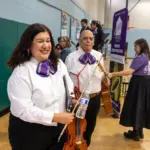
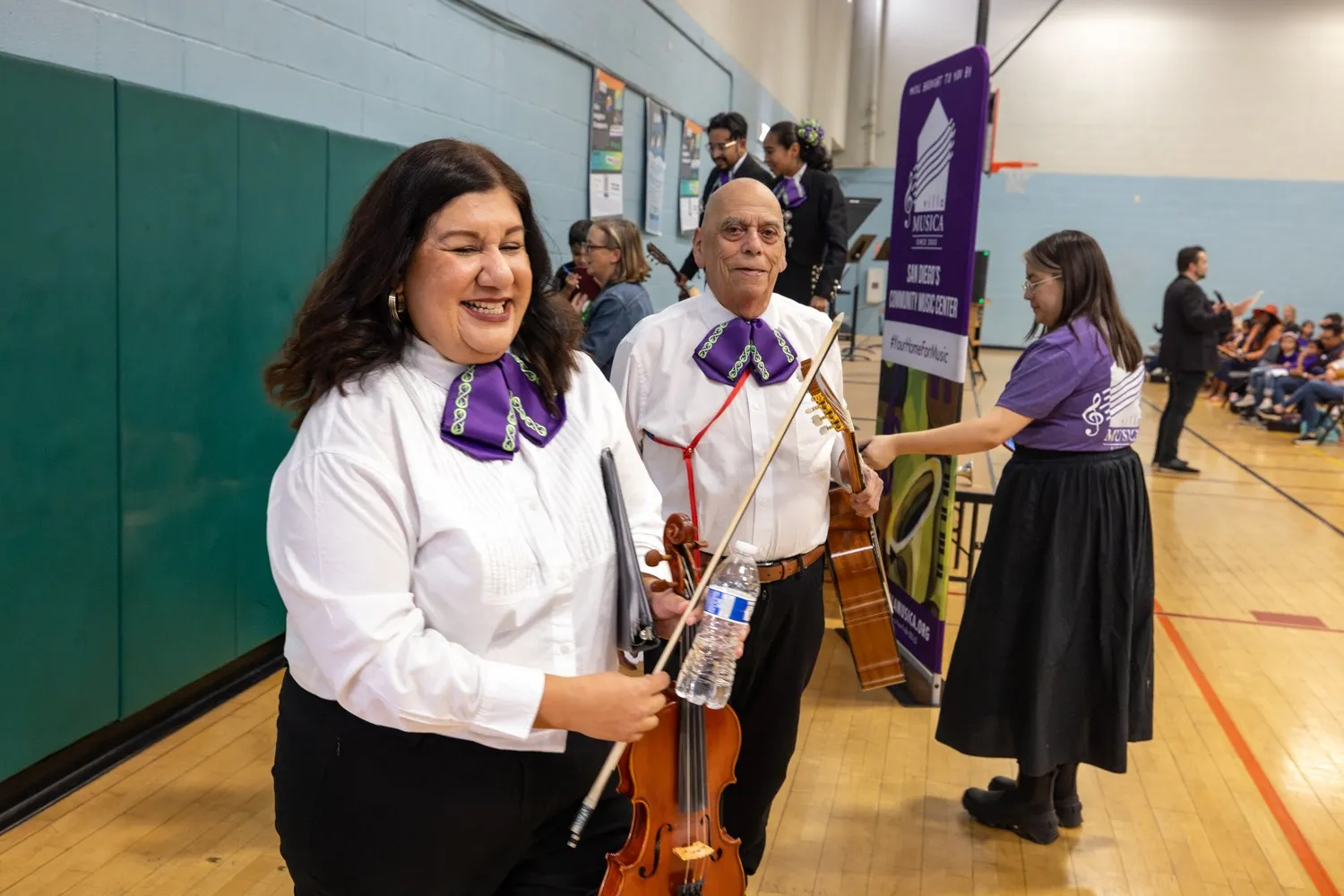
Rosalío Chavarín passed away on Sept. 3, at age 81, but not before spending the last few years of his life as a mariachi playing alongside his daughter, Veri, and his granddaughter, Lucía Chavarín López, in the Logan Heights Mariachi Ensemble. The ensemble is a program of Villa Musica, a nonprofit community music center providing access to music education for lower-income families and seniors, and the three generations of Chavaríns practiced and performed together since 2021. Two years ago, they were introduced to documentary photographer and filmmaker Steven Wade Adams through the nonprofit, who was originally planning a photo shoot to focus on the intergenerational angle of their story.
“But then, he started getting to know my dad, and he was like, ‘Rosalío, I really want to document your life. Your story is really interesting, and this is amazing that you’re pursuing your dream at your age, and that you’re accomplishing it,’” Veri says.
Adams spent two years interviewing family and friends, attending rehearsals and performances, culminating in the 13-minute documentary, “Yo Soy Mariachero,” being screened at the San Diego International Film Festival this year during the San Diego Scene shorts block on Oct. 15 and 18 at AMC 14 UTC La Jolla.
Veri and her siblings grew up in Chula Vista, and her parents—Rosalío and Maria Trinidad Chavarín—were married for 53 years, filling her childhood home with the sounds of both of them singing and playing the mariachi music they loved from the same town they were raised in. She took some time to talk a bit about her father’s life, his love of mariachi music, and how she hopes he’s remembered. (This interview has been edited for length and clarity. )
Where did your dad grow up, and did he ever talk about what it was like for him?
He was born Aug. 30, 1945, in a small town, in Jalisco. The town is called Tecolotlan. I learned a lot more when we were preparing for Steve’s film. A lot of the interviews were with my dad, so that was a really nice opportunity to sit and listen to him for hours, sharing his story. Prior to that, I knew my dad had lost his father when he was younger than 1 year old, so he was mainly raised by my grandmother. He and his siblings had to work at a very early age, so they were pulled out of school very early on. I think my father went up to, maybe, the third grade, we don’t really know for sure, but that was because he had to work the farms. He was a farm worker for the family, and then later on, in his teenage years, he decided to come to the United States, to pursue more opportunities for money to support his family.
How would you describe his personality?
He was a very funny guy, so humor was very big for him, but I think everybody who met my dad knew his universal language was music. Music was super important to him. He had a very quiet spirit, but he loved talking to people. Everywhere we took him, he would find a friend, or he would have some connection to someone. I think that’s what I admired most about my dad, someone could be totally different from him, and he would find some kind of commonality. He had a real gift for that. I think most people would remember him for his humor. He just loved to imitate us and make fun of us, in a fun way. People now will say, “You know, your dad never made fun of me, so I always wondered if he loved me or not.”
How would you describe what kind of father he was, and your relationship with each other?
I was very close to my dad. By the time I was born, he was a waiter, but before that, he worked in farms and was a laborer. When he was a waiter, even though we didn’t spend a lot of hours together, my dad always dropped us off at school, he always spent his days off with us. I rarely saw him using that time to go with his friends, or spend it with other people; he always made sure we were the priority, and we would always have really deep-hearted conversations. He had so much wisdom because he had a lot of resiliency. What he wanted for us was to not go through some of the challenges that he faced as a young man. Because he didn’t get to go to school, he recognized really early that education was one of the ways Latinos could accomplish economic stability and social mobility. He would always tell us, “La escuela es tu trabajo,” or going to school is your job, so our homework was the priority and our pay was getting an education, obtaining degrees, graduating. He would volunteer at our elementary school when he had time, and I really admired that. I think that really influenced me. I think, because of his passion for education and valuing education, he was able to get all of his kids, not only through K through 12, but to go on to college and even get graduate degrees. Three out of his four kids have doctorate degrees. I love to think of my dad’s story because it came from this really small town, and Teco (the shortened version of Tecolotlan) and his roots now go all the way through to Harvard. My sister and my niece went to Harvard, and I think that’s amazing to see where his influences have reached. We went to USC, UCLA, Harvard, San Diego State, and we’ve all pursued education and positions that influence others…We sort of continue his legacy through that. I studied theater arts at UCLA for my bachelor’s, and then I went into educational counseling at USC for my master’s, and ended up staying there and pursued a doctorate in higher education leadership. Right now, I’m working at UCSD in the anthropology department.
What do you know about his introduction to mariachi and his relationship to it when he was young and still living in Mexico?
Read more State blames mail delivery issues for dozens of ballots from rural Alaska not counting in primary
A year ago, we took the course at Southwestern College with professor Jeff Nevin, and that’s really where my dad and I, at the same time, learned a lot about the evolution of mariachi. With my dad, he lived it, he was in one of the towns where it started and his relatives were mariachi musicians. In his town, mariachi was really more about celebrations—you go to a wedding, you go to church, maybe a civic event or something, and a lot of mariachis would play there. It was really people like him who were the musicians. They weren’t necessarily musicians as a profession, but they were farmers or whatnot. What’s nice is Tecolotlan was part of this migration towards making mariachi a lot more urban and having an urban audience, so that’s really where the mariachi roots are, and he was raised in that. He didn’t really ever look back to realize that until we were in the class, and we were like, “Wow, your life sort of reflects the evolution of mariachi,” which is really cool.
After the Mexican Revolution, mariachi moved more into urban audiences, and that’s when they started wearing the traje de charro; that’s when they introduced the trumpet because trumpets were not initially part of it, it was mainly strings, guitars, and they used to have harps, and a lot of groups still do. A lot of the early musicians were not even really musically trained; they really just played by ear, which is what my dad did. My dad did not know how to read music, he played completely by ear and that’s how he was trained; that’s how he would play in the mariachi with Villa Musica, as well.
How were you introduced to mariachi? Did you hear it a lot growing up?
Mariachi is a very central part of my family because of my mom and my dad, because they grew up in Tecolotlan, so mariachi plays a big role in both of my parents’ lives. My mom was an amazing singer—I say “was” because she has Parkinson’s, so it’s really gotten in the way of her of her vocal ability—she had an amazing voice. She could have easily been a famous mariachi singer, like Lola Beltran, so I grew up listening to my dad and her singing all the time. Then, my mom’s sister and brother were professional mariachi singers in Tijuana, so we grew up going to a lot of their performances at different venues or mariachi conferences. It was just always a part of my life because they would sing every single day.
How did you and your family become involved with Villa Musica?
My son attended elementary school in Logan Heights, and the public library is right next to the school, so they do a lot of activities together. They sent out a flyer and one of the activities on it was a free mariachi class, and I told my dad and asked if he would want to go. I’m like, “Let’s go check it out, I’ll go with you. I’ll take you,” and he was like, “Yeah, let’s do it.” He was really motivated, really excited. We didn’t know what to expect at all, we just went and we loved it immediately. At the time, Andrew Rodriguez was the instructor, and Andrew plays a lot of mariachi and has his own mariachi group here in San Diego. Andrew became someone really special to my dad. He’s a lot younger than my dad, obviously, but he really looked up to Andrew, and what he loved was, he said, “Andrew lets me just put what I feel in my playing. He really enjoys me sharing all the music I know. He’s not a stickler for whatever songs we’re playing. Like, if I recommend a song, suggest a song, even if it’s a really old one, he’s totally open to playing it, and then he starts jamming with me right away and I love it.” Andrew was formally trained, so that really gave a whole other angle to my dad’s experience. Very quickly, it became a community for us because, what’s beautiful about that group is that it really embodies what mariachi strives to be. With any genre, with music in general, it’s a universal language, and mariachi, in particular, focuses a lot on love, loss, hope, universal human emotions. We’ve had kids as young as 7 years old in the group, all the way up to my dad’s age, and now we’re starting to see more families come together. It’s just beautiful to see because that’s what mariachi really is, it’s passed down through generations, and I think that’s why it has evolved in the way it has. And, it’s great to see that not everybody in the group is of Mexican descent, we have Asians, we have White, everybody’s in there and that’s been really beautiful because, obviously, all the songs are in Spanish and no one’s saying, “Well, I don’t speak Spanish, I’m not going to sing that song.” They take it on and they love it, so it’s a beautful ensemble.
What instrument(s) did your dad play?
He’s played the guitar his whole life, so he knew that instrument. He could play it backwards, probably. He’s self-taught, he knows all the chords, he can follow anyone. Sometimes, I would be like, “Dad, do you know this song?” and he’s like, “I don’t. Just sing it to me.” I would sing it, and then he would just play it. He was starting to (learn to read music) for a little bit, but he would get frustrated, like, “You know what? A real mariachi, we just follow the singer. I know all the sounds I hear, all the notes I hear, so I just listen because when you’re stuck to looking at the music, what happens if a singer speeds up? Slows down? Or, forgets something?” I’ve been more trained with Villa Musica because I play violin, and I didn’t know violin before coming in, so for me, I really depend on the notes. That’s the point of frustration for me, sometimes I’m like, ‘Oh, I need to improvise and I need to learn how to do that’ because I don’t know how to do that.
Why do you think this documentary was something your dad wanted to do?
He was just really excited. I think he loved anyone who was interested in mariachi, or the arts in general. He was very open to it. For my dad, it was really special because I don’t think he ever had a platform where he could share like that. Just from sitting with him, I’m thinking of all the things my dad went through in life with his health, with being undocumented and then later a citizen, and all the jobs he went through; with his whole journey, I’m thinking his mental state is amazing for someone who went through all of that. So much trauma, but I realized that when he would interview him, it was almost therapeutic for my dad because it was like he was going through therapy, just going back through his life and reflecting. A lot of these questions were so deep that my dad had that opportunity to just really cry, to share, and he loved it. He loved the whole experience.
Did your dad have a chance to see it before he passed?
I’m so glad that he did because when he finished the film, Villa Musica had an anniversary celebration, and the final event was they rented out the theater in Old Town, and they had all of these photographs with the ensemble and our rehearsals projected onto the screens, which looked amazing. Then, they had us play the songs, and they did a private screening, and my dad was able to see the film there. I still remember that day because it made me think about my dad’s life because his health was already declining, and we actually thought he wasn’t going to make that event because he had been in the hospital, but somehow the universe aligned, and he got well for, like, two days. We took him, he performed, he watched the film, and then the next day he was back in the hospital. So, he did get a chance to see it and he said, “I can’t believe (Steve) took all of those interviews and made such a beautiful film, and how he was able to capture my life in this short film.”
What do you think of how it captured him and told some of his story?
I thought the same thing. He was able to really get to the essence of my dad’s life and the most important, critical points in his life, and share them in a very deep, but also light-hearted way. In a way that inspires people to think about their dreams. I think a lot of us have dreams we haven’t fulfilled, and those are dreams that are very important to us and that we’re very passionate about. We kind of forget, or we think, “Oh, I can’t do it anymore,” so I feel like he really depicted in the film that it doesn’t matter what point in life you’re in, if you allow the universe to make it happen and you go for it, it’ll happen. You just kind of jump at opportunities because you never know how it’s going to end up.
For me, seeing my dad accomplish that, it returned my life to the arts because I had given up on the arts a long time ago. At Chula Vista (High School), I was part of the School for Performing Arts, and then I went to New Zealand and studied theater, and the arts have always been 80% of my soul. I had given up on it because, I guess when you think of stability, the arts usually don’t align with that, so I pursued education. In a weird way, it sort of mimics the arts because it gets you out in front of people all the time, you have to be creative, you’re working, collaborating, and performing a lot of the time. Seeing my dad do this has allowed me to come back into a whole different genre that I always loved, but I never thought I was good at or could pursue. I love singing mariachi, and I think this opportunity has really allowed me to develop that skill further.
Beyond that, I was already thinking of starting a nonprofit for kids to get into the arts. With all of the gaps with school districts and funding for the arts, I really wanted to bring kids more into the performance arts with theater, but also vocalization, and maybe visual arts. That’s something I’m still thinking about doing. For now, I’ll keep doing the mariachi and helping Fiona; she’s mentioned having me join the board, and I kind of want to do that, too, and keep my father’s legacy going. We’re trying to build a memorial fund for him and working to help future mariachi players to be able to study music.
How would you like your dad to be remembered?
As someone who has a very strong work ethic and believed in the power of education and community, and who was very compassionate and cared about the well-being of everybody.
Read more Ban on selling handguns to young adults under 21 is unconstitutional, Justice Department says