




Chula Vista police reported there had been at least 33 instances of federal immigration enforcement operations in the city in 2025, according to the first annual compliance report presented last week to the City Council under the Safe Neighbor Ordinance.
Read more Chula Vista council approves $4M for affordable housing project over neighborhood objections
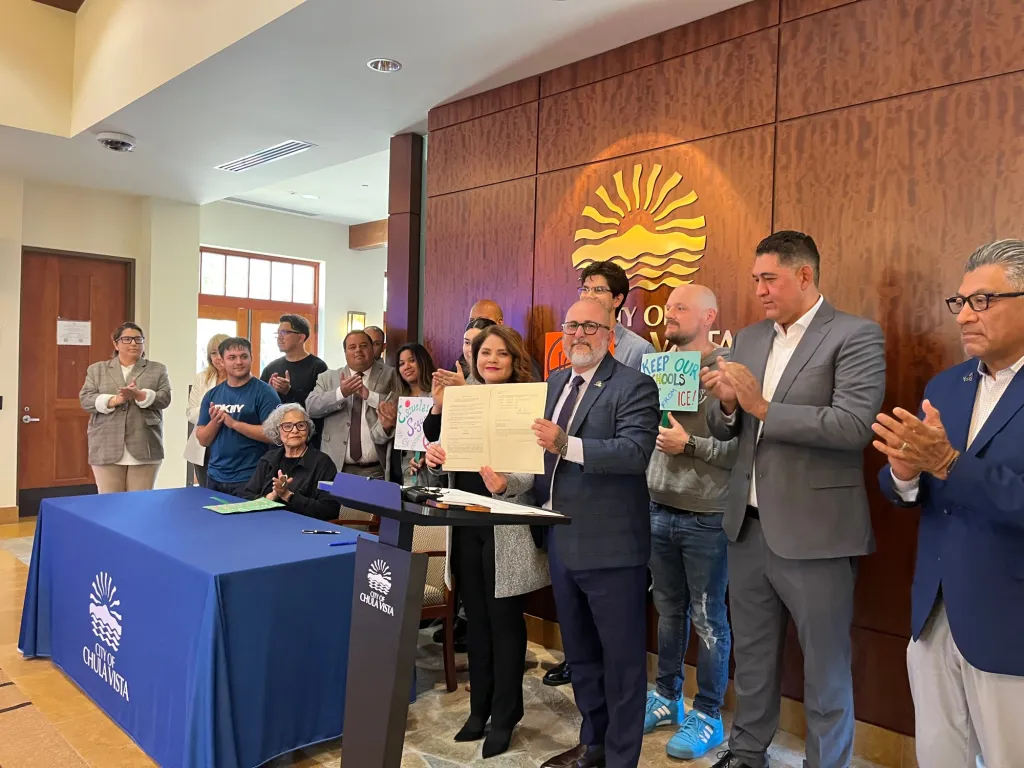
The ordinance, passed 4-0 by the council in March and signed into law in April by Deputy Mayor Cesar Fernandez, requires the city to track and publicly disclose federal law enforcement activity within city limits on a semiannual basis. Mayor John McCann recused himself from voting on the ordinance, citing his Navy Reserve service as the legal basis.
The report, covering a period from Jan. 1, 2025 through Dec. 31, 2025, was accepted by the council unanimously. McCann, who has previously abstained from voting on related matters, also voted to accept the report, explaining after the fact the vote “was a routine administrative matter in which the City Council voted to accept a summary of facts presented by the Police Department.”
Going forward, reports will be issued every six months.
Acting Police Chief Dan Peak presented the findings to the council Tuesday, detailing a methodology that began with 91,234 total calls for service in 2025.
Analysts then manually searched the calls-for-service database using terms related to immigration status, deportation, federal agencies (DHS, CBP, ICE, USCIS), and Spanish-language equivalents. The analysis initially flagging 395 calls — 0.43% of total volume.
After filtering out unrelated hits such as “ice cream” or “ice” deliveries, 92 calls were confirmed to involve federal agencies. Of those, 33 were determined to specifically involve ICE or federal immigration enforcement operations. A Chula Vista Police Department spokesperson specified these were notifications from federal agencies to advise CVPD that they would be operating within the City of Chula Vista. They were not calls from civilians to the department reporting federal immigration activities.
Peak said when federal agencies call in to advise the department that they’re conducting operations in Chula Vista, notifications are often vague.
“We don’t know exactly where they’re at,” Peak said. “Chula Vista is quite large and so getting knowledge that they’re in our community, but not knowing exactly where, is common practice from the federal law enforcement agencies.”
The calls came mostly from U.S. Immigration and Customs Enforcement, with one from the Department of Homeland Security, one from a joint I.C.E./Federal Bureau of Investigations operation, one from a joint I.C.E./Homeland Security Investigations operation, as well as one U.S. Marshals operation.
According to the report, incidents were logged predominantly in the early morning, with I.C.E. accounting for the vast majority of operations. A spike in August — eight incidents that month alone — represented nearly a quarter of the year’s total activity. Nearly all operations involved multiple unmarked vehicles and plainclothes armed officers.
“No assistance was requested from the Chula Vista Police Department,” Peak told the council, adding that CVPD had no involvement in any of the 33 calls and did not respond in any capacity to federal immigration action in the city.
Read more US strike on an alleged drug boat kills 2, leaves 6 survivors, in the eastern Pacific Ocean
Most of the confirmed incidents — 25 of 33, roughly 75% — involved federal agents conducting stakeouts of residences or locations, according to the manual review by CVPD staff. The remaining calls were classified as informational notices to CVPD (3), warrant service (2), a special detail (1), a mental health evaluation (1) and a knock and talk (1). Activity peaked in August, with eight calls that month.
Peak said CVPD did not respond to any reports of federal law enforcement at a school or business during the reporting period, though he acknowledged community concern about a detention that took place near Camarena Elementary School. CVPD learned of that incident through social media, not a federal notification.
“We are at the mercy of our federal law enforcement partners in regards to being able to refine this data,” Peak said, “because if they don’t call us and let us know that they’re in our community, then that is something that we can’t track.”
The department also disclosed participation in eight joint law enforcement task forces in 2025, which collectively resulted in 2,697 arrests. Peak said that no task force officers were involved in any of the 33 immigration-related calls.
CVPD launched a public transparency portal in April 2025 where residents can view reports of federal or out-of-state law enforcement activity within the city, with postings required within three business days of notification.
Deputy Mayor Cesar Fernandez encouraged the public to engage with the portal and asked whether future reports could flag incidents occurring near sensitive locations, such as schools or churches. Peak said that level of specificity is a goal but is constrained by the vague nature of federal notifications.
“I can’t imagine how many hours it took to make this report, and I appreciate your department for taking this very seriously and working on this,” Fernandez said. “Hopefully, we can just keep refining it as we put these reports out.”
One public speaker, who went by the name Aldo B. for fear of reprisal, urged the department to use its network of approximately 150 Flock license plate cameras to better track unmarked federal enforcement vehicles, citing community fear generated by unidentified vehicles.
“It instills fear in people when you’re subjected to this kind of threat, of being picked up for doing nothing wrong,” he said. “American citizens have been picked up in unmarked vehicles across the country for doing nothing wrong, by people who claim to be representing federal law enforcement. That really degrades trust and the sense of safety that people can feel in the community.”
Read more San Diego’s budget crisis reflects skyrocketing lawsuit payouts, liability insurance premiums