








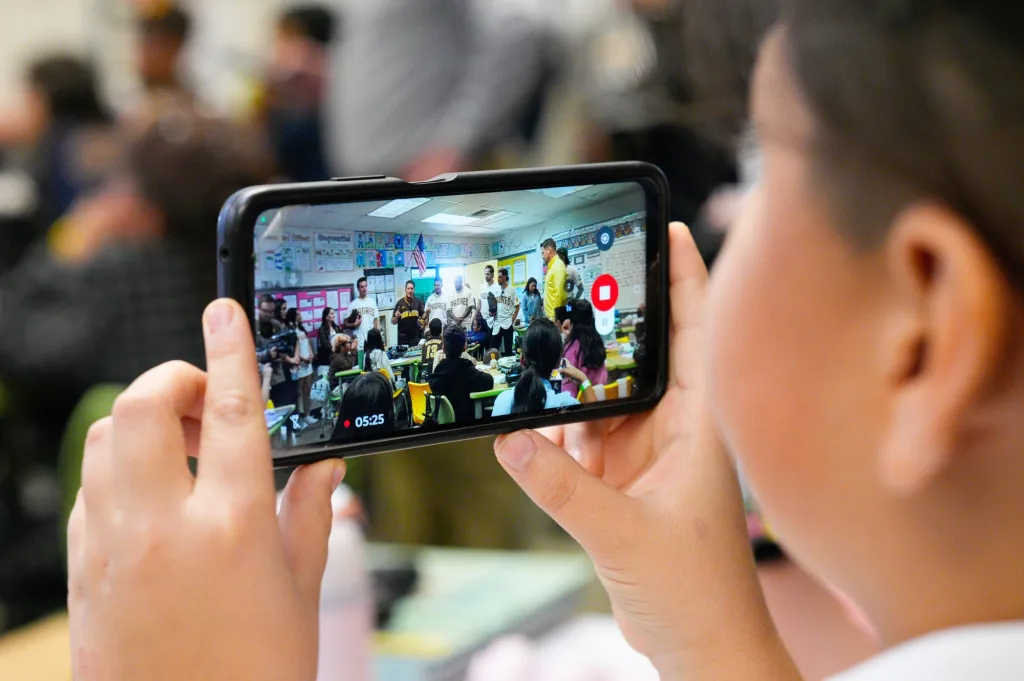
San Diego Unified became the latest school district to place greater restrictions on screens in classrooms, as screens and educational technology have faced mounting scrutiny across the country.
Read more Dozens of states could face new costs because of high error rates in SNAP food aid
The resolution passed unanimously by the SDUSD school board Tuesday evening puts in place a timeline of steadily more restrictive guidance on screens and technology for educational purposes.
Ahead of the vote, Trustee Shana Hazan, one of the sponsors of the resolution, said the intention wasn’t to only reduce screen time but also about creating learning environments that increase student engagement, communication, critical thinking and academic growth. She said the resolution sends the message that the district doesn’t condone unvetted technology.
“My hope is that by the end of this [2026-27] school year, the superintendent will bring forward a clear plan identifying the specific outputs and outcomes we expect our technology practices and policies to produce,” she said.
After screens and remote-learning became ubiquitous during pandemic school closures, parents and other stakeholders have pushed for school districts to cut back on screen time and devices in schools. Chapters of Schools Beyond Screens, which pushes local school districts to adopt guidelines for guidelines on technology in classrooms, have popped up across the country, including multiple ones in San Diego County.
Members of the local chapter have spoken at board meetings leading up to the resolution, and board members indicated their efforts contributed to the resolution.
Los Angeles Unified School District, the largest district in the state, passed a restrictive screen-time and device policy earlier this year that eliminated nearly all student digital devices through first grade, among other measures.
Trustee Sharon Whitehurst-Payne, who represents the southeastern part of the San Diego Unified district, said she wants to make sure her community members are represented, and she has not seen members of her community speaking about the debate over technology in schools at board meetings in recent weeks. She said that they don’t necessarily have access to the internet.
“Just knowing that if we’re having any kind of committee and any kind of input, we need to be sure that all communities are represented, because all parents care for their children, maybe that they don’t have access or the resources to articulate and to project themselves as others do concerning this issue, but I do want them included in any kind of discussion that goes forth,” she said.
Whitehurst-Payne said that she had trepidations around artificial intelligence, but she said there are good things happening with technology, so they need a balanced approach. She said she wants committees to have a broad community representation and bring something “solid” back to them.
Before the first day of the new school year, the district will prohibit video streaming, such as YouTube, and non-instructional gaming platforms on devices provided to students. Computer carts will also be removed from transitional kindergarten classrooms, but still allows access for individualized education plans, 504 plans (a type of accommodation plan for students with eligible disability) or linguistic needs.
Ahead of the winter break, the district will maintain the computer cart or technology lab model for grades K-1 and begin transitioning second grade to that same model. The district will create device usage guidance by grade level, subject, linguistic need and student disability, while focusing on supplementing educator instruction.
Read more What to know about the push to make Bible stories required reading in Texas public schools
The district will also revise board policies to align with new device usage guidance and distribute that guidance and revised board policies to school sites. Those procedures could include guidance to prevent excessive screen time; prohibit non-instructional use of devices on elementary and middle school campuses; and provide an option for elementary students to leave devices at schools.
The district plans professional development for educators on how students can use technology in an “active” as opposed to a “passive” way. The district will also provide families with access to online parent-control tools and information on district-approved applications and student-data privacy standards.
Before the end of the 2026-27 school year, the district will restrict the use of software containing AI functions to district approved applications; require district-approved applications used for instruction or on devices to not have advertisements; provide school sites with clear expectations for teaching grade-level digital citizenship lessons; and provide options to opt out of taking devices home over the summer.
The district will also conduct annual reviews of all approved instructional software contracts, systems and processes. The review will be shared at a public board meeting and will include a report of student application usage by grade level.
The district will update the Acceptable Use Policy and the Universal Form aligned with current research and language appropriate for the age of the student signing it.
The resolution says that the district will revise existing board policies and guidance in collaboration with research partners, students, staff and families.
Elizabeth Johnson, a member of the leadership team for the local San Diego chapter of Schools Beyond Screens, said in a phone interview that group is celebrating the unanimous vote but advocating for further reform.
Among other things, it wants a breakdown of the budget for technology spending and contracts. The group also hopes for a research-based framework to evaluate technology use at all grade levels.
“This is a very reasonable group of people who remain steadfast in their belief that our beloved human teachers are indispensable and cannot and should not be replaced by the slow creep of screens,” she said.
Canning, requested to comment Wednesday afternoon about further technology restrictions, referred back to the board discussion and a press conference prior.
Read more Trump is frustrated gasoline prices don’t mirror oil’s decline. Experts say it’s not that simple