









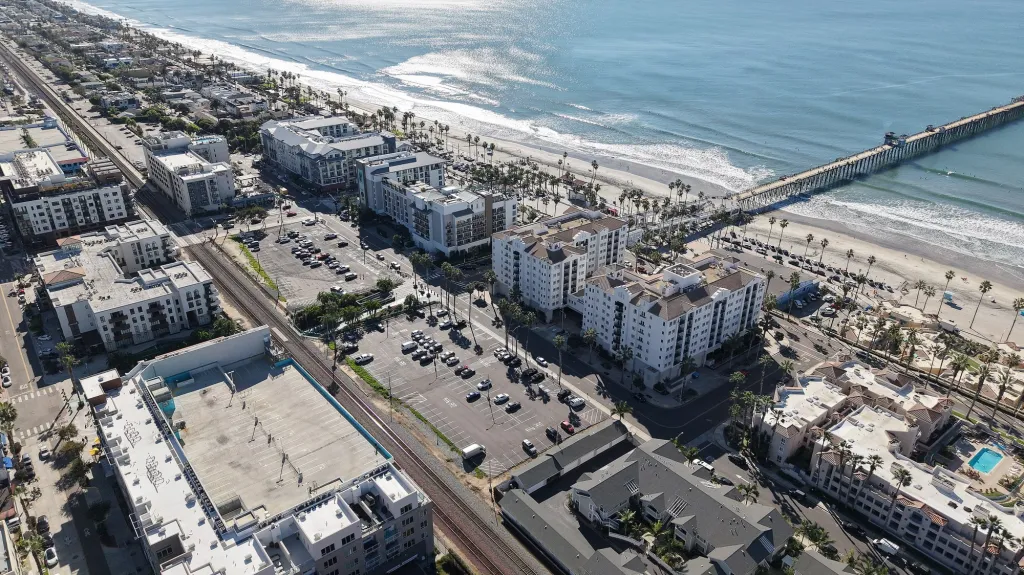
Oceanside is preparing for an additional 45,000 residents by 2050 in its newly updated general plan, a state-mandated document often called a city’s blueprint for long-term growth.
Read more National City weighs business tax overhaul amid mounting budget pressures
One way the city intends to handle that growth is by channeling development into what the plan calls “smart and sustainable corridors” such as Oceanside Boulevard, Mission Avenue and Vista Way, areas that already are built up commercially and have access to public transit.
“This is a very ambitious effort,” said Councilmember Eric Joyce, when the update was presented at Wednesday’s Oceanside City Council meeting, where it was unanimously approved. “It’s very comprehensive, and it has a beautiful vision of the future of our city.”
The plan’s latest updates project that Oceanside, with a present population of a little more than 172,000, will get 16,875 more housing units, meaning multiple types of dwellings at various income levels, and 28,500 more jobs in the next 25 years. About 8,300 of those homes and 14,500 of the jobs should be in the city’s smart and sustainable corridors, the plan states.
That would continue a trend underway for the construction of multi-story, mixed-use buildings in the city’s oldest and most dense neighborhoods. Several large, dense residential developments are planned or being built within walking distance of its downtown transit center and train stations along the east-west Sprinter rail line that terminates in Escondido.
California requires cities to prepare a general plan that looks at the various elements of their expected development. Cities must consider the best ways to use the available land, roads, and natural resources, along with environmental factors such as noise, air pollution and water quality.
City planners have been working with consultants and community residents since 2020 to produce the plan’s latest updates. The City Council approved an earlier phase of updates covering the plan’s economic development and climate action elements in 2019.
Some elements of the general plan are updated more frequently than others. The housing element, for example, must be updated every eight years with an emphasis on what cities are doing to accommodate affordable housing.
Read more If the planet is unhealthy and out of balance, everything on it will be, too—including humans
Mobility is another important element, which covers road capacities, public transit availability and strategies for managing transportation. The mobility element is updated every 10 to 20 years.
Some of the elements, such as those for safety and noise, change little over time and have not been updated since the city adopted its first general plan in the mid-1970s.
More than a dozen people spoke to the council about the update. Most of them supported it, though many asked for minor changes or additions such as creating more community trails, increased incentives for electrification, or adding ways to prevent birds from colliding with the reflective surfaces of tall buildings.
City officials responded that aside from the provisions in the general plan, most of those things could be dealt with at other stages of development. A few cities have tried to mandate all-electric construction, but the requirement has been overruled in court.
“We cannot ban natural gas plumbing,” said Justin Gamble, the city’s sustainability program administrator. “But when we look at the existing building code … it keeps getting more and more stringent. It’s almost more cost effective now for builders just to choose to go all-electric.”
Oceanside also adopted an updated climate action plan Wednesday, with guidelines for reducing greenhouse gas emissions from new development. Greenhouse gases such as carbon dioxide, methane and nitrous oxide are atmospheric pollutants that contribute to climate change.
Cites that fail to update their general plans face the possibility of fines, lawsuits and the loss of state grant money.
Read more San Diego gas prices still high, but heading lower as July 4 weekend nears