





A few jumbo bond measures are on the fall statewide ballot, and at least one sizable bond proposal likely will go to voters living in the San Diego Unified School District.
Read more Why American elections are so complicated — and secure
A countywide sales tax increase and similar measures in some San Diego cities will also be on the ballot, while a couple of other local municipalities are considering putting tax proposals of their own on as well.
Even some measures that don’t raise taxes potentially require substantial taxpayer money.
Much of the ballot tax discussion has been focused on the so-called “billionaire tax,” Proposition 40, which has been at the center of the nationwide debate about whether a “wealth tax” should be assessed on the rich.
But the breadth of the other state and local revenue measures is coming into view now that the proposals are being finalized. Many support popular causes — affordable housing, medical research, public safety, the environment and more — even if achieving the means to address them can be a difficult ask: raising taxes.
All have different reasons for being, but there are some common themes surrounding them. Politically, there’s the worry from supporters that, cumulatively, the proposals may seem overwhelming and lead to a higher potential of “no” votes, even if some of those voters might have supported individual measures in isolation.
Raising taxes is always politically challenging, especially in uncertain economic times like these where people are feeling financially stressed.
There’s also something of an existential question about whether the structure of funding state and local governments needs a sweeping overhaul, given that so many budgets are underwater or perpetually on the bubble.
Of course, there’s plenty of justified criticism about how some jurisdictions are managed and their spending priorities. Locally, the city of San Diego has been the poster child for this. Perhaps because of that, the city has passed on a revenue-raising measure in this election cycle despite continued budget shortfalls.
But living within their means is increasingly difficult for governments in San Diego, regardless of size, partisanship or fiscal acumen.
Democratic-leaning Oceanside is pursuing a half-cent sales tax extension. The still-Republican city of Santee — political demographics are shifting there — is pushing a 1-cent sales tax increase.
“I never thought in my day that this city would ever be looking at a tax measure,” said Mayor John Minto, a Republican, according to Hannah Elsmore of The San Diego Union-Tribune.
“The reality is that the prices keep going up, and we’re still getting more unfunded (state) mandates. We have to do something.”
Variations of his latter comment could be voiced by other local government leaders, though the Democratic majority on the county Board of Supervisors has largely pointed to federal cuts by the Trump administration to justify their half-cent sales tax proposal on the November ballot.
The need for more revenue isn’t new, but it seems more intense. Other cities around the county, including Escondido and San Marcos, have raised their sales tax in recent years, while still others, like El Cajon, extended a previous increase.
Meanwhile, there’s talk in Chula Vista, a Democratic city with a Republican mayor, of a hotel tax, though its prospects at this point remain unclear, according to the Voice of San Diego. Mayor John McCann hasn’t been shy about boasting about the city’s healthy budget. (City Council members are also moving toward a ballot measure asking voters to give them a substantial pay raise, the Voice recently reported.
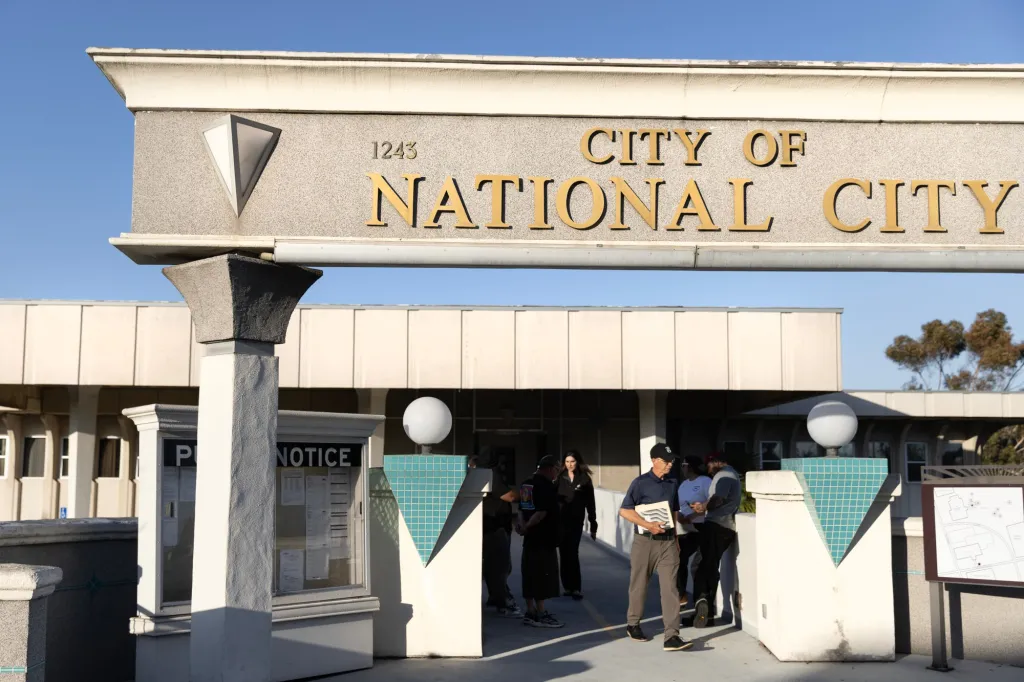
The situation is different next door in National City, which is heavily Democratic for those keeping score. Facing a budget shortfall, the City Council is considering a ballot measure on a business licensing tax.
Read more Maine shooting and officer’s background raise new questions about ICE’s rapid hiring
The proposal, which has faced staunch opposition from the business community, would shift the license payment from a tiered flat fee to a percentage of gross receipts for larger businesses, as Walker Armstrong of the Union-Tribune reported.
Most tax measures get a lot of attention, but the National City business tax perhaps even more so, if it goes on the ballot. Cities in California and across the country increasingly have been attempting to raise more revenue from businesses.
Some leaders in the city of San Diego have been quietly discussing whether to head in that direction in the future, given the recent failure of a sales tax measure and a second-homes tax, along with the repeal of parking fees in Balboa Park and the reduction of new trash collection fees.
Opposition there would also be tough. City Council members recently withdrew a wage-enforcement fee plan on businesses after complaints by hotels.
There’s not a lot of data that clearly show how multiple tax or revenue-raising measures might sway the vote. However, a poll by the nonpartisan Public Policy Institute of California released in May found that 55 percent of Californians want to pay lower taxes and have a state government that provides fewer services.
And to be clear, those individual tax increases being considered by cities would only go on ballots for voters living within their boundaries. Chula Vistans would not be weighing in on a National City tax.
But those individual taxes all would be on the ballot with the county sales tax proposal and the state measures as well. Fourteen state propositions are on the California ballot in November, though only a couple are direct tax measures, which are targeted at upper-income residents.
There’s Proposition 40, asking for a 5 percent tax on billionaires, and Proposition 3, which would extend a temporary tax for schools and health care on individuals earning more than $360,000 for single filers, $721,000 for joint filers, and $490,000 for heads of household.
But there’s an $11.25 billion affordable and veterans housing bond, Proposition 1, almost all of which would be general obligation bonds paid by taxpayer money through the state. The same goes for Proposition 38, an $8.4 billion bond to support research in immunology and immunotherapy.
(The San Diego Unified $3.5 billion bond would be paid off by property taxes, according to the Voice of San Diego.)
Added to the mix is Proposition 37, a statewide $25 billion bond to help middle-income residents buy a home. Those are revenue bonds, however, which would be covered by homeowners’ mortgage payments.
Proposition 4 asks voters if they want publicly financed political campaigns. Proposition 39, the voter photo ID proposal from Assemblymember Carl DeMaio, R-San Diego, would add tens of millions of dollars to implement the measure and possibly larger amounts annually for ongoing administration of elections, according to the Legislative Analyst’s Office.
There are also measures that would void the billionaire tax, Propositions 41 and 42. Then there’s Proposition 43, which would impose higher voting thresholds on special taxes.
Confusing or not, voters will need to get used to it. Even with tax increases, government costs will continue to rise.
Numerous tax and bond measures — and likely fights over how to raise taxes — will be a regular feature on future state and local ballots.
Read more China rejects Trump’s election interference claim as ‘groundless accusations’