








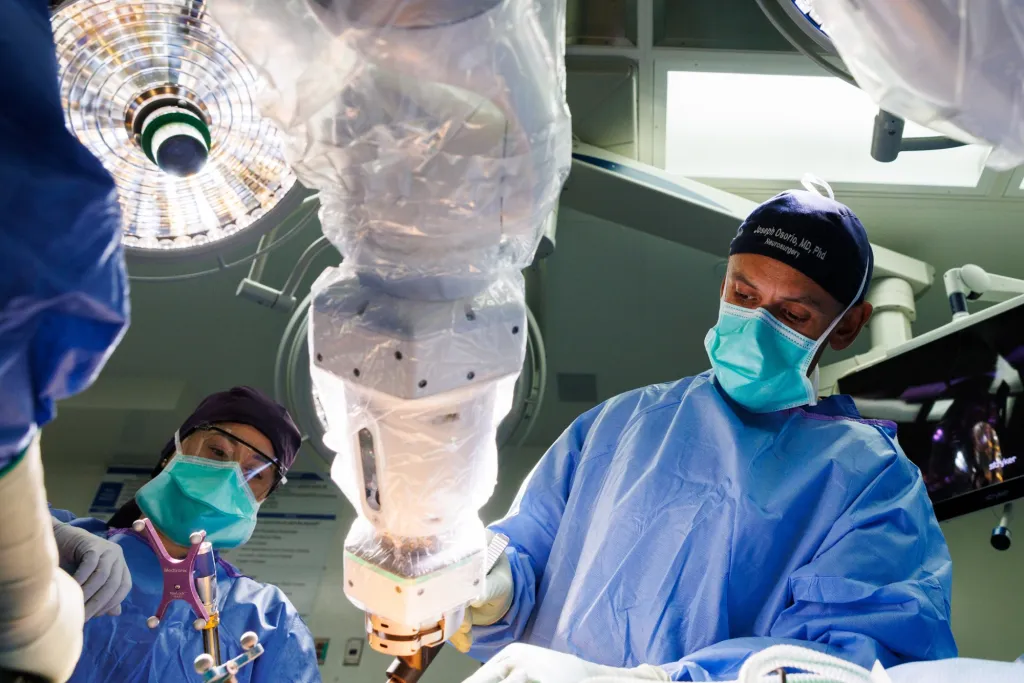
Artificial intelligence is rapidly inundating health care, from systems that transcribe doctor-patient conversations to algorithms trained to spot anomalies in chest X-rays.
Read more Democrats’ narrow path to Senate majority gets rockier as Platner faces sexual assault allegation
A new initiative at UC San Diego, the Institute for Applied Health Intelligence, seeks to “harness transformative ideas” arriving daily and determine which can effectively transform patient care and which are not likely to scale from proof-of-concept pilot projects to broad adoption.
At least, that’s part of the goal anyway.
The idea, explained Dr. Amy Sitapati, the institute’s inaugural director and UCSD Health’s chief medical information officer of population health, is not simply to identify the best emerging technology, but to view the entire landscape through a lens of patient service.
“You can study all of the fancy machine learning models you want in the cloud, but if they don’t help real-world patients today, what good are they?” Sitapati said.
Sitapati is uniquely qualified to lead this effort. She earned her undergraduate degree in biomedical engineering before earning her medical doctorate, both from Case Western Reserve University. Specializing in internal medicine and still seeing patients, she has also worked in biomedical informatics research.
According to an announcement published online Monday, the institute will “unify experts from UC San Diego Health and faculty across six academic schools” on campus. This effort, Sitapati said, is not about governance but rather about collaboration across the broad set of academic specialties that medical AI is already touching.
“We have to work across schools and get all of the right people in the room to build the new technology that’s going to help real people, and that’s what this institute is designed to do,” she said. “It gives a structure for grants, for contracts, for education, for leaders to learn how to do this work and not be in any one specific school or program.
Read more Private immigrant detention center in Otay Mesa sold to DHS as part of $1.5 billion deal
“It’s a unifying entity, so it takes the best of everyone trying to do this work and creates a home to supersize it.”
UCSD has been among the university health systems pushing the AI revolution forward. An ongoing effort that uses algorithms to detect the likely development of deadly sepsis among emergency patients has received broad industry attention, and a recent paper explores adding an AI chatbot to the university health system’s online patient portal. Voluntary participants, researchers found, enjoyed the experience of using a digital expert to better understand medical test results.
Having recently received treatment at Moores Cancer Center, Sitapati said she participated in the trial, trying to provoke the chatbot into saying something incorrect or insensitive about her own results.
“It didn’t give me back anything that seemed incorrect, but it actually also highlighted a couple of things I hadn’t seen in my hundreds of pages of lab procedure results,” she said. “I was like, ‘wow, I learned something about my health by participating in this study, this is amazing.’”
UCSD, Sitapati said, is already significantly down the path of AI adoption with the technology already present, in one way or another, in about 100 different roles.
Read more EU lawmakers call for probe of FIFA boss over Trump contact before US-Belgium match