





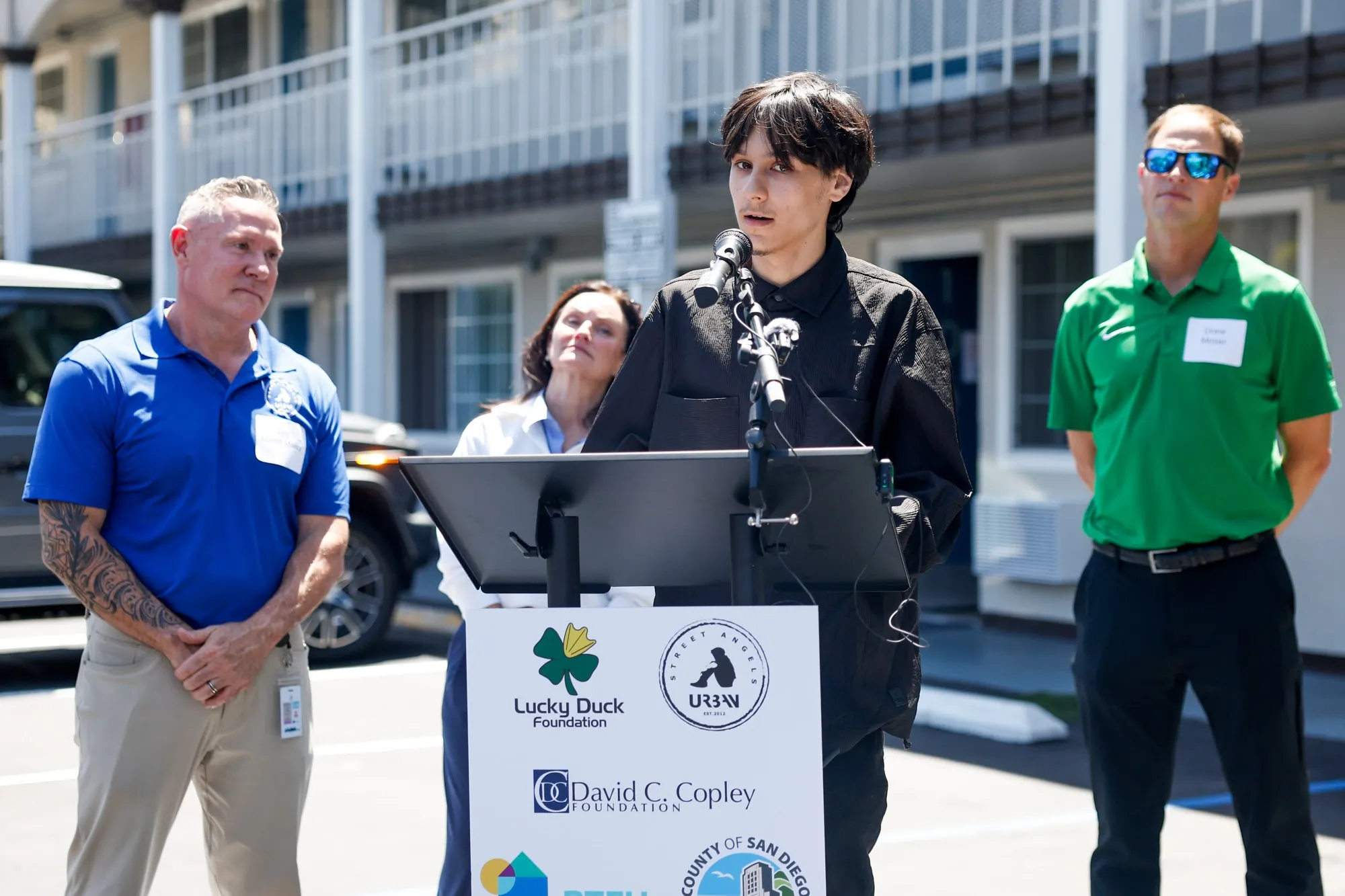
Operators and guests celebrated the opening of a new transitional shelter Thursday in downtown San Diego to divert young people from trouble on the streets to lives of enrichment and meaning.
Read more Photos: Creelman fire aftermath
“We help them find their way,” said Eric Lovett-Maerz, founder and president of the nonprofit Urban Street Angels. “They want to make it. They want to be successful.”
Urban Street Angels opened the HarborTAY House shelter in collaboration with the Lucky Duck Foundation, David C. Copley Foundation, the County of San Diego, and the Regional Task Force on Homelessness. The building is a former motel on Pacific Street near the County Administration Center, Waterfront Park and Little Italy.
HarborTAY House has 34 rooms with 54 beds for participants ages 18 to 24. Urban Street Angels operates other similar programs including VisTAY House that opened in Vista a year ago. TAY is an acronym for “transition age youth.”
Participants in the programs generally stay nine months to a year, while they pursue jobs, education and other goals. Along with housing, they receive food and basic necessities, case management, peer support and career development. With its 34 rooms, HarborTAY has the potential to help 100 people a year.
“We are celebrating the possibilities in the community coming together,” said Tamera Kohler, CEO of the Regional Task Force on Homelessness.
The task force coordinates the region’s annual Point In Time Count. The one-day assessment of unsheltered people in San Diego County is an important factor in the distribution of financial aid and other services.
“That is our sole goal, to address homelessness, but it has to be addressed collectively,” Kohler said. “Housing creates the foundation, but it’s the education and services that create a path forward.”
Helping people when they are young is the best way to prevent chronic homelessness, she said.
“The surest way to end homelessness tomorrow is to invest in youth today,” said Drew Mosier, CEO of the Lucky Duck Foundation.
“HarborTAY will be a safe haven and a launching pad for healing, growth, and independence,” Mosier said.
HarborTAY House began accepting residents about two weeks ago and is now about half full, officials said. Two of the new residents spoke at Thursday’s celebration.
A 19-year-old woman who gave her name as Olie M.A.C. said she grew up in Chula Vista. She got into trouble at school and at home, and she ran away the first time when she was 14. She returned briefly, but soon left again and lived primarily with friends before finding the Urban Street Angels program.
“Without this community, I don’t know where I’d be,” she said.
“I have made amazing friends here,” Olie said. “It makes me want to do more. It makes me want to do better in life.”
San Diego native Robert H., also 19, said he grew up in the foster system “with a lot of violent kids.” His mother died of drug addiction. He, too, felt fortunate to be in the shelter program.
“They give you all the resources you really need,” he said. “This is the spot.”
Lucky Duck and the David C. Copley Foundation provided start-up funding for HarborTAY. The County of San Diego and the Regional Task Force on Homelessness will provide funding for its ongoing operations.
San Diego County’s overall homelessness decreased by 1%, from 9,905 individuals in 2025 to 9,803 in 2026, according to the most recent Point in Time Count.
However, the number of people in shelters increased from 4,191 in 2025 to 4,695 this year, up 12%, the results show. People contacted on sidewalks and in cars, parks, abandoned buildings and outdoor camps declined from 5,715 in 2025 to 5,108 this year.
The statistics, while generally considered a rough estimate, indicate social service programs have been successful in moving people off the streets and into shelters with assistance services, officials said.
Read more Trump welcomes Dodgers to the White House for second World Series title celebration