


Although it may not have the force of law, the San Diego City Council on Monday approved a resolution urging the California Legislature and Gov. Gavin Newsom to give local authorities control over the deployment of autonomous vehicles in their respective jurisdictions.
Read more Escondido school district makes board appointment in contentious meeting
Approved on an 8-0 vote, the resolution also includes provisions seeking protections for drivers whose jobs may be jeopardized by the new technology and urges the San Diego County Regional Airport Authority to prohibit autonomous vehicles, also known as AVs, from operating at the San Diego International Airport.
“San Diego should not be a testing ground where corporations introduce new technology onto our public streets without meaningful local input, accountability or consideration for the people who will be affected,” City Councilmember Sean Elo-Rivera said.
“I am not sitting here asking San Diego to get off the road to innovation,” said Councilmember Marni von Wilpert, who co-introduced the measure with Elo-Rivera. “I am simply asking for San Diego to have a say in where that road is going.”
Councilmember Henry Foster was absent from the vote.
The resolution comes as multiple tech companies jump into the San Diego market, offering ride-hailing services.
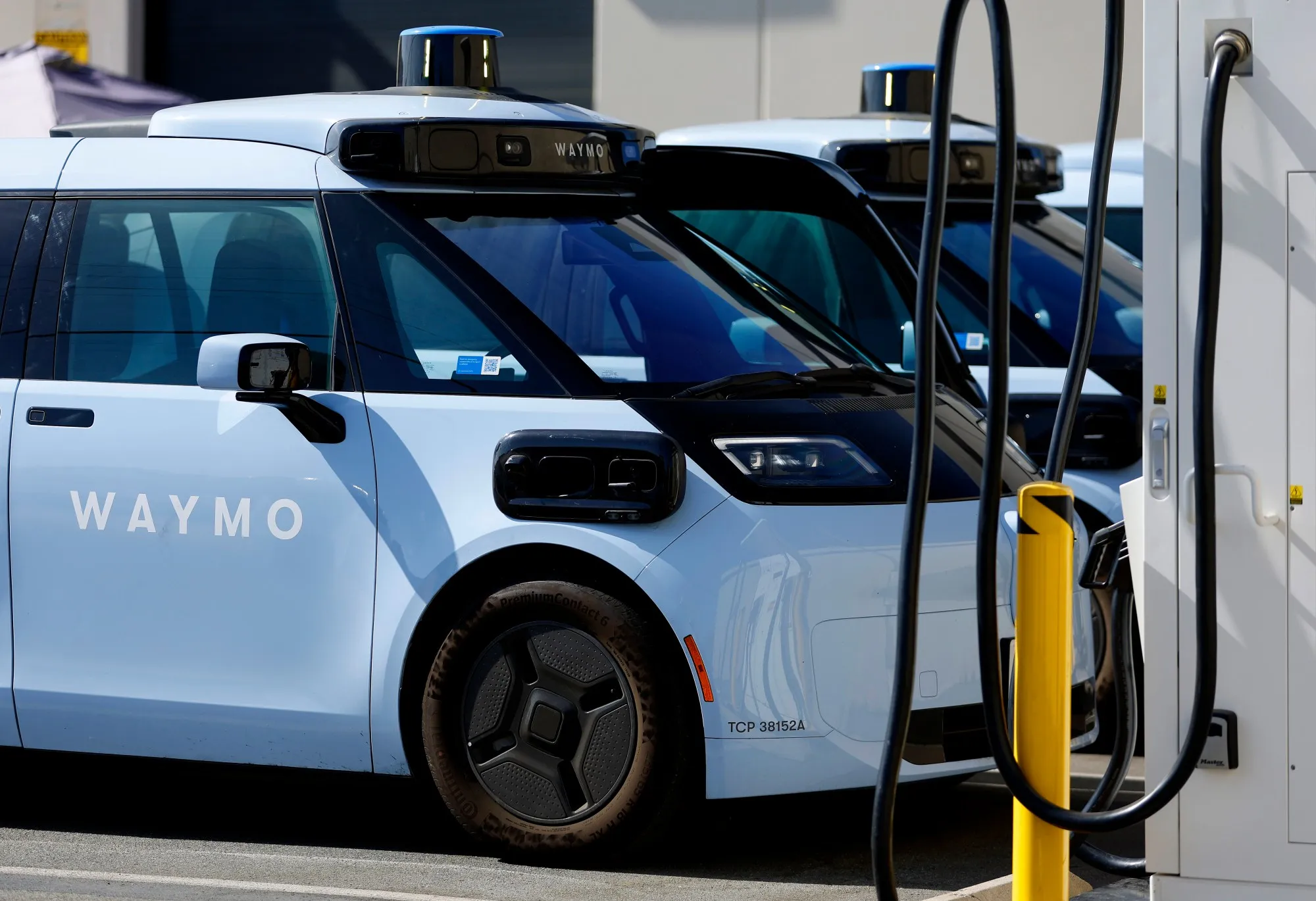
Earlier this month, Alphabet-owned Waymo officially launched its robotaxi service to early-access customers that covers roughly 40 square miles of central San Diego, aside from the airport, as the local authority has jurisdiction over which ride-hailing services are allowed to pick up passengers.
Amazon subsidiary Zoox announced that it will soon begin testing for its fleet of vehicles. Meanwhile, locals have spotted Tesla’s gold-colored Cybercabs zipping around town, fueling speculation that Elon Musk’s company is poised to join the AV fray in San Diego as well.
During the public comment portion of Monday’s meeting, Waymo’s state and local public policy manager, Adam Lane, phoned in and called the resolution “extraordinarily premature,” saying “thousands of safe trips” have already been completed in the first week of operations in San Diego.
In an email to the Union-Tribune, Waymo spokesperson Ethan Teicher said, “This ill-conceived motion could lead to the restriction (of) San Diegans’ transportation choices at the airport, hurting those whose needs are not met by the status quo.”
As of 6:30 p.m. Monday, the Union-Tribune had not received responses to the passage of the resolution from the airport authority or from Mayor Todd Gloria, who last November came out in support of “innovative and promising technologies like Waymo’s autonomous vehicle service.”
Currently, AVs in California are regulated by state agencies, not local authorities.
The California Department of Motor Vehicles issues testing and deployment permits, sets rules for vehicle equipment, and tracks collisions and traffic safety.
The California Public Utilities Commission licenses companies that use autonomous vehicles to transport members of the public and oversees robotaxi pilot programs.
The commission recently approved Waymo’s expansion permit, allowing the company to pick up passengers in San Diego. Thus far, the CPUC and the DMV have granted permission for Zoox and Tesla to test their respective fleets with a human behind the wheel.
So is the resolution merely a symbolic move? Von Wilpert said it’s not.
“What we are asking this resolution is for our state representatives to change the law in Sacramento,” she said before the council’s vote. “They could easily change the law … which will then kick off a lobbying campaign to pressure them to change the law and let us have control.”
Read more US watchdog tallies Iran war’s hit to weapons stockpiles, military bases and more
While acknowledging the technology is already here, Elo-Rivera said, “Things can always be rolled back. There’s nothing saying that the operation on our streets today means that they get to operate here in perpetuity and it doesn’t mean that if they continue to operate, they can’t be reined in a bit.”
Elo-Rivera is also chair of the Taxi Advisory Committee and the entry of robotaxis into the San Diego market has drawn opposition from taxi and ride-share drivers.
“This is hurting us a lot; we are already struggling,” Mikaiil Hussein, president of United Taxi Workers of San Diego, said during a news conference.
“Many drivers are concerned about their jobs and their family’s future,” said Luis Arias, president of San Diego Drivers United. “Technology can bring progress but that progress should not come at the expense of workers, public safety, accessibility or local infrastructure.”
Earlier this year, the Metropolitan Transit System’s board of directors voted 12-1 to approve a resolution against Waymo expansion.
Transit system CEO Sharon Cooney has raised a host of economic and safety issues. Citing a December 2025 power outage in San Francisco that resulted in driverless Waymo vehicles blocking intersections, Cooney expressed concerns about autonomous vehicles blocking streets or trolley tracks and disrupting transit service if a similar event happened in San Diego.
Despite some of the viral videos of robotaxi fails, Waymo says it has partnered with 290 first responders, including personnel from various San Diego public safety agencies.
“Additional training is scheduled throughout this year and next,” Teicher said. “This includes new engagements with National City Fire and Coronado Fire, alongside refresher sessions for the San Diego Police Department, Harbor Police, California Highway Patrol (CHP) and San Diego Fire-Rescue Department.”
The resolution passed Monday also called for “responsible autonomous vehicle operations” requirements within the city of San Diego, which includes AV operators complying with local noise and nuisance laws, as well as keeping charging hubs and fleet facilities away from locations such as homes, schools, healthcare institutions and public safety facilities.
The measure also came out in support of a bill on Capitol Hill to establish federal requirements for manufacturers and operators of autonomous vehicles.
Introduced last month by Rep. Kevin Mullin, a Democrat from South San Francisco, the legislation is dubbed the AV Emergency Response Coordination Act. Among its provisions, HR 10033 would require companies to provide clear, standardized emergency response protocols for first responders and create a 24/7 hotline for public officials to communicate directly with AV businesses whenever incidents occur.
Waymo’s baby-blue, all-electric robotaxis can be seen in more than a dozen cities, including new deployments in San Diego, Tampa and Denver. The company is also testing in 18 other locales, such as Tokyo and London.
The company’s current service area stretches from Pacific Beach south to Sunset Cliffs, southeast to Barrio Logan and northeast to Normal Heights. The company is waiting to get a permit from the city to start taking customers to and from the San Diego International Airport.
Zoox will soon begin testing in San Diego with human drivers behind the wheel.
The company’s boxy, almost toaster-shaped, big-wheeled EVs will collect data and map tourist areas and residential neighborhoods in Little Italy, the Gaslamp Quarter, Old Town, University Heights, Mission Valley, Balboa Park, North Park and South Park.
Read more Trump nominates wife of ‘God Bless the USA’ singer Lee Greenwood to serve as US ambassador