






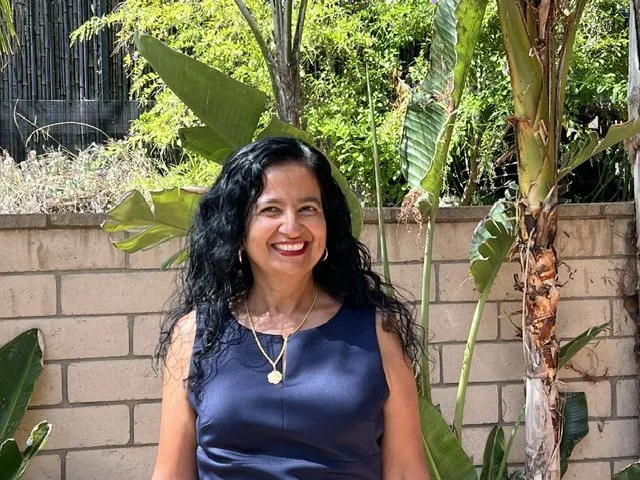
Davinder Kaur was 39 when she first told her story. It was in 2009 in front of a class at San Diego State University.
Read more Men accused of distracting people at banks to steal debit cards arrested in Lemon Grove
“I was a trembling mess,” she said. “I thought I was going to pass out.
“I could sense the shock and amazement in the room, and I realized what I’d said wasn’t normal for the rest of the world. But when I finished, I felt like I was freeing myself.”
She was born in 1968 and raised in England to Punjabi parents who had immigrated from India and maintained strict cultural traditions.
Her mother enforced a code that included no dating, makeup, school activities or dresses other than school uniforms. Her daughter was to cook, clean and prepare for marriage.
She was not permitted to attend college after high school. There was no need, she was told, as she would be married at 18.
“There’s two types of Indians,” Kaur explained. “Those who want education for their children, even their daughters, and those who focus on marriage and don’t care about education, especially their daughters.”
“Mine was the latter. They just wanted me to get married.”
Kaur said her mother was demanding and critical. For punishment she would be slapped, berated or sent for 20 minutes to a dark locked cellar.
“When I was 11 or 12, I didn’t think life was worth living anymore,” she recalled, describing how she attempted to slit her throat with a knife. “Thankfully, I was not successful.”
At 14, she was shown a photo of a boy her mother wanted her to marry when she reached 18. “I knew I couldn’t say no. My human rights were stolen from me at age 14 because I was officially engaged and someone else’s property. I was spoken for.”
The boy visited England from India a few weeks later, and they posed for photos. She was told not to speak with him and said only two words, “hello” and “goodbye.”
As she approached 18, Kaur ran away. She was tricked into returning, however, and married the boy to save her family embarrassment.
“I didn’t want to marry him,” she said.
“Two weeks into our marriage, I announced I wanted a divorce. I was absolutely certain the relationship wasn’t going to work. I didn’t want it.”
Her husband did not react well. The relationship spiraled downward to the point she said he physically abused her.
Read more San Diego police lieutenant placed on administrative assignment after Chula Vista arrest
Six weeks into the marriage she left. They were eventually divorced.
Kaur found her freedom.
She lived for periods of time in Denmark, London, Australia, New York and Washington, D.C., supporting herself as a waitress, secretary or administrative assistant.
She moved to San Diego in 1998 and opened a restaurant in Encinitas, which she successfully ran for nine years before selling.
Kaur enrolled in community college and eventually San Diego State, where she earned a bachelor’s degree in business management in 2010.
Following the speech to her class in 2009 Kaur found her voice, sharing her story through social media and speeches at various colleges. She became involved in advocacy groups, spreading awareness about child and forced marriages.
“Forced marriages are a form of trafficking,” she said.
In 2021, she published a book about her life, “Forced to Marry Him: A Lifetime of Tradition and the Will to Break It.”
Her book won several awards, including the Hope Pyx Global International Book Award at the 2023 International Conference on Abuse. That year, she was named “Woman of the Year” by the San Diego Youth Sikh Society.
Her family learned of the book and officially disowned her again, the first being when she left her husband at 18.
Today, Kaur, 57, lives in Escondido and has three children who enjoy freedom she fought for.
Her oldest daughter graduated college and earned a post-graduate nursing degree. Her son is in college, and youngest daughter will soon enter college.
In the Dedication section of her book, Kaur wrote: “To my mum, I hope one day you will understand. I love you and have forgiven you.”
About this series
Goldsmith is a Union-Tribune contributing columnist.
We welcome reader suggestions of people who have done something extraordinary or otherwise educational, inspiring or interesting and who have not received much previous media. Please send suggestions to Jan Goldsmith at [email protected]
Read more Some homeless find relief in air-conditioned library. Others seek out shade on the street.