






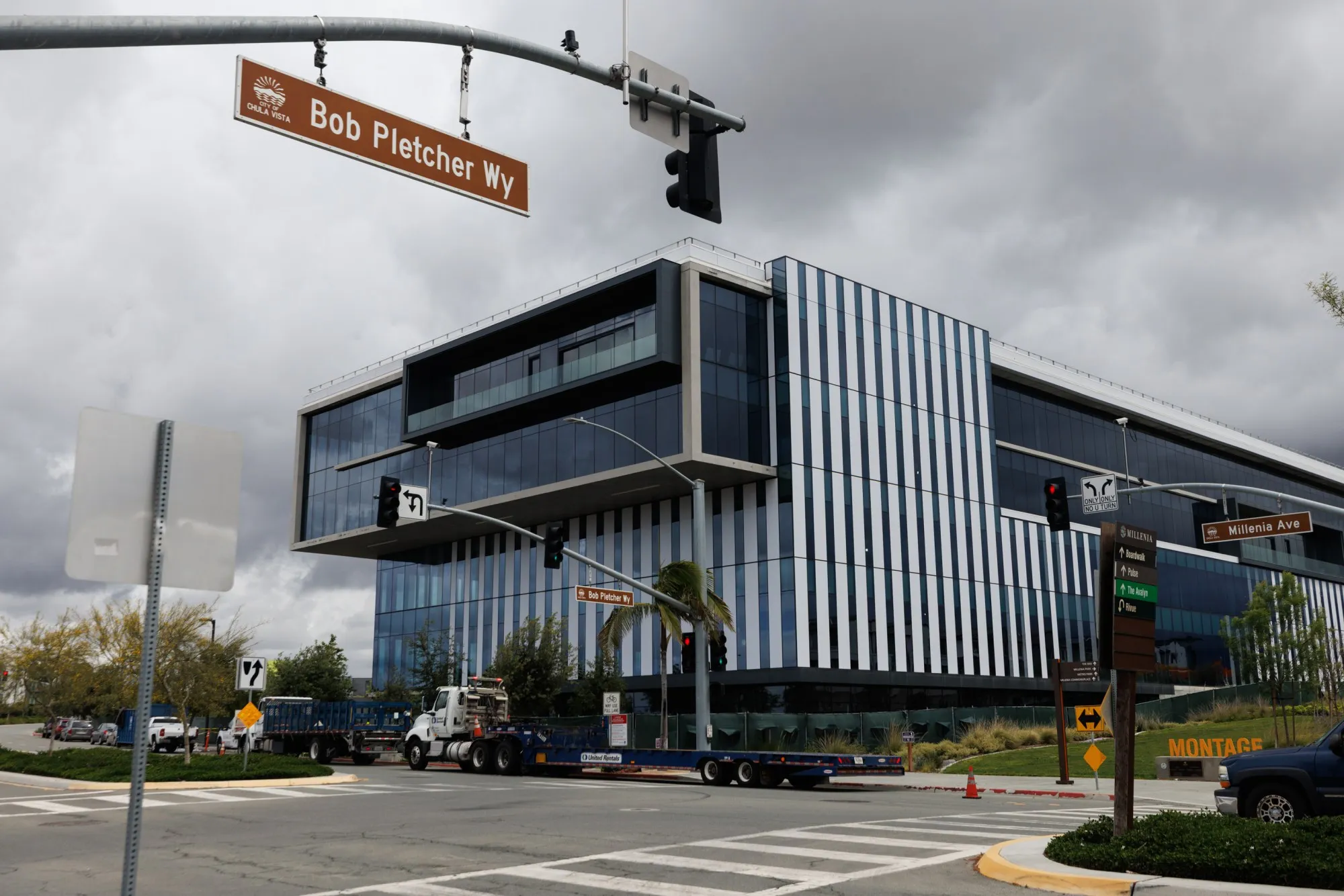
The body responsible for developing plans aimed at creating a four-year university in Chula Vista took a step toward shaping a proposed governing structure during its second meeting Friday, laying the foundation for what the estimated $2.17 billion university might eventually look like.
Read more San Diego Community College District to expand student housing downtown
The South County Higher Education Planning Task Force heard a staff recommendation for the initial governance structure for the proposed 35-acre University District at Chula Vista, voting to schedule an additional meeting in January dedicated specifically to governance before finalizing any recommendation. The task force will also meet in November and February.
The task force, created under Assembly Bill 662, must submit governance, financing and land-use recommendations for the proposed four-year university district to the California Legislature by July 1, 2027.
Because the proposed university district would be a multi-institution site, the staff-recommended governance structure would pair a Joint Powers Authority (JPA) — a public legal entity with authority to hold property, issue debt and employ staff — with a nonprofit intended to enable participation by Mexican higher education institutions, which cannot legally join a JPA.
The university district’s multi-institution model builds on partnerships already underway at Southwestern College, which has agreements with San Diego State University, UC San Diego, CSU San Marcos, National University, Point Loma Nazarene University, Arizona State University and the University of Southern California.
Staff also proposed an academic advisory board and said state-authorizing legislation could be pursued later if it clearly benefits the enterprise.
Task force legal counsel Adriana Ochoa, a partner at Snell & Wilmer, told members the recommendation is not final and reflects the early stages of development.
“It’s kind of (an) early stage MOU to recruit and solicit partners, then the establishment of a JPA … and then maybe at or around the same time, the formation of a nonprofit so that we can start developing the operational and binational component,” Ochoa said.
Several members said they needed more time to weigh governance options against financing mechanisms, which the task force is scheduled to discuss at its November meeting.
Task force member John Moore, dean of undergraduate education for the University of California San Diego, proposed holding the additional governance meeting after the finance discussion rather than in October.
“I think rather than having something in October, it might be better to have our next meeting about finance (in November), then schedule another task force meeting,” Moore said.
The task force approved a motion empowering Chair Clarissa Falcon to work with staff to schedule the additional meeting, tentatively targeted for January.
Read more Seneca Nation calls for reversal of Trump’s ‘Lake America’ executive order
Task force member David Malcolm also raised the possibility of asking Assemblymember David Alvarez to introduce legislation exempting the roughly 383-acre site from future challenges under the California Environmental Quality Act, citing the city’s 2018 certified environmental impact report for the property.
“One of the things that concerns me is a challenge to the (Environmental Impact Report) that was done in 2018,” Malcolm said. “If somebody doesn’t like the traffic, somebody doesn’t like the lighting from the ball field, somebody doesn’t like the noise … and all of a sudden we find ourselves in a lawsuit for years.”
Ochoa said the task force could formally recommend such legislation, but the item was not on Friday’s agenda and would need to be scheduled for a future meeting.
Earlier in the meeting, representatives from the task force’s Binational Roundtable presented three recommendations: forming a nonprofit to enable Mexican university representation, establishing a “binational hub” to coordinate cross-border student services, and pursuing a limited pilot extending the principles of Assembly Bill 91 — which allows eligible Mexican residents near the border to pay in-state community college tuition — to students at the university district.
Joel Pilco, director of binational and international programs at Southwestern College, said the college has enrolled 358 students in its AB 91 program this semester, 84% of whom are U.S. citizens who completed high school in Tijuana. He said those students have posted persistence rates — the percentage who continued enrollment from one semester to the next — and course completion rates above 90%, exceeding the general student population.
Pilco also cited a dedicated student lane launched in April at the San Ysidro and Otay Mesa border crossings, developed with U.S. Customs and Border Protection, San Diego State University and UC San Diego.
“Within a month, a student is saving 380-plus hours in two semesters by using that lane,” Pilco said. “That is 16 days of life given back to the student.”
Orlando Vicente-Lazo, student trustee at Southwestern College, urged the task force during public comment to guarantee a permanent voting student seat on the eventual governing board, rather than a non-voting advisory role.
“We are the ones who will actually live with the decisions that you guys make and we know exactly what resources and support systems our classmates need to graduate,” Vicente-Lazo said.
Staff also provided updates on other task force activities, including a July 25 community forum that drew more than 60 attendees and a $50,000 pledge from the James Irvine Foundation to fund community outreach.
Read more Measles deaths reported in Pennsylvania spark fight among politicians and health officials