






When a jumble of candidates launched their campaigns last year for California superintendent of public instruction, they were competing for a position that would have given them control over the California Department of Education.
Read more America’s ‘Cult of the Offensive’: Why the US is headed for failure in Iran
Now, following a long-attempted overhaul signed into law this month, the job will become more advocate than policy leader, and the governor will consolidate control of education policy — thanks to two San Diego County lawmakers.
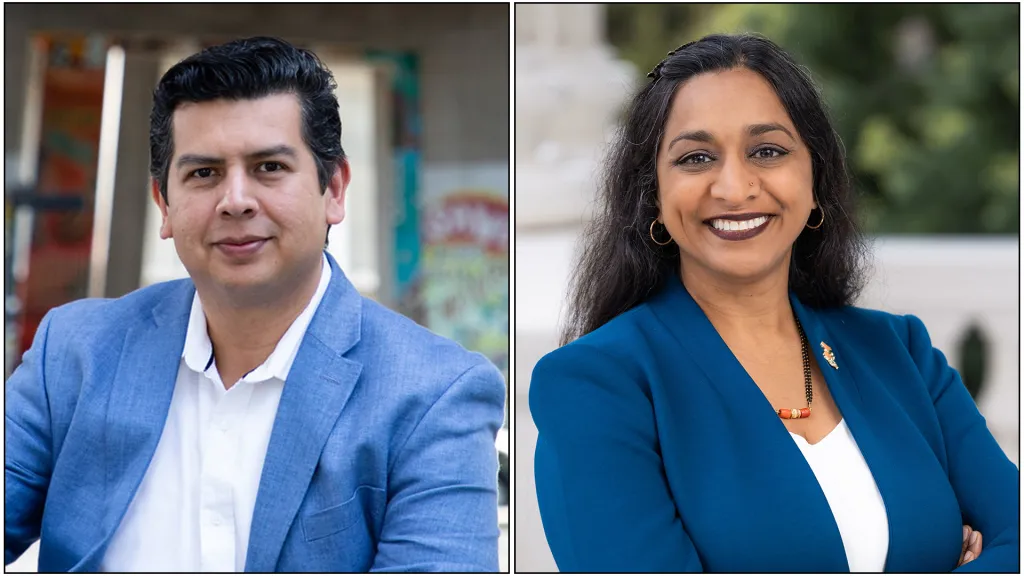
Assemblymembers David Alvarez and Darshana Patel, both Democrats, crafted and ultimately saw through the legislation, after Gov. Gavin Newsom had pushed for it.
Meanwhile, the pair brainstormed about how to improve public education. Both are former school board members. She chairs the Assembly Education Committee; he chairs the Assembly Budget Subcommittee on Education Finance. And they sit by each other.
“The speaker sat us as seatmates on the Assembly floor,” she said. “So we get many opportunities, flying up on flights, or in conversations on the floor or in conversations in committee. I sit on his committee, he sits on my committee.”
Their legislation, signed into law this month, creates a new position of education commissioner, appointed by the governor and confirmed by the Senate, that will oversee the state Department of Education. The directly elected state superintendent will be relegated to what Patel calls a “visionary” role.
The effort follows a number of attempts to accomplish something similar, beginning more than a century ago and including failed ballot measures in 1928, 1934, 1958 and 1968, according to the legislative analyst.
Both Patel and Alvarez see their overhaul as a way to improve education in the state — while opponents view the process that created it as undemocratic.
“The status quo is not working for students, and the data speaks for itself,” said Alvarez. “We had superintendent after superintendent after superintendent to talk about putting students first, and student progress — and with all that said, we haven’t seen the progress.”
Alvarez said timing was a big part of the reason this year was the year to make the changes: Both the current governor and state superintendent face term limits — so both races are open.
“Any other time, there could be this assumption that could be made that, well, one is trying to take away from the other, and it could be personality-driven,” he explained.
The effort that culminated this month began in earnest last year, and the think tank Policy Analysis for California Education (PACE) released a report in December advocating for a restructuring of the state’s education system.
Newsom began pushing for more control of the state Department of Education, too.
After Patel became chair of the education policy committee in February, she says one of the first things she did was put the governor’s proposal through a “policy pathway” that invited input.
That input, she said, helped lead to elements of the final legislation — including Senate confirmation of the new appointed commissioner, and legislative appointments to the state Board of Education.
Under the new law, the state superintendent will also serve on the state Board of Education and on the board of the state’s community college system, in addition to its university systems.
Read more WTA introduces gene testing for all players on women’s tennis tour
Like previous attempts to overhaul state education leadership, this one faced fierce opposition.
It has been openly opposed by California’s largest teachers union, the California Teachers Association, which has enjoyed unmatched influence in the state’s education system and whose endorsed candidate historically is elected superintendent.
The overhaul effort “didn’t have teacher and educator voices, or parent voices, or student voices,” said its president David Goldberg.
He believes the commissioner’s first year on the job will be bogged down by bureaucratic work. That’s because under the bill, they are supposed to “develop findings and recommendations for a second phase of education governance consolidation and streamlining” by October 2027.
“So it just becomes an absolute waste of time, rather than really focusing on what’s needed,” he said.
Also among the opposition are the two candidates for superintendent, Richard Barrera, who now leads the board of the San Diego Unified School District, and Sonja Shaw, who leads the board of a Riverside County district.
The pair agree on very little else — other than that they would still be running for superintendent even if they had known from the beginning what the job would entail.
Barrera took issue, like Goldberg, with the lack of transparency. “I don’t think that the process was done well,” he said.
But he said he believes the job’s primary role is that of an organizer and advocate, and that change in schools doesn’t happen from the top down anyway.
Shaw called the changes an assault on the state constitution and on the will of voters, pointing out that voters have rejected the changes. She criticized Newsom for going through a “back-door budget trailer bill.”
Asked if the changes to the job risked confusing voters in the middle of an election with the job on the ballot, Alvarez said, “I always feel strongly that the voters are not given enough credit.”
Nationwide, states have mixed methods of anointing their top schools chiefs. Some leaders are elected. Some are gubernatorial appointments. Some are selected by a state board of education, whose members may or may not be appointed or elected themselves.
California is one of a dwindling number of states that directly elect theirs — and because the job is enshrined in the state constitution, the superintendent will continue to be an elected position, even if it lacks all of the previous responsibilities.
Read more Council approves $3.1 million settlement for San Diego police sergeant in discrimination lawsuit