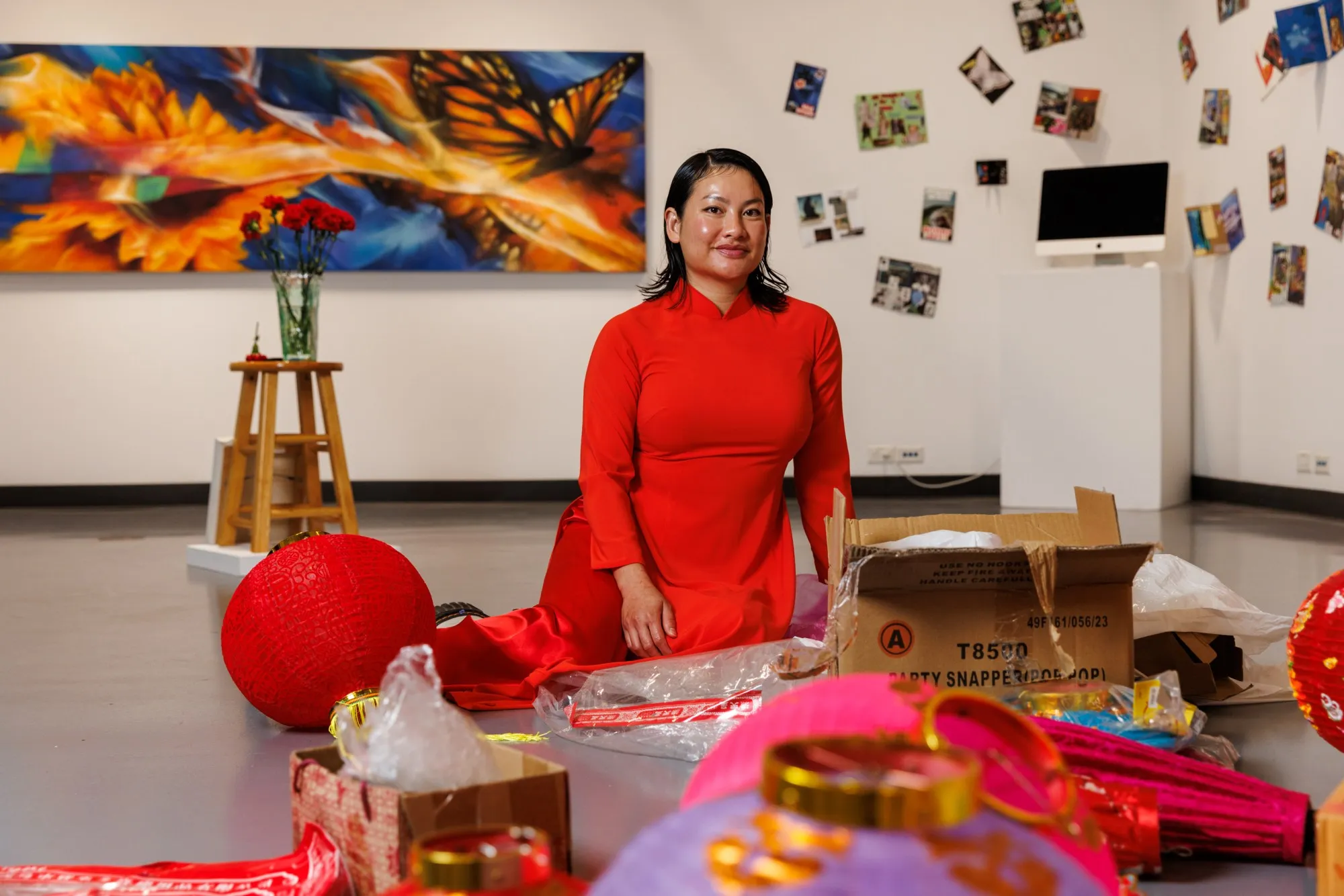
It was 2023 and the first time that artist Thao Huynh French returned to Vietnam since leaving for the United States as a 1-year-old refugee with her family. An aunt she had never met before picked her up and drove her to the home where French had been born.
Read more Cash-strapped colleges are draining their endowments to survive
“On our way there, we passed by this massive lotus flower field, and it just took my breath away. We got to actually go into it, and I just spent countless hours there, just in awe,” she says, noting that the lotus is considered Vietnam’s national flower, requiring harsh conditions that include wet, soggy, muddy ground, with lots of humidity and bugs “to become the phenomenal, showy flower that it is.”
“It’s just so ironic that I’ve always painted flowers, and then I started to connect that it’s always been my point of view, whether as background or foreground in my memory.”
“Future Flowers: Memory, Meaning, Mischief” is her solo debut exhibition, featuring paintings, installations, and archival materials that explore the history and experiences of refugees, Asian American life, and culture through the lens of her heritage. The exhibition is on display through Sept. 17 at the San Diego Mesa College Art Gallery, with an opening reception from 4 to 7 p.m. today, and a gallery tour artist talk led by French at 6 p.m. Sept. 9.
A multidisciplinary artist, she was commissioned to create two murals for Mesa College’s KUP Unity Village (a dedicated space on campus for students in Kapwa, Umoja, and Puente communities) over the summer, through her Mindful Murals organization that she runs with her husband. She used her background giving lectures and running workshops with students at UC San Diego and Cuyamaca College, to tailor that curriculum for the students at Mesa. In her social justice workshops, she helps students use their creativity to raise awareness about the issues they care about. The result at Mesa incorporated prominent elements and symbols from the students’ cultures, and a visual commentary on the things important to them, adding to the more than 400 murals Huynh French and her husband have facilitated.
Huynh French, 37, lives in Clairemont with her husband, Kolten, continuing her practice as an artist, muralist, and photographer, incorporating social justice work and public arts programming into her work. She took some time to talk about her work, her experience revisiting Vietnam and the refugee processing center in the Philippines where her family stayed before relocating to the U.S., and her goal to make the world feel safer and more beautiful through her art. (This interview has been edited for length and clarity. )
What do you recall of your own introduction to art, painting, drawing?
I kind of love that I grew up without electronics. When I look back, I was so bored and so poor. We didn’t have anything, so my first art supplies were literally blue-lined composition paper and a big pen or a pencil, and I would just use that to draw with. I was watching “Sailor Moon” and “Dragon Ball Z” at 6 every morning before school, and I would collect Pokemon cards, and I would just start replicating that. Eventually, I started drawing my own girls. I was always drawing girls in fashion dresses and things like that, and my mom wanted to do better for us, so she went to nail school, and she practiced doing nails on me. While she was practicing, she also had to learn how to do nail art because that’s what the customers would want. Those little, tiny designs ended up having so much influence in my work because now, when I look back, I’m like, ‘Oh, that’s where those flowers that look kind of like abstract and flaming come from, with lots of movement and curves.’ That’s where it comes from, so I would say that also influences my work pretty heavily now. And, if you come to the (opening reception of “Future Flowers”), my mom’s going to do a quick pop-up doing her nail art.
In the materials for the exhibition, you’re quoted as saying, “Please remember to…create thoughtfully, to take care of each other, to make something beautiful—it can shift human behavior.” What are some examples from your own life of how this kind of thoughtful creation—whether by you or by other artists—has shifted your own behavior?
At first, when I started painting murals, I wanted to create change through my creation, and it started out with school murals where I could enrich those spaces with my husband. We started Mindful Murals as a passion project, and it’s sort of evolved into something beyond what we could ever even imagine, which is to help kids have more beautiful spaces, more joyful spaces where they could feel safe and interact. I would say we’re creating quite a bit of impact, and even maybe planting some future artist seeds, so to speak.
I want to create art that would interact with the community in a way where it helps that community, but also sparks systemic change. This current project that I’m working on, I want to be able to translate that into beautiful paintings, whether they’re on canvas or on the streets. That storytelling element is always going to be crucial, so I want to be thoughtful around that, as well, because I’m not just putting a mural up for the sake of putting something up, but I want to be able to bring people in to learn more about what the content is. Even teaching people about untold history because I truly do believe that the people who control the narrative hold power, and we’re seeing how that’s being weaponized in real time right now, especially at a time where immigrants and refugees are political scapegoats. Our practice is shifting right now into advocating for refugees and immigrants. Being a refugee myself, that’s very personal for me.
Your “Future Flowers” exhibition includes a section about the 50th anniversary of the fall of Saigon, including photos and documents you saved from a refugee processing center in the Philippines in 2025, which is where you and your family lived before coming to the United States? Are you comfortable talking about that time and experience?
Read more San Diego shouldn’t guess when it comes to homelessness funding, new report says
The exhibition is going to house a lot of that, but the linocuts that I produced, they were reflections of the fall of Saigon, and those aren’t actually in the show anymore because we ran out of space. I got so ambitious.
My mom thinks I was 1 year old when we left Vietnam, but she doesn’t know for sure, and we lived at the camp for about six months. She applied for refugee status right after the Amerasian Homecoming Act was created (in 1987, this legislation allowed people born in Vietnam between 1962 and 1976, and whose fathers were U.S. citizens, to move to the U.S. with their children and immediate family members). She told me that we took the bus from Cam Ranh Bay, where I was born, to Saigon. She went to the office where they were processing all of this, and I said, “Well, what did you have to show them? I mean, I can’t imagine you having much,” and she said, “I just showed them my face.” My mom said that they were able to prove that my grandmother assisted the U.S. military through the airport where she was working as a kind of caretaker. So, it was my two older twin sisters, me, my mom and my grandma, and my biological father.
We were one of the last big waves of refugees to be processed at the camp at Bajaan, Philippines, which is also another crazy story because the processing center opened in 1980 to take in Southeast Asian refugees. It was created by President (Ferdinand) Marcos at the time because he wanted to look like a world savior while he was a dictator, and also ruling under martial law, so there was a lot of human violations happening at the time and he knew that the walls were closing in. He was going to be held accountable, but because he created his camp in collaboration with like the U.S. to facilitate the transportation of refugees, he was basically never held accountable for his crimes. My friend who took me to the camp for me to do documentation of this place, told me that Marcos stole the land from indigenous people and displaced them to take in external refugees. So, he actually created internal refugees to take in external refugees to look like a savior on a world stage, and it worked.
(In “The Philippine Refugee Processing Center: The Relational Displacements of Vietnamese Refugees and the Indigenous Aetas,” written by Yen Le Espiritu and J.A. Ruanto-Ramirez and published in “Verge: Studies in Global Asias” in 2020, the authors note “a largely hidden fact of the Marcos government’s ‘donation’ of land for the construction of the [Philippine Refugee Processing Center is ]: the eviction and relocation of the Aetas, members of the Magbukún tribe of Negritos believed to be the first inhabitants of Morong, Bataan. … Using the lens of critical refugee studies, it shows how the Marcos government’s motivation to host Vietnamese refugees in the 1980s derives from its need to project itself as a liberal democracy to divert attention away from its much-maligned martial law policies.”
A 1986 article from the Los Angeles Times about Marcos conceding power and being granted U.S. asylum, says that he was an exception to the rule against political asylum for deposed leaders accused of human rights violations ” in part because he has always supported U.S. foreign policy.”)
After the refugee camp, we stopped in Fargo, North Dakota, which was a huge mistake. Apparently, it was way too cold, so my mom put us on a bus and we came to Fresno, where I lived until 20 years old. Then, I was visiting my sister, who was living in San Diego at the time, and my purse got stolen and I was stranded. I didn’t have a car, I didn’t have any money to get home, so I ended up just staying in San Diego (in 2010).
Can you tell us about the mural project with Mesa College students you’ve recently completed? What did this work entail?
They wanted to get two murals that really represent what the student center does for their students, where they’re trying to create a place of belonging for them, a space where they feel empowered and have resources to really help them navigate the college experience. When I came in, they asked me to be the guest artist, the lecturer. The interactive component was crucial, so we had the workshop that I was already doing with UCSD and Cuyamaca students were undocumented. I was able to take my curriculum and customize it for the Mesa College students. They’re trusting me to create two mural concepts from this experience, so we’re going to create a ‘zine, I’m going to talk about social justice and art, and how art has been used historically as a form of social justice. I talked about Gordon Parks, who’s one of my favorite photographers; Kara Walker, also another great visual artist; we’re talking about Banksy, people like that. There’s institutional photography, people who are in visual arts, and also in street art, so I wanted to help them understand how art could be used in many mediums as a form of protest, a form of dialog with the masses. After that, we created a ‘zine together, and sent it to a print shop to publish. That was me being able to give them a way to express important ideas into self-published media, so they could feel like it isn’t out of reach for them, that this is something they could do on their own, even after this. After that, we brainstormed ideas on what that mural could look like, what they envisioned, what they wanted to feel when they looked at it, what colors did they see, what memory was sparked for them.
I also took them on a mural tour and a food tour in Little Saigon, which is one of my favorite things to do because most people don’t know that it’s even there. I got to give them a crash course on the history, where to get the best egg rolls, where to get sugar cane juice, the gentrification that the people have experienced, and the cultural exploitation, as well. When I was living in City Heights and starting out as an artist, there were business associations that were taking advantage of me because I didn’t have a name yet and I was a starving artist at the time, so I felt and experienced firsthand a lot of harm in that area; so, I gave them a rundown on what happened and how it could be extremely dehumanizing to create cultural tourism unthoughtfully, not working with any Vietnamese artists, not really advocating for the people who live there.
We talked about everything, and then I translated that into two different murals. We talked about having a future, so I wanted to paint a student graduating. There are some photos that I saw in the KUP center of them just being in the space together and connecting, so I took snapshots of that. There are hands offering plumeria flowers to a student; the hummingbird is a really important symbol in Aztec culture, often associated with the supreme god, Huitzilopochtli, symbolizing strength and resilience. Hummingbirds have a very similar symbolism with butterflies, too, where they represent an ancestral spirit. Then, the red-tailed hawk is to honor the indigenous land, the Kamehameha people; the butterfly is also representative of ancestral spirit. I wanted to give it a lot of movement because the painting itself is called “Flow of Life,” so it’s connecting different people from different walks of life. The sky and the water are represented; the fabric on the left-hand side is a Kente cloth from Ghana; the koi fish remind me of my childhood; the sunflowers were chosen as a flower that means the future.
Read more Iran fires on its Gulf neighbors after US military strikes Iran after a monthlong lull