





Randal Tanner had been homeless and estranged from his family for decades, drifting from place to place.
Read more Another large intake of dogs leaves no shelter space at San Diego Humane Society’s main campus
He found odd jobs to complement the disability payments he collected after getting a medical discharge from the military. He managed to buy an old GMC Safari van he soon made his home. It broke down along Piper Ranch Road in Otay Mesa. He fell behind on its registration. But he kept living inside.
Tanner, then 58, wasn’t home when Deputy Donald Glover first approached the van on May 31, 2019, San Diego Sheriff’s Office records show.
The deputy noticed the van was illegally parked more than 18 inches from the curb and was more than six months out of registration. He called a tow truck to impound it.
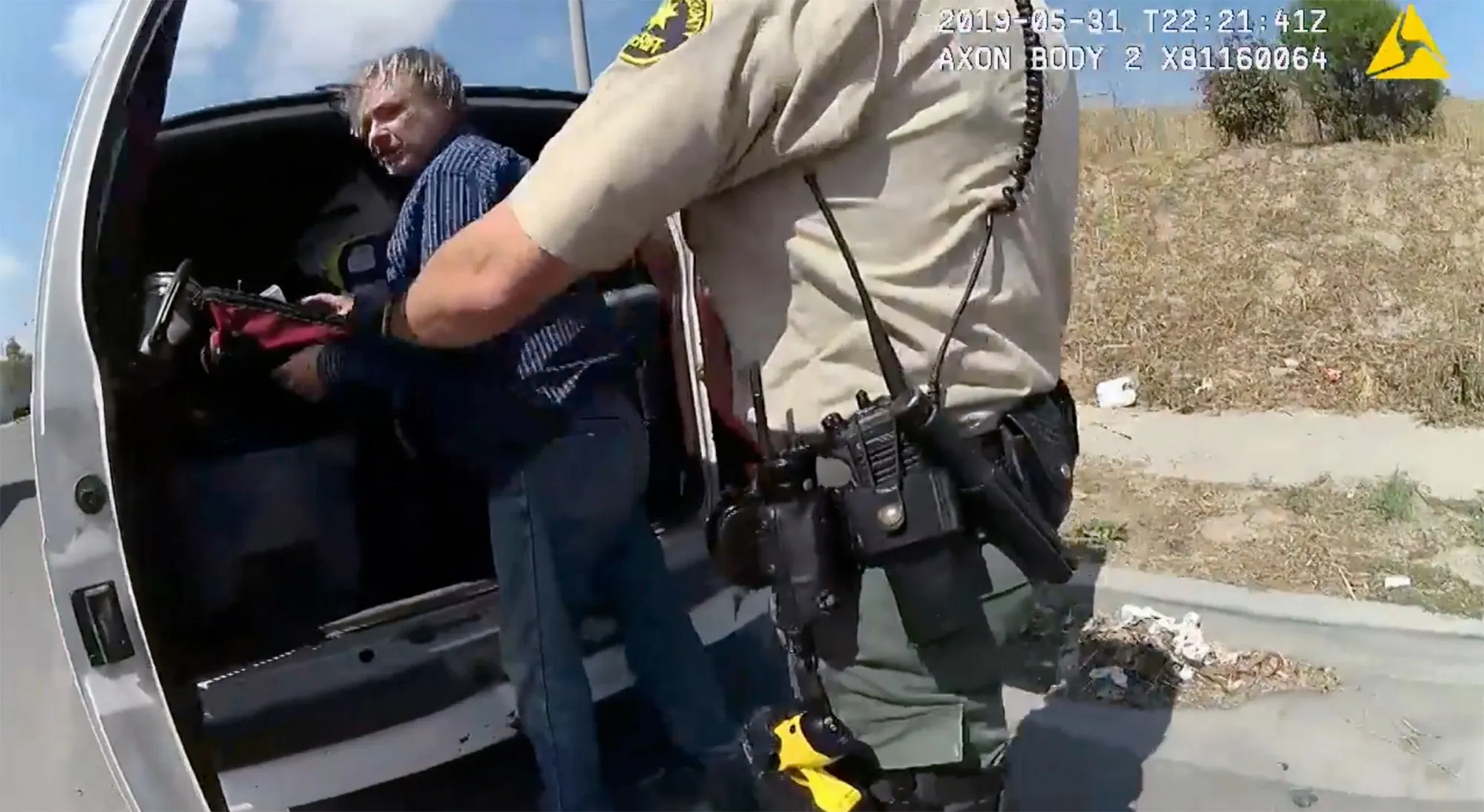
Tanner approached the van and pleaded with Glover not to tow his home. When Glover declined, Tanner began unloading the van, tossing his belongings from it into a wagon — and throwing a piece of rubber toward the deputy’s legs.
Glover and his partner took down Tanner violently, hitting his head on the curb; the deputies pinned him to the ground with pressure on his back as they handcuffed him.
“I can’t move, I’m paralyzed,” Tanner shouted, according to body-worn camera footage later released by the Sheriff’s Office.
Deputies knew Tanner had been injured but did not believe he was immobilized.
“I saw blood begin to pool up under his head,” Glover wrote in his report. “I advised Sheriff’s Dispatch of the use of force and requested Emergency Medical Services to evaluate Randal for his head injury.
“Due to his injury being a head injury and his statement that he was paralyzed, Randal was transported to Scripps Mercy Hospital for further evaluation.”
Tanner was never charged with a crime related to his encounter with deputies.
He also never walked again. Instead, Tanner spent the next four years in rehabilitative and skilled nursing facilities, unable to move his legs and barely able to move his arms.
Tanner died on Feb. 12, 2023.
“He developed quadriplegia, cervical spinal cord contusion injury, cervical myelopathy and neurogenic shock secondary to an altercation with police on May 31, 2019,” the autopsy said.
“The decedent had resided in multiple care facilities since the incident,” it added. “He reportedly remained wheelchair bound and retained some gross movement of the arms but was unable to use his hands.”
The medical examiner’s findings further show that Tanner suffered physical repercussions from that 2019 arrest for the rest of his life.
By his final days nearly four years later, Tanner was complaining of chest and stomach pains and vomiting, the report said. He was intubated and suffered from septic shock. Confronting a grim prognosis, his family agreed to move him to comfort care.
His cause of death was small bowel ischemia and necrosis, a condition in which blood flow to the small intestine drops dangerously low and the nearby tissue begins to die.
The manner of death, the medical examiner , was homicide.
‘No new evidence’
Civilian oversight investigators first began looking into the case back in 2019, just months after the altercation.
In 2020, the Citizens’ Law Enforcement Review Board, or CLERB, concluded that Glover’s actions were justified. It also decided allegations of excessive force used by the other deputy, Trissa Taguacta, were unfounded.
Both Glover and Taguacta would later leave the San Diego Sheriff’s Office. Taguacta retired in 2023, and Glover left in 2024, according to public pension data.
CLERB investigators reopened the Tanner case in 2024, one year after the Medical Examiner’s Office ruled that the death was the result of a homicide.
But this week, ahead of a Thursday board meeting where the case is set to be discussed, the executive officer said the secondary review found there was nothing more to examine.
“Although CLERB opened this case out of an abundance of caution, it was determined there was no new evidence regarding the original complaint of excessive force,” said Brett Kalina, the former FBI agent who now runs the oversight board.
“Nor did the ME’s report produce any new evidence of the use of force, and therefore CLERB cannot revisit the original findings,” he said by email. “Without new and substantial evidence of the use of force, CLERB does not have jurisdiction.”
Kalina said the secondary review took until now to complete due to delays in learning about the homicide ruling and securing related documents.
“CLERB was notified of the death in mid-2024,” he said. “It took some time to collect all records to determine if there was any new evidence.”
The San Diego County Medical Examiner’s Office has issued homicide findingsat least twice before in the deaths of people who died in jail or while being taken into custody — once in the 2022 case of Lonnie Rupard and again in the 2023 death of Keith Bach. The families of both men filed lawsuits against San Diego County.
The Sheriff’s Office, which has a history of jail deaths stretching over several decades, did not immediately respond to a request for comment on the CLERB findings.
The former executive officer of the Citizens’ Law Enforcement Review Board could not disagree with Kalina more strongly.
Paul Parker, who oversaw the civilian oversight board for four-plus years over two terms before quitting in frustration in 2024, said the board is obligated to open a new investigation as a result of Tanner’s death.
Read more Six who died in separate San Diego County crashes identified
Parker said the coroner’s finding that “blunt force injuries of the head and neck” contributed all but requires it.
“Even though the 2019 case found no misconduct and the involved deputies are no longer employed, there is clearly a public interest in knowing exactly what occurred,” he said. “It should be reconsidered and included in a comprehensive CLERB investigation.”
Parker, who also is a former pathologist and Los Angeles police officer, criticized the way the Tanner case is presented in its , which he said appears to downplay the gravity of the situation.
“It should have (been) made very clear that the ‘medical cause and manner of death’ clearly indicates that the ‘remote blunt force injuries to the head and neck’ that contributed to the death were sustained during Tanner’s interaction with deputies,” he said.
“It should also have indicated that it was solely because of these injuries and interaction that the manner was listed as homicide.”
San Diego attorney Julia Yoo has read scores of autopsy reports and CLERB findings over her many years defending people who died or suffered life-altering injuries during encounters with law enforcement.
She reviewed the Tanner records at the request of The San Diego Union-Tribune and said she grew more outraged as she read.
“It is unimaginable that deputies got on the back of an unarmed man and inflicted such force on his spine to render him a quadriplegic, especially over expired car registration,” she said. “This case also highlights the importance of proper, timely independent investigation.”
Yoo, who has won millions of dollars in legal settlements for victims of abuse and neglect by local law enforcement officers, also was mystified that the review board found no misconduct in the 2019 case and that the subsequent death review took so long.
“Mr. Tanner deserved justice seven years ago,” she said. “Instead, he became just another statistic of yet another homicide at the hands of San Diego sheriff’s deputies.”
The District Attorney’s Office is not yet prepared to pass on the Tanner case.
A spokesperson for District Attorney Summer Stephan declined to comment on the Medical Examiner’s Office homicide finding but did say the office is in the process of reviewing the case for potential criminal charges.
Tanner was born in San Jose in 1961, the middle child of three sons born to a dysfunctional family that moved around and eventually split up, according to Richard Tanner, Randal’s older brother.
The retired electrical engineer said his younger brother lacked interpersonal skills and harbored a deep distrust of people due to his childhood.
The family moved to Oregon, but their parents divorced, Richard said. Randal joined the military — he wasn’t sure which branch — but received a medical discharge before finishing basic training due to his mental illness.
“If he had been born 20 or 30 years later, there might have been all kinds of treatment available to him,” Richard said in a telephone interview from San Jose.
Randal bounced around for decades, keeping to himself and living a vagabond lifestyle due to his mental issues and general disillusionment, his brother said. He traveled to Nevada, to Florida and primarily in Southern California.
San Diego County court records show Randal Tanner was arrested in April 2016 on suspicion of illegal possession of ammunition and possession of concentrated cannabis. He was arrested again the following month on misdemeanor charges of cannabis possession and unlawful lodging.
It was not immediately clear what punishment Tanner received as a result of those charges.
But Richard Tanner said his brother’s distrust of society was on full display in the body-worn camera footage of Randal’s encounter with sheriff’s deputies in Otay Mesa in 2019.
The video — which was posted on an obscure corner of the Sheriff’s Office website in 2022 along with copies of the initial reports — shows Randal acting disturbed as Glover proceeded with the towing of his van.
He can be seen tumbling to the ground and calling “I need a doctor, I need a doctor” several times after striking his head and lying prone in the street.
After his death, Randal’s brain and spinal cord were sent to an outside lab for a secondary consultation, according to the medical examiner’s report. That review “demonstrated remote traumatic injury to the mid-cervical spinal cord” and a host of other deficiencies, the report said.
Richard Tanner said his brother consulted several lawyers after he was paralyzed, but none would agree to pursue the case.
“Randy fell through the cracks his entire life, from conception to his grave and beyond,” the older brother said. “He spent his whole life treading on the edges of society and always seemed to fall through every crack there was.”
He would continue to do so in death.
Richard Tanner said he never received his brother’s remains from San Diego County after Randal was cremated. He also never got his laptop, personal diaries or other possessions.
CLERB will convene its regular monthly meeting at 5:30 p.m. Thursday. The meeting will be open to the public and broadcast online.
Read more Riders increasing on Amtrak, Coaster trains in San Diego County, report shows