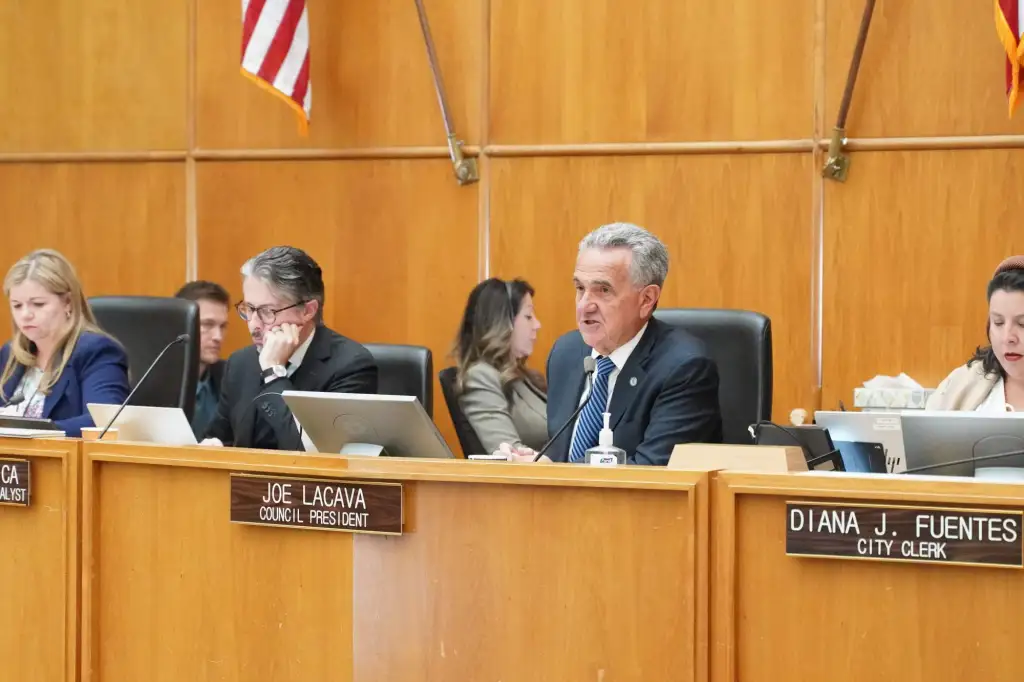









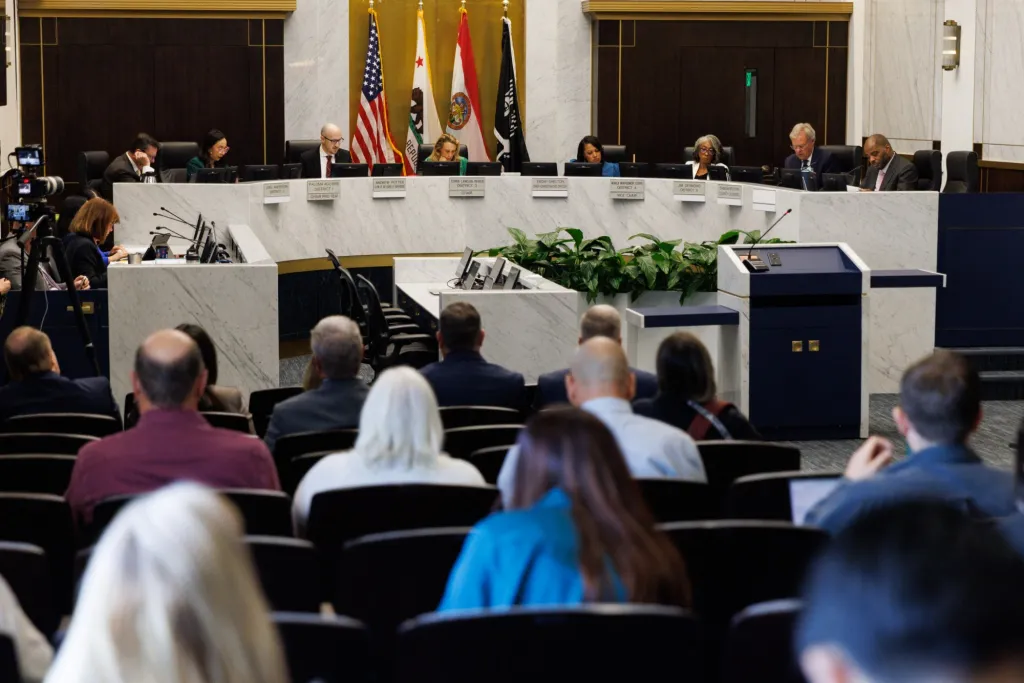
A San Diego County budget season marked by uncertainty and the impact of the Trump administration culminated on Thursday with supervisors unanimously inking a $9.2 billion spending package that taps millions in reserves to bolster embattled social services.
Read more Former executive sues Meta over attempts to ‘silence’ her memoir, ‘Careless People’
The budget boosts spending for core parts of county government such as social services, behavioral health and public safety, as well as capital projects, which faced steep cuts in last year’s budget.
It also taps $95 million in one-time reserves for projects in the Tijuana River Valley, housing and social safety-net programs such as food assistance and Medicaid, which faced a considerable federal overhaul of rules and eligibility last year.
Democrats defended their management of county finances, saying the package balances core services while taking a more activist role by investing millions in new and existing safety-net programs.
Republicans feel differently, warning the new spending could push the county into a fiscal crisis if it isn’t curbed in the long term.
A recent report from the San Diego County Taxpayers Association, a nonpartisan watchdog group, also sounded the alarm on the county’s budget, cautioning about the expansion of the county’s workforce, cuts to infrastructure projects and an overreliance on federal and state funds.
On Thursday, Democratic Supervisor Monica Montgomery Steppe argued that for too long the county has hoarded hundreds of millions of dollars that were better deployed in the community.
When supervisors voted to spend more of their reserves last year, the reserve fund eligible to be spent stood at about $382 million.
“This is not a hedge fund,” Montgomery Steppe said. “This is a government entity that is mandated to take care of our most vulnerable communities.”
Republican Supervisor Jim Desmond countered that the reserves would be better used accruing interest and that the county has become over-reliant on them.
“These are valuable reserve funds,” Desmond said. “This money’s just not going to be there once it’s spent.”
Top of mind for Democrats are federal changes to the Supplemental Nutrition Assistance Program, known as SNAP or food stamps, as well as Medicaid, the federal health insurance program for low-income people, administered as Medi-Cal in California.
Historically, those programs have been funded by the federal government and administered in part by counties.
Under Republican legislation nicknamed the “Big Beautiful Bill” and passed by Congress last summer, certain SNAP and Medi-Cal recipients are now subject to new eligibility checks and work requirements.
The county plans to hire more than a hundred new staff members to help with biannual eligibility checks for food stamps that took effect at the beginning of June. The county estimates the work requirements could cause nearly 94,000 people to lose their benefits.
Similar eligibility checks and work requirements begin for Medi-Cal recipients at the beginning of 2027, and the budget has set aside $44.7 million in one-time funds for the new administrative burden.
The existing re-enrollment process for Medi-Cal already makes people lapse in their coverage if they forget to file the paperwork, and there’s fear that new eligibility checks will make even more people lose coverage, said Dr. Manisha Sharma, a San Diego community physician who works with Medi-Cal recipients.
Read more Oceanside to place half-cent sales tax measure on Nov. 3 ballot
Sharma pointed to a recent patient of hers, a 79-year-old woman who had to have shoulder surgery postponed because she didn’t reenroll in Medi-Cal at the beginning of the year.
“All of a sudden there’s this new administrative piece that says ‘prove to me that you’re poor,’” Sharma said. “Can you imagine that happening twice a year, and on a massive scale too?”
Ahead of the new regulations, in the San Diego region, according to county data.
Over the last year, food stamp enrollment fell from about 401,000 recipients to 369,000, an 8% drop. For Medi-Cal, enrollment has gone down from 878,400 people to about 804,500, also an 8% drop.
Up to 13,000 food stamp recipients in the county are expected to lose their benefits under new restrictions for many immigrants that took effect in April. California also froze new Medi-Cal enrollment for many immigrants at the beginning of this year.
The future of social services at the county is now at the mercy of how the finances interact with rules set by the federal government.
County officials have vowed to use their financial resources to keep people on benefits. But the one-time funding they’re tapping can’t fund new staffers and administrative costs in perpetuity.
With the budget passed, county voters now get to decide the future of the county’s budget through a half-cent sales tax hike that will appear on November’s ballot.
The coalition behind the ballot measure, made up of labor unions and nonprofit leaders, anticipate it will bring in $360 million in new revenue for the county in its first year. Part of that will go to the administration of social services such as food stamps and Medi-Cal.
Another flashpoint in Thursday’s budget meeting was the county’s Immigrant Legal Defense Program, which provides free representation to detained immigrants and unaccompanied minors in removal proceedings.
Launched in 2021, the program’s budget remained under $5 million. But a county report from March indicated that the program could face a funding shortfall due to increased immigration detentions under the Trump administration.
Since Donald Trump returned to office, the number of people detained at the Otay Mesa immigration detention center has spiked, according to data from Immigration and Customs Enforcement. In 2022, the facility’s average daily population was 466 people. In 2025, it was 1,390.
In response to the increasing legal needs of people in the facility, the county hiked spending on its legal program to $13.2 million in the new budget, with $5.5 million of that coming from one-time funds.
“This budget also protects due process,” Supervisor Terra Lawson-Remer said on Thursday. “I believe we should live in a country where the government cannot pull you off the street, lock you up away from your family, and force you to face deportation alone simply because you cannot afford an attorney.”
Desmond voiced his opposition to allocating more money to the program.
“This is not what local San Diego County folks should be paying for,” Desmond said.
Read more Egg-throwing attacks on LGBTQ businesses in Hillcrest investigated as hate crime