



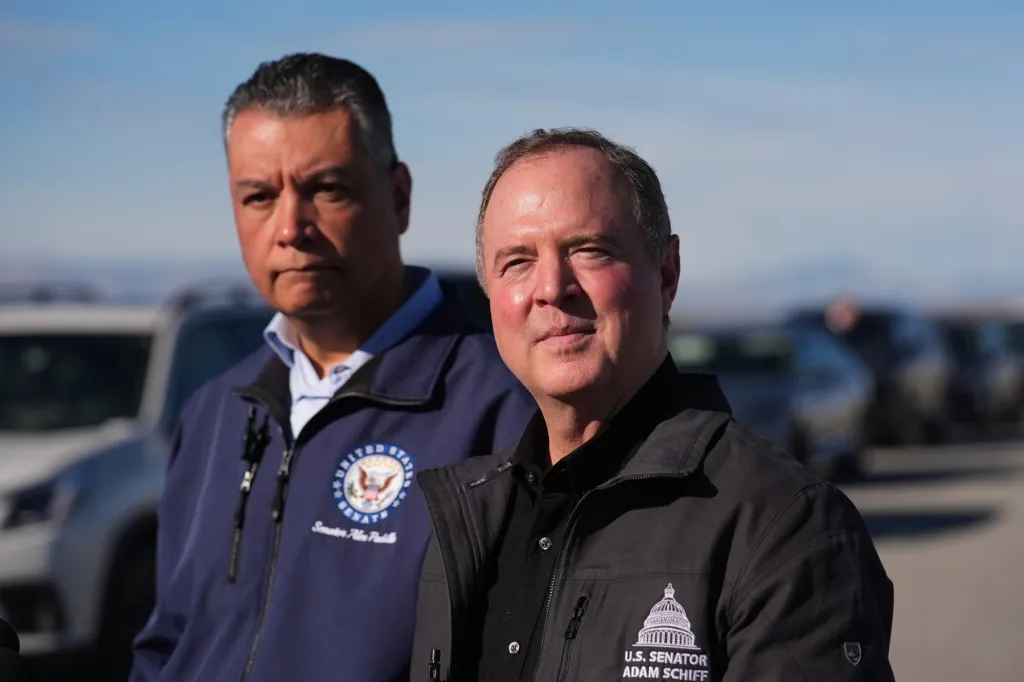
California Sens. Alex Padilla and Adam Schiff have recently introduced legislation to improve election security and restrict federal involvement in what legally and historically have been state-run operations.
The chances of the bills passing don’t seem great. The underlying rationale for the bills is to stop President Donald Trump from limiting voter access, undermining the election process and perhaps stealing elections this November to protect Republican majorities in the House and Senate.
Good luck finding the necessary GOP votes.
As much as they would like legislative success, the overriding goal for Schiff, Padilla and several of their Democratic colleagues appears to be hammering home to the public what Trump has been doing for years: attempting to manipulate election outcomes to his liking, regardless of public sentiment or how votes are cast.
“We’re talking about redistricting fights, we’ve been talking about voter purges, now trying to access voter rolls, everybody’s personal information now, (and now) elimination of vote by mail,” Padilla, ranking member of the Senate Committee on Rules and Administration, which oversees federal elections, said last week on MS NOW.
“We need the American public to know, hey, we’re on it. We’re pushing back, fighting back legislatively, legally, by any means necessary to protect people’s access to the ballot.”
For at least a decade, Trump has made empty claims that there has been widespread election fraud. No proof of that has been unearthed in numerous court cases, recounts, in-depth reporting and even a review by his own special task force during his first term in the White House.
Yet he’s taken bolder steps down this path during his second term. He’s had federal officials raid election offices in Georgia and subpoena election records in Arizona, issued an executive order aimed at preventing the U.S. Postal Service from delivering mail ballots in states that refuse to turn over voter rolls to the administration, and involved national intelligence agencies and the Department of Homeland Security in election oversight.
He tried to overturn his 2020 re-election defeat, inspiring the violent assault on the U.S. Capitol on Jan. 6, 2021. Given all his recent moves, there’s plenty of concern he’ll try again to upend elections that don’t go his way.
He recently boasted of asking federal prosecutors to investigate the June 2 California primary, with the goal of boosting GOP gubernatorial candidate Steve Hilton.
Trump has further raised the prospect of armed immigration agents and National Guard units going to polling places and election facilities in November.
Acting Attorney General Todd Blanche and Department of Homeland Security Secretary Markwayne Mullin signaled support for such actions to prevent noncitizens from casting ballots, despite little evidence of this happening.
Democrats fear law enforcement officers could not only intimidate legitimate voters from casting ballots but otherwise tamper with the election process.
“The only reason why my officers would be there is if there was a specific threat for them to be there, not for intimidation,” said Mullin, according to The Hill. “There will be a reason for us to be there, and it’ll be known why we’re there.”
Earlier this year, Schiff flatly said that Trump “fully intends to try to subvert the elections.”
“He’s basically telling us he intends to interfere in this upcoming election,” Schiff said on ABC’s “This Week.”
Some of the executive branch moves appear to be illegal and have been blocked in court, at least for now.
Read more The 2 earthquakes that struck Venezuela are known as a ‘doublet.’ Here’s how they happen
Then there are the laws in Republican states that make it harder for people to vote by restricting eligibility and mail ballots, and the extraordinary congressional redistricting binge launched by Trump that, nationally, appears to favor the GOP.
Trump upped the ante by abruptly canceling a signing ceremony for a broadly supported bipartisan housing bill unless Congress passes the Save America Act, which would require proof of citizenship to vote in federal elections, restrict mail voting and impose new restrictions on transgender Americans, among other provisions, according to The Washington Post. Senate GOP leaders have said repeatedly the votes are not there.
Democrats have several bills seeking to counter the GOP moves. Last week, Sen. Elissa Slotkin, D-Mich., was joined by Padilla and others in introducing the Protect Our Polls Act, which would require congressional approval before the president could deploy uniformed military or federal law enforcement to polling places.
Schiff and Padilla introduced the State and Local Election Security Act to provide up to $10 billion to improve election security and efficiency, including countering cyberattacks. Padilla also has submitted the Absentee and Mail Voter Protection Act.
The senators have emphasized the Trump administration’s dismantling of federal election security efforts and the disinformation attacks on California’s vote-counting process in the recent primary election.
Once again, California’s frustratingly long count has given rise to conspiracy talk from Trump and others. There’s no evidence of skullduggery, of course, and California officials continue to say they will stand by the system because it provides expanded opportunities for people to vote and ensures accuracy.
Still, there’s growing criticism of the slow vote count, even from those who reject the conspiracy theories, including The New York Times editorial board.
Paul Mitchell, Democratic redistricting expert, wrote on social media that one expensive proposal to count nearly all votes within 48 hours of Election Day “would be disenfranchising tens or hundreds of thousands of voters.
“For what? To convince people who still insist that the 2020 election was stolen and the FBI was guiding people into the Capitol on Jan 6? To stop Twitter trolls, some of whom we have found are getting paid to push disinformation?”
He said more can be done to make the counting more efficient in the huge state, “but I think we can’t let conspiracy theorists or the loudest disingenuous actors online guide our policy choices” — who likely wouldn’t be appeased regardless of any changes.
Senators and election experts have held forums and written commentaries not just about the threats to elections, but what can be done about them.
To prevent troops from moving in, they say lawyers would need to prepare to file legal action in advance, given that Election Day court orders likely would be too late to prevent deployments. Nonpartisan groups should be organized to monitor the election, giving early warnings of brewing intimidation or violence, while also debunking misinformation with real-time fact-checking.
Election systems need to be transparent, and the news media also must immediately report any disruption, being careful to distinguish apparent intentional action from routine election glitches.
Ideally, partisans should work hard to mobilize their voters in an effort to give favored candidates substantial victory margins that would be tough to dispute.
Read more The man who set a Virginia city council member on fire gets 40 years in prison
And voting early couldn’t hurt.