







North County health care changed significantly Wednesday, with two key partnerships finally taking effect.
Read more Photos: Navy Band Southwest’s Wind Ensemble perform
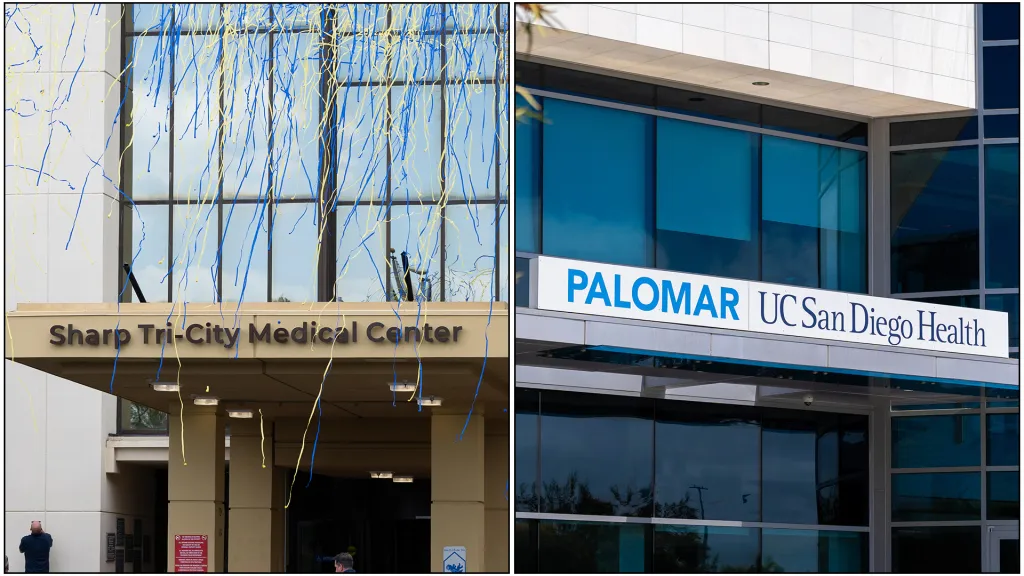
Just before noon, a crowd gathered outside the front entrance of Tri-City Medical Center in Oceanside, with hospital director and board chair Tracy Younger unable to contain her excitement.
“I’ve always wanted to do this: It’s official!” Younger said, commemorating Tri-City’s formal merger with Sharp HealthCare. Technically a 30-year lease, the deal brings financial stability to an organization that always stood alone, overseen by elected community members, since it opened in July 1961.
Younger’s jubilant declaration brought a massive round of cheers. It was a smaller group than cheered Monday when the new board of the Palomar UCSD Health Authority unanimously approved the documents that finished a deal between those two organizations. While signage for “Palomar UC San Diego Health” began appearing on the organization’s Escondido medical campus Wednesday afternoon, and an employee town hall answered questions from employees, legal teams were still working to iron out technical contracting details of the complicated deal.
During Monday’s meeting, Diane Hansen, Palomar’s chief executive officer, expressed her excitement that a long journey toward partnership had finally arrived at its destination.
“I can’t wait for us to announce to the world that July 1st is live and here we are, and we’re a new entity,” Hansen said. “All of the work that’s going to go on over the next several months, over the next year, two years, three years, I think we have a great foundation to make it successful.”
Both Palomar and Tri-City are public health care districts, operating independently through decades of consolidation in the health care marketplace that increasingly favors large organizations. While both organizations have flirted with affiliations for decades, severe budget difficulties that caused elimination of services forced deals long delayed to finally materialize.
Both collaborations call for modernization, especially around electronic patient health records and core services. With backup from larger partners, Palomar and Tri-City hope to restore shuttered services and expand into new areas, with cancer care, a service that is increasingly in demand in an aging population, at the top of the list in both operations.
Voters had the final say on Tri-City’s collaboration with Sharp, with nearly 93% of ballots cast in favor of transferring all of the hospital’s assets and liabilities to the region’s largest medical provider for the next three decades. Sharp has committed to investing at least $100 million into the facility, and that work, officials said during Wednesday’s celebration, has already started.
Scott Evans, Sharp’s executive vice president of hospital operations and chief strategy officer for health care, said that renovation work in the hospital’s currently closed maternity unit has already begun. The goal, he said, is to resume delivering babies at Tri-City this year.
Sharp plans to follow the same strategy it has used with labor and delivery departments at Sharp Grossmont Hospital in La Mesa and Sharp Chula Vista Medical Center, renaming them as extensions of its Sharp Mary Birch Hospital for Women and Newborns, a brand that carries significant weight throughout San Diego County.
“We’ve expanded the Sharp Mary Birch brand to all of our facilities that deliver babies, and so we’re taking that strength, that confidence, and bringing it here,” Evans said.
While he said that the highest-risk pregnancies, those where birth occurs as early as 24 weeks, would still travel south to San Diego for delivery in the main facility adjacent to Sharp Memorial Hospital, anything at 36 weeks gestation or later would be handled at Tri-City if families choose to stay up north.
It will be Sharp’s task, then, to convince expectant mothers that the Mary Birch-branded unit at Tri-City delivers an equivalent experience to what they would experience down south. Evans said that much work is underway to make units operate with the same quality regardless of location.
Read more New autopsy of a baby killed by police in Mississippi deepens outrage
“From our perspective, it’s literally the same clinical protocols, same review process, same scrutiny regarding patient care,” Evans said.
Cancer care is expected to be the other immediate service addition. A vacant and never-used medical office building on the Tri-City campus is being studied as the home of an outpatient cancer clinic offering a range of services from medication infusion to radiation therapy.
When might this service begin? Evans said that planning is not quite as far along as is the case for maternity.
“I don’t have a time frame on it yet, because we haven’t got back all of the components that are going to be in there,” Evans said. “We’re working with a consultant to really develop what the program looks like, and we expect to get that information back, honestly, in a few weeks, and from there we would develop a timeline.”
While the Sharp-Tri-City deal has the Oceanside hospital joining Sharp’s overall health care system, one that already includes medical centers in San Diego, Chula Vista, Coronado and La Mesa, the Palomar-UCSD deal is very different.
Palomar’s facilities in Escondido and Poway, and its affiliated medical groups, will continue to operate independently of UC San Diego Health but will now be run by a new board of directors in a legal structure called a joint powers authority. Both parties are transferring significant assets, with Palomar contributing its Poway campus and 15% of its assets on Citracado Parkway in Escondido. UC San Diego has already loaned Palomar $40 million to help it cope with ongoing financial difficulties, and documents show it will contribute an additional $160 million to the JPA for a wide range of improvements. Like Sharp on the coast, UCSD is eager to extend its cancer services into North County.
In an interview this week, Patricia Maysent, chief executive officer of UC San Diego Health, said that three medical oncologists have already been recruited to begin working at Palomar’s existing oncology center in Escondido. Likewise, plans are underway to increase the amount of cardiothoracic surgery performed at Palomar facilities.
“They’re ready to go, I think probably in August,” Maysent said.
Unlike the Sharp-Tri-City situation, Palomar facilities will not automatically become part of UC San Diego Health’s facility network, which includes hospitals in La Jolla, Hillcrest and the College Area of San Diego. But there will be a name change. Instead of operating as Palomar Health, the new moniker will be Palomar UC San Diego.
The addition of UC San Diego’s name to signage signifies the university health system’s role in management rather than its connection to existing branded providers such as UC San Diego Health Medical Group.
“If you’re in our faculty practice, you’re going to continue to get care just like you always have,” Maysent said.
As new services are added at Palomar, some UCSD patients will be referred to Palomar. Likewise, the executive added, UCSD is exploring the possibility of Palomar receiving federal graduate school medical education funding, which would allow closer work with the UC San Diego School of Medicine.
UCSD plans to build out two partially-empty floors at Palomar Medical Center Escondido, and Maysent said that the exact services that will be placed in those areas have not been decided yet. Over the coming three years, she said, additional services will end up cementing Palomar as a significant source of services for university health system patients.
“We’re getting a place to grow our destination services, a way to decant some of the volume, particularly in La Jolla, so that we can create more room for growth here … and we get a broad array of post-acute services that we don’t now have access to, which are going to help us with patient flow,” Maysent said. “If you think about it more broadly, what we’re trying to do, if you combine it with what we’re doing in Imperial Valley, we’re trying to build a sustainable public health system.”