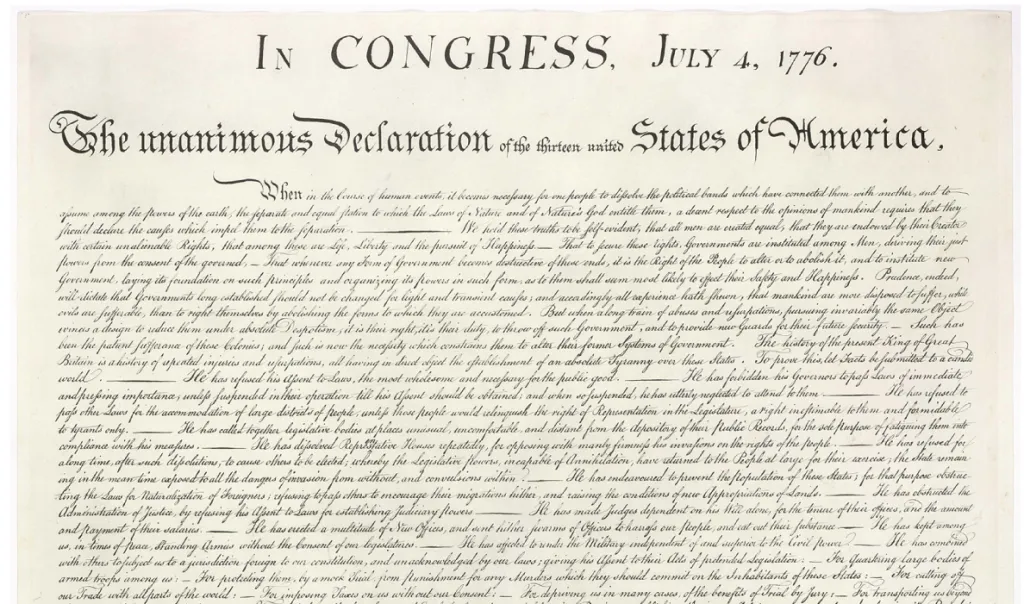



The United States of America was founded on the ideals of liberty, justice, opportunity and equality. As we celebrate that great experiment of democracy 250 years later, the American identity remains rooted in the pursuit of those ideals.
Read more El Cajon passes lean budget, officials warn of reserve spending trend
The Union-Tribune asked 26 San Diegans to reflect on a central question: What does being an American mean to them? Their backgrounds and life experiences may be varied, but their responses paint a portrait of collective American values — honor, sacrifice, service, self-determination, freedom, diversity and optimism.
Daniel Rios, Sycuan Indian Reservation
Haawka and hello. This is how Daniel Rios greets the elders of his tribe. The first, a Kumeyaay expression, carries a wish: May the fire in your soul burn bright.
These greetings represent the two halves of Rios: Sycuan Band tribal member and San Diegan. All of him is American.
“As a Native person, we live in two different places,” he said at the Sycuan Cultural Center, where he volunteers as a researcher. “On one side, you have to be prideful to be an American, and on the other side, you have to be prideful to be a Native person. They try to be separate, sometimes. But what I’ve learned is that it’s OK to be both.”
Rios, 28, is working on preserving his Kumeyaay culture and language, and studying the past.
“I’m trying to learn more of those struggles that we went through, in order to appreciate those people that came before us. I’m honoring the past,” he said. That is his responsibility to himself, and to America as a Native American. “I mean, just to make sure that people know we’re still here.”
Self-determination, honor, pride and strength are his top values as an American.
“I’m happy to live in these two worlds,” he said. “I’m proud to be an American. I’d rather see the Stars and Stripes than something else.”
— Roxana Popescu
Robert Falken, Lake San Marcos
Robert Falken was 18 when he started manufacturing and selling surfboard wax in his garage. Since then, he has filed more than 200 patents, including for an eyebrow hair removal tool and a new type of wetsuit.
“I think invention, for me, runs in my blood,” he said. “I’m just guessing. I can’t turn it off.”
Invention and being American are closely tied for Falken, 46, a fourth-generation San Diegan and a descendant of Alfred Robinson, another inventor, who conceptualized the Balboa Park Botanical Building.
“To be American, to me, is (having) the freedom to create, the freedom to contribute to the community and to have that resonate across borders,” he said.
Being American and inventiveness overlap in many ways, he added. They’re both fueled by grit, tenacity, the willingness to try and fail, and the willingness to accept others’ “crazy” ideas and run with them.
“It’s a shared belief, as I look at it, universally in America, that I can reach out to other like-minded people who will be receptive to my needs or desires, and they’ll pick up the baton with me, and everybody’s together in that acceptance,” he said. “It’s a very accepting culture.”
— Roxana Popescu
Yvette Porter Moore, Emerald Hills
Genealogist Yvette Porter Moore first became aware of her American identity when she was 18 years old and registering to vote.
It was the capstone on a civically-minded upbringing in San Diego. Her parents, both educators, hosted campaign parties for candidates in their home, and her father was president of the local chapter of the National Association for the Advancement of Colored People.
With community leaders and advocates coming and going from the house, Moore grew up with a sense that the ideals of the American dream must be pushed for, continuously so. That’s why voting — a right that hasn’t always been afforded to Black Americans — is so important to her.
“For me, being an American is having opportunities to have a better life, even if we have to struggle, even though there may be things that are against us,” Moore said.
Through her work, Moore, 58, has been able to trace back her family’s history in North America to the 1500s, including to ancestors who fought in the Revolutionary War.
This family history of civic engagement, she says, leaves her feeling “a responsibility that we must pursue, and be a participant of, what we think is right.”
— Maura Fox
Joshua Kai Tran, Mira Mesa
“Valor, purity and justice are only some words that describe the three colors of the American flag.”
With these words, Joshua Kai Tran, 12, opened his award-winning essay about the U.S. flag, which was recognized this spring by the National Flag Day Foundation.
In 221 words, Kai, who goes by his middle name, connected the colors to his parents’ perilous boat trip to the United States from Vietnam.
“Red symbolizes the blood sacrifices and lost lives that were made in the journey,” Kai wrote. “White symbolizes the new start for my family to write their own future after they made it into America.” Blue “symbolizes the vast ocean which my parents spent weeks on in a small boat.”
For Kai, being an American means opportunity: freedom, prosperity, safety.
“You get to follow your passions and your dreams, and you get to have a family. You get to be safe, and — my brother has a face painting business, and he’s 17. So you can do stuff like that,” he said.
When he thinks of the United States of America, he focuses on that first word: united.
“Despite everyone having different cultures and being from different places, like, everyone is still one family,” he said.
— Roxana Popescu
Connie Rascon Gunther, Escondido
Connie Rascon Gunther’s family has lived in the San Diego area since before America was America.
“At least 10 generations, I guess.”
Her mother’s family sailed in from Spain. “Probably prior to 1769, with Father Serra,” she said.
Rascon Gunther, 67, a small-business owner who leads a group of descendants of early San Diegans, is driven by a desire to help people know their roots after she learned about her own.
The impulse to help others mirrors her view of what it means to be an American.
“To me, to be an American is to be able to open the door for others, take your traits and your skills and not only focus internally on yourself, but then use that to be a voice for your community.”
Her life has unfolded on both sides of the U.S.-Mexico border, and her aerospace career has taken her on trips to countries with different political systems: communism, socialism.
Coming home each time, she was struck by the same feeling.
“I felt so relieved that I live in America, because you see (other countries) and if you’re not born into the right family or into the right structure, you’re not given the same privilege. Here, you can go from rags to riches. That American dream really is true.”
— Roxana Popescu
Joe Corona, Chula Vista
From his seat at LA’s SoFi Stadium, Joe Corona cheered on the U.S. men’s national soccer team as it made its World Cup 2026 debut last month. The electric atmosphere and the chills that came from a packed stadium singing the national anthem together brought back many memories.
Corona, 35, who played professionally for 16 years on both sides of the border, knows firsthand what it means to rep the stars and stripes on an international stage. “It’s an honor and a privilege,” said the retired soccer star. “For me, it always was.”
The Sweetwater High School alum, who is of Mexican and Salvadoran heritage, was playing for the Tijuana Xoloitzcuintles of the Liga MX when the opportunity arose to play for a national team. In 2012, he chose the U.S., his native country.
“Being an American means representing such a diverse country — one that gives you the opportunity to fulfill your dreams,” he said. “It means wearing these colors with pride and representing them in the best way possible.”
The midfielder played in three Gold Cup tournaments with the U.S. men’s national team, winning two of them, and also competed in World Cup and Olympic qualifiers.
— Alexandra Mendoza
Johnny Bear Contreras, San Pasqual
As a sculpture artist whose work largely revolves around preserving the Kumeyaay Nation’s culture for future generations, Johnny Bear Contreras, 63, says freedom is rooted in his craft.
“When it comes to being an artist, I can move to different genres and places, and the things I’m working on, without worrying about persecution,” he said.
That freedom stems from Contreras’ American identity, he says, something he started to uncover growing up in Escondido in the 1970s.
He was immersed in the Kumeyaay culture and traditions and tribal meetings, all while the movement for Indigenous rights gained momentum across the country.
But he also recalls the end of the Vietnam War, when community members came home after serving. This experience — especially after seeing how his uncles were impacted after serving in World War II — made Contreras acutely aware of his rights and who fought for them.
Even when he faced discrimination for the color of his skin, he thought of the “organic documents” — the Constitution and Bill of Rights — and the freedoms they afforded him.
“What does it mean to be American? It means you have a choice. Individuals are sacrificing every day… so that we have a choice.”
— Maura Fox
Faye Jonason, Fallbrook
Decades of Faye Jonason’s life have been dedicated to asking questions.
Jonason, 78, recently retired after 30 years as the historian at Camp Pendleton, the Marine Corps base established in 1942. With history dating back thousands of years before that — from the Luiseño people to the Spanish missionaries and cattle ranchers — she says “there’s enough story in that land to last you a lifetime.”
In her work, she’s found that the best way to learn that story is by asking questions — ones that have connected her to the experiences of service members, their families and San Diego and American history.
“There are things that you did not know, and there are things that you learn, and they make a fuller understanding and a fuller feeling of what it means to be part of the United States,” she said.
Having had the chance to learn about and from those who fought for the U.S. and lived on the land of Camp Pendleton, being an American “means I have gratitude for all the freedoms that we’ve been gifted,” Jonason adds.
As she sees it, new knowledge allows for the constant evolution and growth of the American identity. “We should be adding all the time to our American experience.”
— Maura Fox
Christian Hwong, City Heights
Christian Hwong feels he has two personalities. The Hoover High senior, 17, is one person around his family of Chinese and Laotian immigrants; he’s entirely different around friends. That second personality feels more real to Hwong — and entirely American.
“When I move out, my family identity will just disappear,” he said.
Part of wanting to shed his parents’ culture is natural for a teenager; but also, the San Diego-born Hwong just likes U.S. culture more.
“Recently I’ve been told I’m kind of a whitewashed Asian-American, and I definitely see that,” he said. While he doesn’t “indulge too much into my own background as a Laotian-Chinese-American,” he enjoys the United States’ melting-pot culture. He felt that keenly on a recent trip to Los Angeles’ Koreatown.
“What made me feel the most alive, feeling like the Constitution really meant something to me, was when I got to see the various different communities come together.”
For Hwong, who has visited Laos multiple times, being an American means freedom and safety. “Life in America has made me feel incredibly safe, and honestly, I wouldn’t like (living) anywhere else,” he said. “I probably wouldn’t have this sense of security anywhere else.”
— Alex Riggins
Allison Garner, Tierrasanta
The Fourth of July was always Allison Garner’s favorite holiday, so much so that her husband, Travis, chose that day to propose in 2013. Independence Day took on even more significance a few years later when Travis joined the Navy at the advanced age of 30.
Aside from grandfathers and uncles who served decades ago, the couple had no close military ties. But nine years on, the Navy is the dominant force in the family’s life. For Garner, whose husband is deployed and who works at the Armed Services YMCA, it’s impossible to separate what it means to be American from the sacrifices of military families.
For example, in the nine years Travis has been in the Navy, the couple has spent their favorite holiday together just once.
“What it means to me to be American is understanding what the military does for us,” Garner, 38, said. She acknowledges there are detractors of America’s wars, but she values the freedom of speech that allows for such criticism.
And as long as the rank and file are being sent to fight, she’ll support their loved ones at home. “We live in a free country, and we can have all these amazing things around us because of the military,” she said. “They keep us safe.”
— Alex Riggins
Brijette Peña, Mt. Hope
If you walk into Brijette Peña’s southeastern San Diego warehouse, chances are you’ll leave with seeds or stickers. Seed packets make excellent business cards, Peña said. Stickers are fun.
Cultivating seeds for herbs, flowers and other plants isn’t just a career. She uses seeds to shape the world. Her company donated seeds to victims of last year’s Palisades fire, as well as to San Diego schools.
For Peña, 37, seed farming is deeply rooted in being American. There’s the commercial piece: selling. And the nature piece: taking something from the earth and developing it. And the environmental piece: Gardeners are “connected with the earth, and they care more about the environment and the soil.”
Being an American means having complexity. You can be more than one thing.
“Being an American is being a chameleon, changing, shifting,” she said. The way she changed when she moved from Kansas to San Diego and married a Mexican American man.
It also means having contradictions, contrasts. “It is not this or that. It is both,” she said.
“We can be both part of what we are in the past, but also something very different in the future,” she added. Not unlike a seed.
— Roxana Popescu
Sye Savoie, Oceanside
Over the last eight years, U.S. Marine Corps Capt. Sye Savoie has risen through the ranks of the demanding military branch, serving with, as they put it, “the toughest fighting force that our nation has.”
But as a transgender Marine, Savoie is being separated from the military under a Trump administration executive order. After years of service to the United States and finding a “purpose” in the Marine Corps, their identity as an American now feels more complex.
“For me, being an American means chasing dreams — while still staying grounded in reality,” Savoie, 29, said.
The nation itself was built on a dream of life, liberty and the pursuit of happiness, Savoie adds. It’s still a dream worth having and working toward, even if “some of us haven’t been able to reach” it yet.
Part of that optimism may be rooted in the Marine experience.
“I represent so much when I put the uniform on; you’re not just you anymore,” Savoie said. The job requires them to “find the best in America, because that’s what I have to represent.”
— Maura Fox
Cecelia Fowler-Ramsey, Mountain View
When thinking about her American identity, Cecelia Fowler-Ramsey’s mind goes to a day in 2008.
She was working for Father Joe’s Villages’ transitional family housing when a group of young Black children ran up to her — “like a herd of elephants” — to tell her that Barack Obama had been elected as the nation’s first Black president.
“It brought back hope again,” Fowler-Ramsey, 76, said, also pointing to how it changed the kids. “They all felt that they could do whatever they wanted to do.”
She hadn’t felt hope so strongly since she first heard James Brown’s “Say It Loud – I’m Black and I’m Proud,” a funk song that became an anthem of the Civil Rights Movement, released months after the assassination of Dr. Martin Luther King Jr. in 1968.
Read more Rare copy of Declaration of Independence found by UK National Archives in papers of captured US ship
Growing up in Detroit and facing cruel jokes about the darker color of her skin, the song helped Fowler-Ramsey gain confidence and a connection to her American and Black identity.
To her, being an American is rooted in self-determination.
“I know my people will never give up,” said Fowler-Ramsey, who works now as a real estate agent. “To me, living in America is freedom.”
— Maura Fox
Jim Putman, El Cajon
Jim Putman, 55, grew up a Navy brat, so it was no surprise when he joined out of high school. “It was kind of in my DNA,” he said.
A more unexpected decision came roughly 15 years later, when he’d been out of the Navy about three years and enlisted in the Army at 34.
“Service to country, service to my fellow countrymen and women … it’s that simple,” he said, though he joked there were probably some other, more practical reasons he had for rejoining.
Putman had left the Navy months before the Sept. 11 attack. With the Army, he was deployed once to Iraq and twice to Afghanistan. After, he went back to college. He now works for the San Diego Military Advisory Council.
“Being an American is about choice,” he said. “I can’t think of another country on this planet where an individual can remake themselves several times over the span of a life … The essence of being an American is … the ability to be who we want to be.”
It’s also about serving others, he said, pointing as an example to the charity Feeding San Diego, whose CEO is a fellow veteran.
“You can’t get any more American than that, if you’re dedicating your life to making other people’s lives better.”
— Alex Riggins
David Amaya, Golden Hill
Like many Americans, David Amaya watched his TV in horror on Sept. 11, 2001, as the World Trade Center was attacked. Unlike most, Amaya watched from Pelican Bay State Prison.
He had just turned 33, and “up until that point, I was a rebel,” Amaya said. But as he watched first responders and everyday citizens rush to help, he felt an unfamiliar pride swelling inside. “That’s the first day that I believed and felt I’m American,” he said.
It took a few more years, but Amaya, 57, began rehabilitating himself. He was paroled in 2015 with a deep, personal understanding of freedom.
“That’s opportunity,” he said. “That’s hope.”
Amaya now works for the Anti-Recidivism Coalition helping other formerly incarcerated people. Overall, he believes the American justice system is fair.
“It allowed me to have time to reflect, to grow, to mature and become a responsible citizen that contributes to my community,” he said. “I don’t think that is possible in any other country.”
Being an American to Amaya is about the ability to vote, a right he cherishes. It’s about abiding by laws, contributing positively to society and being fair, equal and just, he said.
“And that’s how I live my life now.”
— Alex Riggins
Donna Yee, Chula Vista
Someone once told Donna Yee that she wasn’t “patriotic enough” to celebrate the Fourth of July because she had never served in the military. But she disagrees.
To her, being American means using your gifts to help others in many different ways, within your means.
“That’s what it means to be American, because you’re accepting of everyone and you want everyone to do better,” Yee, 42, said.
She also emphasizes the importance of learning about the contributions of veterans, immigrants and those who came before us.
Yee, a substitute teacher and the daughter of Chinese immigrants, started volunteering as a poll worker in 2008 because she wanted to learn more about the voting process. Most recently, she was the site manager at Montgomery High School’s polling place for the California primaries.
“Our voices matter,” she said, explaining her motivation. The experience has also allowed her to get to know her community better.
“The most interesting stories are when the couples come in, and they’re voting together, but one’s Republican and one’s Democrat,” she said. “And then they’re like, ‘Oh yeah, we get along,’ and it’s like, yeah, why can’t the world be like that?”
— Alexandra Mendoza
Ryan Andrews, Vista
Bartender and distiller Ryan Andrews grew up in Oakland’s punk rock scene. It was a community that valued a DIY mentality and going against the grain — and the belief that protest is patriotism.
They’re attributes that Andrews, 44, still values today — and ones that could be seen as distinctly American, though Andrews doesn’t feel all that connected to his American identity. He disagrees deeply with many of the country’s foreign and domestic policies and actions, past and present.
“I feel like being American in the 21st century, you need to be aware and responsible for the actions of what the country has done globally,” he says.
Having tough conversations is part of that. “The second we stop talking about things that we do not agree with… I think that’s when we start to lose a big part of what being free in America is really about,” he said.
Andrews acknowledges that the defiant spirit of America — and its founding revolution — is similar to that of the punk rock scene. “That idea of a rebellious teenager is, I would say, pretty much at the core of Americanism.”
— Maura Fox
Nicole Danos, Bay Park
University of San Diego biologist Nicole Danos came from Cyprus to the U.S. in 1998 believing it “supported independent thinkers and free spirits.” Nearly three decades later, with a bachelor’s from UC Berkeley and a doctorate from Harvard, she still feels the same.
“One of the things I’ve enjoyed most as a scientist is being in an environment where people come together from all over the world … to push the boundaries of what they’re doing,” she said. “That spirit of the best from all over the world wanting to be in the U.S. — as a scientist, as an intellectual — that’s amazing.”
Danos, 49, previously had a visa but finally achieved U.S. citizenship last year. Her U.S.-born daughters couldn’t understand why she cried through the ceremony. She registered to vote on the spot.
Being an American to Danos means being “a member of a really diverse and yet cohesive country that has a lot of potential.” She’s sad about the state of politics, but hasn’t lost hope. “The American people can still keep this country being really … the best country in the world in terms of protecting its people, working toward the global good and advancing science and technology. I’m pretty proud to be a part of it.”
— Alex Riggins
Robert Turley, Fallbrook
In college, Robert Turley got a football injury that could have let him forgo military service. Instead of making excuses Turley, now 86, made history.
He is one of the American Marines who rescued civilians from Saigon in the spring of 1975 at the end of the Vietnam War. He also served in Dong Ha and said he was exposed to Agent Orange, which he realized after studying a map of where that toxin was used. He retired as a lieutenant colonel and continued serving others — as a systems engineer, community college instructor, coach, husband and father of five.
Turley enlisted because he felt a responsibility to do so. “When the stuff is hitting the fan, if you can’t come to the flag, to stand there to protect it, you don’t deserve to have a flag.”
“To me, being an American is being invested in your country beyond taxes, such as serving your country — either in the military with the draft, or Kennedy’s Peace Corps. Giving a commitment and then honoring it.” A draft, he added, would strengthen and “temper” today’s youth, who have gone “weak-kneed.”
One must have values you’re “willing to bleed over,” he said. “You have to give of yourself. Physically, mentally, psychologically commit.”
— Roxana Popescu
Emma Sánchez, Vista
Emma Sánchez, wife and mother to U.S. Marine veterans and an active-duty service member, recalled the day she took the oath of U.S. citizenship. Despite her basic English, she sang the national anthem as best she could. In that moment, she reflected on her journey.
Two decades ago, after having lived undocumented in the U.S. for six years, she tried to legalize her immigration status at the U.S. Embassy in Ciudad Juárez. Instead, she was banned from the U.S. for 10 years despite being the wife of a military veteran and mother of three U.S. citizens.
For 12 years, her family was split between San Diego and Tijuana until she was allowed to return to the United States in 2018. “It has been a long, thorny, painful journey,” Sánchez, 50, said.
She became a U.S. citizen in 2024. Looking back, she believes the wait was worth it. To her, being American means having peace of mind knowing she won’t be separated across borders from her family. She also embraces her newfound responsibilities — particularly the right to vote.
She said that because politics has touched her life, she feels motivated to have a voice now. “I’ve voted two times already. I feel like I’ve got a say in this country.”
— Alexandra Mendoza
Josh Higgins, La Jolla
When he’s not working as an oncology nurse at UC San Diego, Josh Higgins, 47, can often be found scaling a rock wall.
Rock climbing is a key part of his life — he’s been teaching a course at the Mesa Rim Climbing Center for at least 15 years and is the president of the Allied Climbers of San Diego, an advocacy group that helps promote and maintain climbing areas.
“I’ll hike any distance as long as there’s rock at the end of it,” he says with a laugh. He’s spent hundreds of days rock climbing in the U.S. national parks and says public lands are a “defining feature of America.”
When he’s not doing that, he’s advocating for his fellow nurses as a union representative, fighting for improved working conditions and better patient outcomes.
Being engaged in his communities is part of how Higgins exercises his Americanness.
“That’s what I associate with being an American personally — we’re all in this together, and we need to try to make the world a better place,” Higgins says. “I would like America to be better for my child than it was for me.”
— Maura Fox
Ilias Benbatoul, Torrey Pines
It was during a lecture that Ilias Benbatoul first heard the metaphor of America as a melting pot. It stuck with him. For the San Diego State University graduate, being American means being part of that pot.
“The United States is a group of so many different diverse races, religions, backgrounds,” he said. “I think that’s one thing that’s super unique about this country, and it’s something we all must embrace.”
It’s a calling, he said, that is informed by his Muslim faith. “We believe that God created us in different groups of people, and it’s obviously all equal, and it’s our job to connect with one another and learn the beauty of diversity.”
The son of Moroccan immigrants, Benbatoul, 24, is a community canvasser for the Council on American-Islamic Relations, which allows him to get out in the community and advocate for its needs. He attends the Islamic Center of San Diego, where three people were killed in a hate crime in May.
Benbatoul, who is preparing to enter law school, said he wishes for a nation engaged in uniting. “We are at a crossroads.”
“Despite our country’s difficult history, there’s always a potential to be great and set an example for the rest of the world. That’s what we’re hoping for.”
— Alexandra Mendoza
Cherie Woods, Allied Gardens
As a teacher, Cherie Woods has guided many students in writing essays about the American dream. Pursue whatever yours may be, she tells them, as long as it doesn’t hurt someone else’s. But, she adds, it’s also about ensuring that every American feels accepted and has the opportunity to pursue their own.
Woods, 46, a former television producer, is a special education teacher at Patrick Henry High School and helps coach the school’s girls flag football team.
For Woods, who has Native American, European and African American heritage, including ancestors who were enslaved, being an American is “knowing that diversity matters.” She emphasizes the importance of being connected to the country and wanting to be part of “something bigger” and its ideals.
“We’ve made extraordinary progress. And yes, we’ve had painful setbacks and parts of our origins that are not good. But I believe that all of that has shaped who we are and where we need to go.”
Woods says she is hopeful about the future. “I see that in my students, I see that in my own children,” said the mother of three. “Fighting for the good, fighting for life, liberty, equality, the pursuit of happiness, all the dreams that that American dream stands for.”
— Alexandra Mendoza
Andrew Minjares, Chula Vista
Maybe the most American thing about Andrew Minjares is his red 1973 Ford Mustang Grande. Steel and chrome, not plastic. It rumbles. It’s sleek. It turns heads.
Or is it his job? He’s worked for almost 30 years as a U.S. Postal Service mail carrier, currently in Encanto. He loves getting to know the people and dogs on his routes. He loves seeing people’s faces brighten when he delivers letters.
“Especially Christmas letters,” the 59-year-old said. Digital cards? “It’s not the same.”
It could be his time in the Navy. Or maybe his side gig doing another iconic American job. He is a radio DJ with Magic 92.5. (You might know him as Hurricane Andrew.)
But if you ask Minjares, being American comes down to three ideas: connecting, helping others and being happy.
As for the pursuit of happiness: “To be an American is to enjoy life and do what you want to do and be free about it. No questions asked. Unless, you know — make sure it’s legal!” he said and chuckled. “I’m a happy-go-lucky guy. I don’t like being a Debbie Downer or crazy person.”
After a pause, he added this pro tip: “Stay away from those people!”
— Roxana Popescu
Linda McLemore, Chula Vista
Despite being born in an incarceration camp in Arizona where people of Japanese descent were sent during World War II, Linda McLemore’s mother wished for her family to embrace American culture. Five of her uncles served in combat as U.S. Marines or in the U.S. Army.
“I wear red, white and blue all the time,” McLemore, 81, said. “I have flags everywhere. Being American is important to me.”
Yet, even that outward expression of Americanness hasn’t stopped McLemore from experiencing discrimination. “If I don’t look in the mirror, I feel totally like a U.S. American citizen, but some people don’t consider it. I wish that there was some way for discrimination to go away.”
McLemore has devoted her time to helping others, so much so that she considers herself a “professional volunteer.” She started volunteering at hospitals as a candy striper in high school. A loyal San Diego Padres fan, she volunteers for the San Diego Padres Foundation, as well as the San Diego Blood Bank, Meals on Wheels and the Chula Vista Veterans Home.
She considers honoring veterans to be one of her biggest responsibilities as an American. “They protect our country. I have so much respect for the military.”
— Alexandra Mendoza
Clark Clipson, Mission Hills
As a boy in 1950’s Atlanta, Clark Clipson idolized the “heroic” Confederacy.
“We would reenact battles with pine cones,” Clipson, 72, said. “I didn’t understand back then what the Confederacy really stood for.”
Music helped change that.
“Growing up playing in bands … the South was just beginning to be more desegregated, but in music that had already happened,” he said. Mingling with Black musicians, “I realized they had a really different perspective of what it was like to live here … (and) that not everybody experiences America the same way I do.”
Clipson came to San Diego for grad school in 1976 and never left. His career as a forensic psychologist, analyzing the minds of criminal defendants, also gave him a unique view of America. “Most of the time, our justice system works well.”
Now retired and still making music, he’s long removed from that Southern childhood. But that upbringing helped deepen his appreciation of American values, even during difficult political moments.
“The ideals of freedom, opportunity and equality are still kicking,” he said. “This experiment in democracy … is well worth fighting for, but it’s really fragile and it doesn’t take much to lose it.”
Read more Saturday night’s fireworks show likely to occur beneath marine layer in San Diego County
— Alex Riggins