
In Arabic, “arif” means “knowledgable” or “wise,” so it was the most fitting name for a new community farming organization that started in City Heights last year.
Read more From the Archives: Patriotic concert
Arif Urban Agrarian Collective is an 8,000-square-foot garden and orchard on the campus of the Peace Resource Center of San Diego. Its four founding farmers are women who came to the United States from Sudan, Zimbabwe, and Mozambique, where they practiced farming and brought their knowledge and experience to San Diego and began farming here, as well.
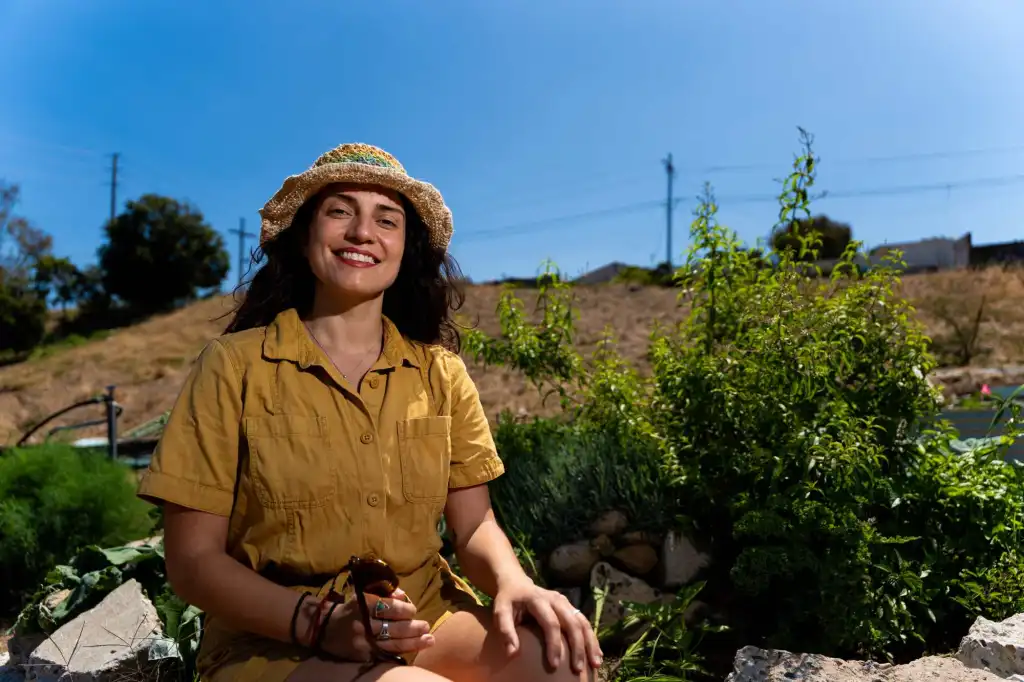
“This is a farm collective located in the heart of City Heights. This land that we’re tending to, we’re restoring was a community farm that, up until late 2017, was abandoned. We took it over in the beginning of 2025 and we’ve been working very diligently since then to restore the farm, restore this land. We’re restoring it in a way, and with the vision and mission, to build a third space for community members that live within the area and throughout San Diego, so that they can come and have a space where they can a connect with the land, be, and grow food,” said Natalia von Hausen, who goes by Nati and is one of the board members for the nonprofit organization. “Ultimately, the food that we grow is not for sale; it’s going to be donated to the volunteers that come and tend the land with us, that help take care of the farm and the entire ecosystem that we’re trying to restore. It will also go to other orgs that are mutual aid orgs that are feeding families around San Diego.”
The collective secures grants to build and sustain their space, and operates with the help of volunteers. The purpose is to feed the community, build a third space where people feel welcome, and to provide a place where folks can heal and connect to the art of growing food collectively, she says. They hold workdays from 5 to 7 p.m. on the second and fourth Wednesdays through November; a workday/skill sharing and lunch every first Saturday; and an informal workday from 8 to 10 a.m. every third Saturday at their location at 3850 Westgate Place, San Diego.
Von Hausen, 34, heads up communications for AUAC, helping manage their website, social media, newsletter, marketing and branding. She also earned a degree in environmental design and urban studies/affairs from the University of Massachusetts Amherst, previously worked as an environmental scientist, and currently works as a corporate sustainability analyst. She lives in Chula Vista with her partner and their two dogs, and took some time to talk about the work being done in City Heights, led by the elders in the community, and her commitment to caring for the environment.
Where did the idea to start this organization come from?
Our founding farmers are a group of refugee women who have come from many countries in Africa—mostly Sudan, Mozambique, and Zimbabwe—and they’ve been here for over 20 years. Before they migrated to the United States, they were farmers in their home countries, so they have this intergenerational wealth of knowledge that we’re trying to harness, coach, support, cultivate, and empower them with. We’re really following their guidance as we focus on growing the food. They have decades of experience growing food in their home countries, and in San Diego, because once they moved to San Diego, they helped start multiple other farms. Whenever they come to the farm, they just share knowledge. They’re immersed because it’s just so natural to them. They’re incredible, so we’re following their leadership when it comes to things like regenerative agriculture, how to replenish the soil, what we should consider as far as pollinators, what we should consider for fertilizer, depending on what we want to grow.
We believe that the land belongs to the people who work it, especially in the sense of food sovereignty and food justice, so this idea came from wanting to empower them. We want them to have the autonomy to show up, and because a lot of them are elders at this point, we want to help with our labor and to help them re-establish, reconnect, and build this new space that we’re tending to with their leadership. That’s really where the idea came from.
We are compensating our founding farmers for the work that they’re doing. We’re going to be working with them and offering them financial support for the knowledge and expertise that they have because they’ll be leading workshops, trainings, and educational programming for the community, so that everyone can have access to this knowledge. Ultimately, we live in San Diego, we can grow food here year-round, and a lot of people don’t notice that and know that. A lot of us are disconnected from the food system; we just go to the supermarket, picking and choosing from a pile of abundance, but we’re not connected to the soil that grew this, the hands that tended to it, the hands that pruned it, that touched the soil. This is just an opportunity to gain a deeper appreciation of that entire process.
What I love about Chula Vista…
Oh my gosh, I love Chula Vista. Even just (the other day), Mexico won against Ecuador (during the World Cup) and people were celebrating all night, and it’s just amazing to see. I love Chula Vista for the incredible community culture that radiates throughout the entire neighborhood, the entire area. I just love being able to go to any business and speak in Spanish. It’s just really, truly lovely. And the food here. The Mexican food down here is just bangin’.
Talk a bit about how the organization functions.
Although we have our board members, we’re all volunteers, just like everyone else that shows up to the farm. We all wear a bunch of different hats, but we lead collaboratively, so if you have an idea or a proposal for a project and you introduce it to the team, then you would ideally be the one leading it, or co-leading it with help or support and volunteers to help you. With our volunteers, anyone who comes to the farm and tends the farm at our informal workdays is going to receive food. We’re constantly harvesting food from the farm, so if you come to the farm and work with us, you’ll likely get to take home apples, passion fruit, squash, or whatever we’re harvesting that day. On the first Saturday of every month, we offer a skillshare and a lunch, so after the workday we’ll have a little educational forum that covers topics like composting, farming, or tenant rights. We want to make sure that our volunteers feel like there’s an exchange taking place, not necessarily financially, but more energetically. We’re building community, we’re connecting with one another, we’re getting to know each other, getting to hear your story and share a little bit about yourself.
Why was this something you wanted to be involved in?
Food justice and food sovereignty is so incredibly important to me. I’m an immigrant myself. I’m originally from Chile, and my family faced a lot of scarcity and insecurity around food when I was growing up, so this is something very near and dear to my heart, the ability to celebrate our autonomy to be able to grow food. It’s something that we’re just so disconnected from—from food and also from community. Food is part of our culture, it’s part of the culture that we continue to maintain and take care of, and also what we’re passing on to future generations. When my friend invited me to join, I had no idea what we were doing. I consider myself an amateur gardener, and it was just an honor when they asked me to join because if I can help alleviate at least one person’s food insecurity, or just build excitement around growing food, I would consider that a success in my life.
Read more Lederer on Language: Celebrating the 250th year of our national birth certificate
Your website says that your founding farmers combine East African agricultural practices with experience growing in San Diego. What are some examples of these practices that are being used in the garden?
We like to grow a lot of culturally relevant food, so we do a lot of beans that would be typically eaten in Eastern Africa. We grow okra, we grow a lot of collard greens, and a lot of those plants require different types of fertilizer, so that’s really what that’s referring to. We’re still sort of new and this is really our first year growing food. Up until a couple of months ago, we were really just working on restoring the land. It was overgrown with years of weeds and years of overgrowth, so we’ve been cleaning, weeding, turning the soil, preparing it for planting.
What have your founding farmers described about their process of learning how to adapt those practices to growing food and plants in San Diego?
Because we can pretty much grow anything in San Diego year-round, I think it’s been pretty rewarding in that way, to them. I think the most challenging thing that they’ve mentioned in passing, from the few times that I’ve been able to pick their brain and interact with them at the farm, has been managing drought. That’s quite similar to something that would take place in their home country, figuring out water reuse and how to be cognizant of water usage. I think what is maybe a little different here is the amount of wildlife that exists in San Diego because San Diego County is one of the most biodiverse areas in the continental U.S. There are so many critters that come in. It’s part of the game, it’s part of the research as a farmer that we get to do—who’s coming in, who’s munching on our watermelon, who’s munching on our squash. I think figuring that out has been something that they know about, but something that was kind of a learning curve in the beginning when they were first starting to farm again here. We also have so many critters at the farm now; we’ve got snakes, hawks, rats, so many birds, so many pollinators. It’s so beautiful to see this return of the wildlife.
What are some of the plants currently growing in the garden?
We have a bunch of summer squash, tomatoes, an herb spiral garden that’s really beautiful. We have a bunch of collard greens, we have a giant rogue pumpkin that no one planted. I think someone just tossed some pumpkin seeds, and it just grew. We have arugula, a bunch of green onions, we have kale, we have corn. We also have around 40 fruit trees, so we have avocado, walnuts, macadamia, figs, apples, oranges, tangerines, pears, we have strawberries, guavas, agave. We have chickens, too, but we grow them for eggs. We would love to also get goats at some point because we do have space, so if anyone has any goats that they’re looking to rehome, let us know.
What led to your interest in working to care for and improve the environment?
I am from Chile, but I grew up in Massachusetts. My family came here when I was about 6 years old, so I grew up on the coast of Massachusetts, which is technically a national park. It’s a very fragile ecosystem; it’s impacted every year by erosion, by rising sea levels. As I was growing up, I didn’t really appreciate it, but as I got older, I was able to really reflect on the beauty of the land that I grew up on that has been tended to and taken care of by the Wampanoag tribe. As I continued to navigate my college education and studied environmental design, I learned more about the importance of protecting our environment and the idea of taking care of the environment in a way that considers seven generations after you. So, it’s just been something that I live and breathe.
I started as an environmental scientist, which was incredible work, but when I moved to San Diego, I stepped into the corporate space, which is a very important work for businesses to understand and really come to terms with the impact of their operation, and that climate risk is financial risk. If your business is not environmentally sound, considering things like climate change, an increase in natural disasters, then you are a risk and that’s that is undeniable at this point. I’ve been working in the corporate space for a while now, and coming back to the farm when my friend invited me to join was just an immediate yes because it’s an opportunity to step deeper into the community I’ve considered home for the past 10 years.
What is the best advice you’ve ever received?
I remember being so overwhelmed my freshman year of college in my Intro to Sustainability class because my professor was basically saying that everything we were learning that semester would be outdated by the time we graduated because things are constantly changing. I went up to him and said, “How am I supposed to decide what I want to do? There’s so much to do, how did you decide?” And he was like, “Natalia, you just have to have faith. You have to have faith in your neighbors, in your peers, in your colleagues, in your community that whatever you don’t devote yourself to, there’s someone out there who will address it.” That, to me, has been so profound, and I always come back to it. Sometimes we get overwhelmed, sometimes we get lost in the sauce, but really stepping into community and being uncomfortable, having faith that whatever you’re not doing or paying attention to that is important to you, is being addressed by someone else because we can’t all do everything. If we could, this place would be very different.
What is one thing people would be surprised to find out about you?
That I am an amateur farmer. I help run this farm, but I consider myself very much a newer farmer. I’ve learned so much in the past year and a half, and I’m so excited to continue to learn more from our farmers and friends and community members. I’m not a master gardener, but I’m very eager to learn.
Please describe your ideal San Diego weekend.
I’m a yoga teacher, so definitely going to a yoga class. Heading out to the beach, jumping into the ocean, maybe even going on a hike, and definitely hitting up the farmers’ market, either in Chula Vista on Sundays or in Little Italy, because I love to support my local farms.