






Nuclear fusion needs blankets, so to speak, and scientists, engineers and workers at General Atomics are poised to create a big place to test them out.
Read more This City Heights nonprofit follows the lead of its East African founding farmers
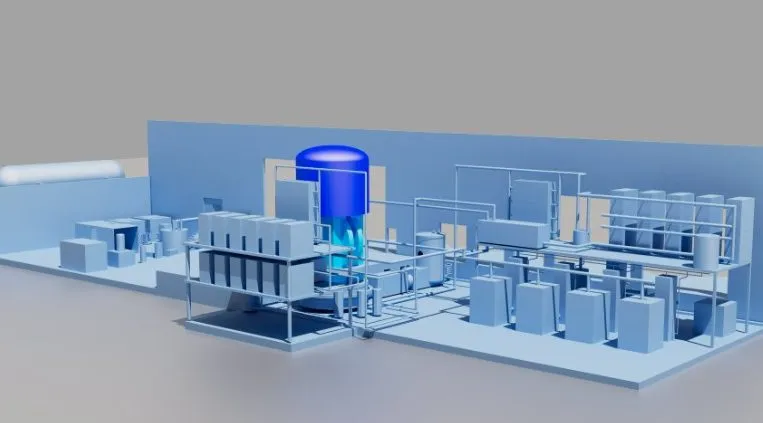
In collaboration with the U.S. Department of Energy, General Atomics scientists and engineers will design and build a “fusion blanket component” test facility in Poway in the hopes the site can further the goal of developing nuclear fusion power plants that can produce a practically unlimited and clean source of electricity.
“A blanket test facility would represent the next stage in turning scientific discovery into sustainable power,” Wayne Solomon, vice president of Magnetic Fusion Energy at General Atomics, said in a statement.
Integrated fusion blanket systems use specialized lithium-based materials — solid, liquid or salt — that line the inside of a fusion vessel to capture energy and produce the tritium needed to sustain fusion reactions.
It’s called a blanket, General Atomics director of Fusion Energy Technologies Brian Grierson said, “because it wraps all the way around the fusion core — and it’s nice and warm.”
How it works
Engineers plan to use the facility to confirm that circulating blanket fluids can effectively remove heat, withstand mechanical stress and extract fuel at the levels needed for power plants.
It’s a challenge “that no one has ever been sufficiently compelled, or driven, to bring to this scale,” Grierson said during an interview with the Union-Tribune. “This would be a facility to test engineering components that would then be bolted onto a fusion device to generate electricity and fusion fuel.”
General Atomics plans to have the facility commissioned in three to five years.
The project got a big financial boost a little more than one week ago when Gov. Gavin Newsom announced General Atomics will receive a $20 million tax credit through the Governor’s Office of Business and Economic Development, or GO-Biz.
The award will be applied to the blanket test facility, which is part of a public-private partnership that includes the Idaho National Laboratory, UC San Diego and others.
“This is not just for the benefit” of General Atomics, Grierson said. “It’s a project we have with multiple organizations, universities, national labs and private industry … They are potentially considering relocating and setting up brick-and-mortar to add to the local economy.”
Why fusion excites people
Fusion is not to be confused with fission — the process used to generate electricity in nuclear power plants such as the now-shuttered San Onofre Nuclear Generating Station.
Unlike fission reactors that split atoms, nuclear fusion merges light atomic nuclei, which releases massive amounts of energy. Fusion is the same process that powers the sun. Hoped-for fusion reactors would leave behind no long-lived radioactive waste.
Fusion’s promoters say a technological breakthrough resulting in the construction of commercial fusion reactors would transform the energy sector — especially with global energy demand growing — by offering a virtually boundless supply of power that emits no greenhouse gases.
But finding ways to harness its vast capabilities has taken decades, and fusion has its share of skeptics.
Fusion technology developed the hydrogen bomb in the 1950s, but as an energy source, fusion power has been generated only for very short periods in the laboratory and no commercial reactors exist. (There’s a long-running joke in the energy industry that commercial fusion is always 30 years away.)
Read more From the Archives: Patriotic concert
What happens next
The blanket test facility will be designed and developed on General Atomics’ Poway campus, home of the company’s Magnet Technologies Center.
That’s where six modules were put together to form a colossal magnet called the “central solenoid” at the center of the ITER project in France — a vast, international effort to help determine the viability of commercial fusion. The last of the Magnet Technologies Center’s modules were shipped to ITER last year.
The magnet center in Poway intends to be refurbished to house the blanket test facility, with the idea that the existing infrastructure and engineering know-how will help accelerate the project’s timeline and save money.
“A lot of the equipment that is there is perfect for running a blanket test facility because it will have a large super-conducting magnet,” Grierson said, adding that standing up an entirely new facility “would take twice as long, if not longer, and it would be a much larger investment” compared to using the Poway site.
California, in general, and San Diego in particular, are fast becoming hubs for a lot of nuclear fusion development.
General Atomics established the first fusion research program in the U.S. in 1957.
And the Torrey Pines campus at General Atomics is home to the DIII-D National Fusion Facility that the company operates on behalf of the U.S. Department of Energy’s Office of Science. Pronounced “dee-three-dee,” DIII-D boasts North America’s largest operating tokamak — a doughnut-shaped vacuum chamber that is surrounded by powerful electromagnets.
San Diego also hosts the Fusion Data Science and Digital Engineering Center, a collaboration of scientists and engineers at General Atomics and UC San Diego to use advanced digital engineering, artificial intelligence, machine learning and high-performance computing to fast-track fusion development.
Up in Northern California, scientists at the Lawrence Livermore National Laboratory made headlines in late 2022 when 192 high-powered lasers created “net energy” through a nuclear fusion reaction. It marked the first time that a fusion experiment resulted in a greater amount of energy coming out than the amount put in. General Atomics assisted in the Livermore experiment.
The San Diego Regional Economic Development Corporation last fall released an interactive “road map” that said fusion research and development has the potential to support more than 40,000 jobs and inject as much as $125 billion into California’s economy in the next decade.
Private companies in the U.S. and Europe are also pursuing the “holy grail” of developing a working fusion power plant that can generate electricity.
China has jumped into contention, with one report estimating the Chinese government is pouring as much as $3 billion a year into fusion efforts, reminiscent of the space race between the U.S. and the Soviet Union in the 1950s and 1960s.
Grierson of General Atomics has spent the better part of 20 years in fusion research. The 46-year-old believes the dream will become a reality.
“I think it’s not a matter of years, I think it’s a matter of resources,” he said. “It’s how many dollars away is it, not how many years away is it.”
Read more Lederer on Language: Celebrating the 250th year of our national birth certificate