






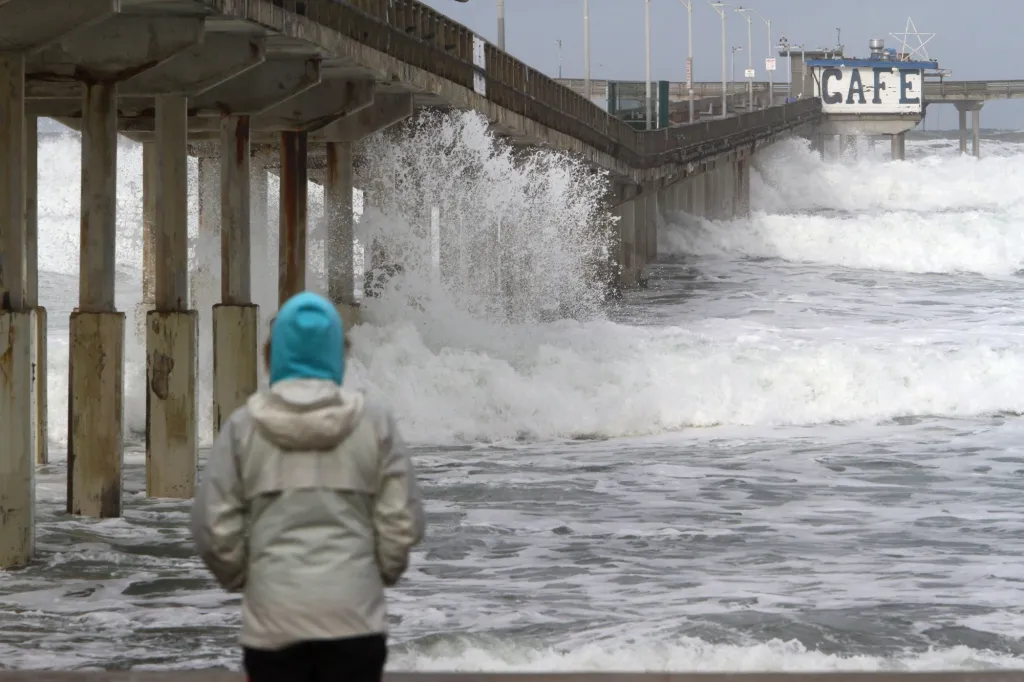
Amid predictions of a “super” El Niño ahead, expectations are high that San Diego’s coastline could get walloped again starting in the late fall.
Read more After years of silence, plan for polarizing Topgolf venue on San Diego Bay on path to approval
Warnings of extreme storms and resultant flooding, erosion and widespread damage abound, along with growing lists of how to prepare for coming turbulent weather.
There may be some reason for long-term optimism in reports by the Scripps Institution of Oceanography focused on El Niños.
One published July 8 in the journal Science Advances carried the headline “Targeted marine cloud brightening could weaken subsequent El Niño.” In essence, the idea is to create shade — or dim sun in the Pacific, if you will — and reflect back some sunlight that, in theory, could tamp down the higher ocean temperatures that lead to the extreme El Niño conditions.
Late last year, two other studies were issued, the San Diego Beach Report: 2025 and a companion study in Nature Communications that found local beaches recovered better than expected from previous El Niño storms, even surprising one of the study’s authors.
El Niño is a climate occurrence in which the surface waters of the central and eastern Pacific Ocean become unusually warm, increasing moisture in the atmosphere. Its counterpoint, La Niña, is a cooling of surface ocean waters and drier weather.
The concept of marine cloud brightening, or MCB as researchers call it, is not new. Some previous thinking held that this needed to take place on a large scale — such as shooting aerosols from planes high in the stratosphere — and would require intricate global cooperation.
Scripps researchers looked at the possibility of using this geoengineering over a shorter term in a relatively regional application that shortens the timeline and reduces the bureaucratic complexity of implementing it.
This is still largely uncharted territory that generates a lot of questions and concerns about unintended consequences, though perhaps not as much in a more targeted approach.
The technique for MCB entails spraying seawater into marine clouds to enhance the clouds’ reflectivity. “While some pilot projects and randomized controlled trials have tested the technique’s efficacy, they’ve only been on very small scales,” said a Scripps summary of the study.
Ironically, a fire disaster fueled by hot, dry weather, not damaging rain, was key to the research. The “Black Summer” bushfires that scorched Australia in 2019 and 2020 served as a “natural experiment,” according to the study.
“The smoke that wafted into the atmosphere was filled with reflective, cloud interacting aerosols akin to those used in a geoengineering method called marine cloud brightening,” according to the report.
Other scientists found the smoke-filled clouds bounced back solar radiation into space, enhancing the La Niña that formed in 2020.
Read more ‘Deeply disturbed’: A family confronts racist bullying, and history, in North County
“It was the key breakthrough to this becoming a viable research question. Without that validation opportunity, I don’t think our findings would be so credible,” said Scripps Oceanography researcher Kate Ricke, who co-authored the study with Jessica Wan, a researcher at Scripps who has since moved on to the University of Chicago.
Relatively quick, targeted marine cloud brightening intervention contrasts with other geoengineering efforts to address human-caused global warming that take international coordination over years or decades, Ricke and Wan said.
Meanwhile, there’s more direct heartening news for beach areas in San Diego and across the state. The annual report found most of the beaches studied in the region “grew in width last year as beaches entered a post-El Niño recovery phase,” according to Scripps.
The other study in Nature Communications discovered that California’s “average beach width has remained remarkably stable across nearly four decades despite notable examples of beach erosion.”
“Being able to look across multiple years of the beach report lets managers assess trends, which can help inform decisions about potential beach nourishment projects,” said Mark Merrifield, director of the Scripps Center for Climate Change Impacts and Adaptation and one of the co-authors of the beach report.
“On the flip side, our research also establishes that multi-year cycles of widening or narrowing beaches are not unusual. Multiple years of beach recovery often occur after a strong erosion year.”
Adam Young, another co-author, underscored that the findings were significant because beaches are the first defense against coastal flooding, in addition to providing recreational, cultural and economic benefits to the region.
The report’s authors also said some of the recent increase in beach width was due to beach nourishment projects in Encinitas and Solana Beach. The sand added for each of those projects has been generally migrating south.
“The sense that the system isn’t necessarily losing sand as fast as we might have predicted was surprising,” said Merrifield, according to Axios San Diego. “It brings a slightly different perspective on long-term planning.”
Researchers could not attribute increased or decreased beach erosion to higher global average temperatures. “However, the report’s authors said such a trend might emerge if accurate records of beach widths extended farther back in time,” according to Scripps.
The Scripps reports may generate long-term hopes and possibilities regarding El Niños.
In the near term, however, that moisture-packed climate phenomenon, along with cyclical drenching from atmospheric rivers, may make last week’s fair-weather king tide flooding in Mission Beach seem quaint.
Read more Ambitious president who turned Southwestern College into a rising star plans to retire
Ray (@rjohdomingo), LGBTQIA+ activist.
“So Pete Hegseth IS in favor of gender affirming care.”