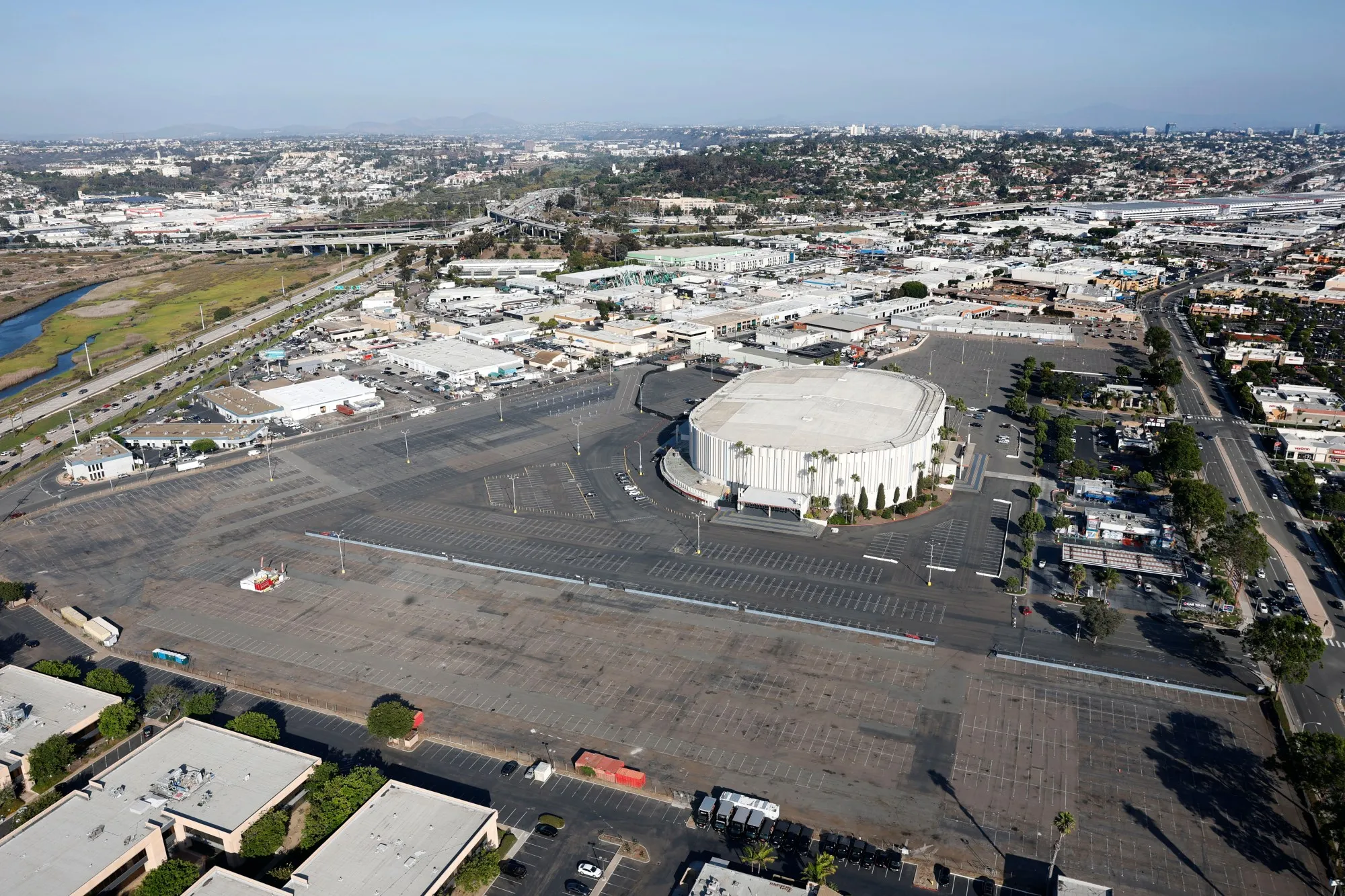







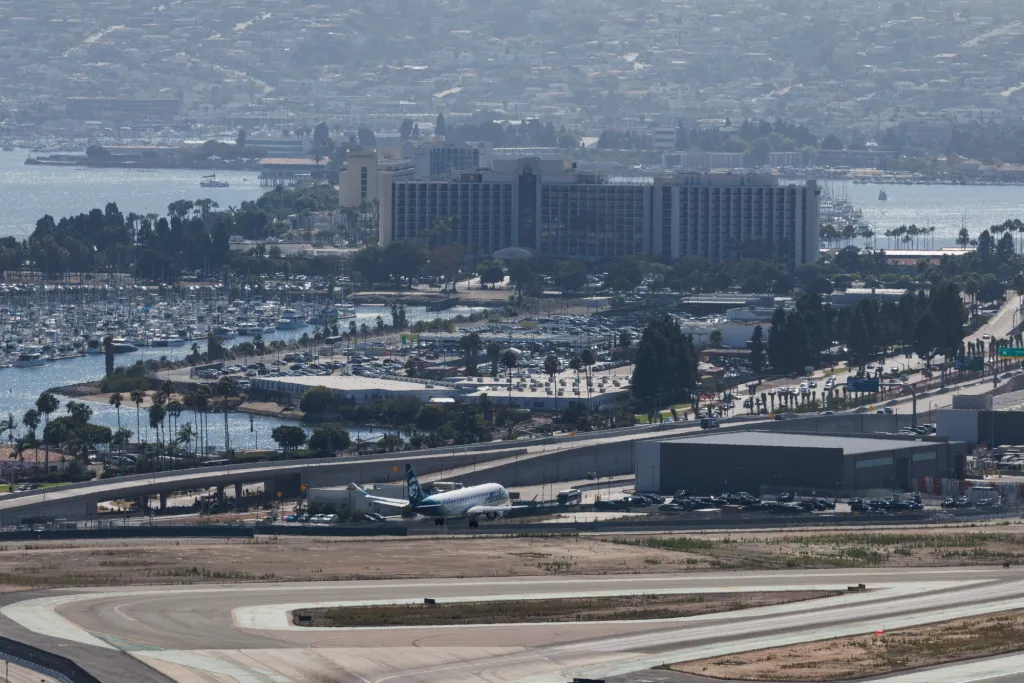
Currently obscured from view, an industrialized portion of San Diego’s Bayfront just opposite the airport is envisioned to become a lively waterfront destination that introduces new experiences, including at least one visually arresting — and polarizing — attraction.
Read more ‘Deeply disturbed’: A family confronts racist bullying, and history, in North County
The vision, as laid out in technical documents prepared to satisfy the requirements of California environmental law, is anchored by a high-velocity, three-story Topgolf venue. It’s poised to draw hundreds of thousands of people, and their cars, to a remade bayfront area that also boasts dining and entertainment options alongside a sprawling waterfront park and promenade, and an improved road with a traffic light intersection.
In the works since 2019, the project’s marquee attraction is, according to different camps, either a welcome addition to a veritable dead zone or an offensive use of public tidelands.
But after years of relative silence, the effort is moving forward.
Last week, the Port of San Diego, which controls the tidelands along San Diego Bay, released its draft environment impact report for what’s referred to as the East Harbor Island Redevelopment/Topgolf and Waterfront Park Project.
The state-mandated analysis shines a light on project impacts to environmental issue areas such as aesthetics, greenhouse gas emissions and transportation. The report’s release gives the public and other agencies a 48-day window to comment before the analysis is finalized and presented to the Board of Port Commissioners for certification, potentially as soon as the end of the year.
It is a transitional moment that moves the redevelopment plan into a new phase of public scrutiny, as the project marches toward a potential construction start date in 2028.
“This is an important milestone. In terms of staff, we hold our breath a little bit to see the volume and the complexity of the comment letters we receive,” Lesley Nishihira, the port’s vice president in charge of planning, told the Union-Tribune. “Sometimes people forget what’s out there today. If you drive down Liberator Way, which a lot of people don’t know exists, you can’t see the water. You see this wall and then old, asphalt rental car facilities. This (environmental impact report) will enable us to provide a huge public amenity on the waterfront.”
Waiting for the green to clear
The redevelopment area spans 38 acres of land on the basin side of East Harbor Island, facing North Harbor Drive.
Today, the site is primarily used by three car rental companies that store, fuel and fix up their fleets behind fences that mask the site’s proximity to the marina behind them. The project area is sandwiched between Harbor Island Drive to the west and a man-made lagoon contaminated by industrial discharges to the east, with the San Diego International Airport Authority using a portion of the site for construction staging offices.
Liberator Way, a little-used street behind the car rental lots, provides access between North Harbor Drive and Harbor Island Drive. The project area also includes the Harbor Police Department Headquarters, expected to be redeveloped through a separate process.
The project calls for demolition of the car rental lots and the construction staging facilities to make room for a 9.8-acre Topgolf venue, a 10.1-acre public park and promenade overlooking the lagoon and marina, and a realigned road with 180 parallel parking spots. It also seeks to designate an additional 12.4 acres of land, just west of the proposed Topgolf site, as commercial recreation, which allows for restaurants, shops and hotels.
In November 2023, the port started the environmental review process required by the California Environmental Quality Act, or CEQA, with the release of a notice of preparation. The following month, the agency’s board agreed in principle to lease the land just west of Liberator Way to Topgolf for 40 years.
At the time, the port expected to release the draft EIR in 2024, with construction on the high-tech driving range anticipated to start the following year.
Instead, there was a protracted period of silence, which Nishihira attributed to the port’s desire to be extra thorough in its analysis.
In the interim, Topgolf was carved out by parent company Topgolf Callaway Brands and sold to a private equity firm, in part because of the substantial financial drag associated with opening and operating venues. Leonard Green & Partners, L.P., purchased a 60% controlling stake in Topgolf in January, with Callaway retaining a 40%, non-operational stake. The deal valued the driving-range brand at $1.1 billion, or around one-third of its value when Callaway closed on its purchase of Topgolf in 2021.
Leonard Green has not communicated with the port on this project, Tony Gordon, the port’s vice president of real estate, said in a statement to the Union-Tribune. However, Topgolf is operating as an independent subsidiary of Leonard Green, and the development team is still committed to building the East Harbor Island facility, he said.
The brand, in an emailed statement, said that it plans to see the entitlement process through to a successful conclusion.
“Our vision is to deliver a multi-level golf entertainment venue, featuring climate-controlled hitting-bays, a targeted outfield, full-service restaurant and bars, private event space, mini-golf, and ancillary games — open 363 days a year to golfers and non-golfers alike,” Topgolf spokesperson Emily Heshley said.
The draft environmental report, prepared by consultant Harris & Associates, looked at 15 different areas and concluded that there would be significant and unavoidable impacts in two areas, greenhouse gas emissions and transportation, even after mitigation measures.
The largest contributing factor to both areas is the car trips to and from the Topgolf attraction.
The venue, taking over a nearly 10-acre site, includes a three-story, 67,030-square-foot building with 108 hitting bays. The building opens up to a 4.5-acre artificial turf outfield with 10 targets, and a polyester barrier netting system suspended on poles up to 170 feet in height. There’s also a full-service restaurant and bar with 382 seats, a rooftop patio and a 2.5-acre parking lot with 289 spaces that will be available free of charge.
At a minimum, Topgolf must spend $61 million on the East Harbor Island facility and parking, per deal terms with the port.
Read more Ambitious president who turned Southwestern College into a rising star plans to retire
Topgolf is anticipated to operate from 9 a.m. to 1 a.m. Sunday through Thursday, and 9 a.m. to 2 a.m. on Friday and Saturday.
The attraction is expected to generate, on average, 1,944 car trips per day. When combining trips to the new waterfront park, the project will generate 2,449 car trips per day and 893,885 trips per year.
The report calls for Topgolf to implement a transportation plan that includes bike parking and lockers for employees. The measure is expected to reduce the vehicle miles traveled by employees by 487 miles per day, meaning transportation impacts will remain significant.
Different strokes, different folks
Most of the project’s impacts were deemed insignificant or less than significant after mitigation.
In terms of aesthetics, the project will not adversely affect scenic vistas or resources. Nor will it degrade the overall visual character of the site, the report states. Only the anticipated glare from reflective materials used at the Topgolf facility and the light produced by 16 building-mounted light fixtures are considered significant impacts, although those can be mitigated, the report says.
Some of the conclusions are likely to be confounding to those who view the addition of sky-high netting, artificial turf, bright lights and supersized LED displays to the water’s edge as view-obstructing blight.
“Most people, when they arrive at the airport, they take Harbor Drive toward downtown, and they see the views over the water of downtown, of the Star of India, of the sailboats that are in the embankment right there, and that is the feel of San Diego,” said San Diego Coastkeeper Senior Attorney Patrick McDonough. “You lose that when there’s a giant, 9-acre Topgolf facility with 170-foot nets in between that exact viewpoint on people’s first arrival to San Diego.”
The water advocacy group has previously flagged concerns about impacts to wildlife and water quality. For instance, Topgolf’s proximity to the water means that individual plastic fibers and toxic chemicals will be washed directly into the bay as soon as it rains, McDonough said.
“We shouldn’t be laying a 4.5-acre plastic carpet right on the bayfront,” he said.
But the nonprofit’s real objection to the Topgolf facility is rooted in something bigger. The nonprofit sees the attraction as a wholly inappropriate, potentially unlawful use of the land.
The port holds the tidelands in trust on behalf of all Californians, meaning it must administer them according to the Public Trust Doctrine, as overseen by the California State Lands Commission. The doctrine holds that trust lands are to be used to connect the public to the water. Allowed uses are generally limited to those that are water dependent or related, and include commerce, fisheries, navigation, environmental preservation and recreation. Ancillary uses that promote trust uses, such as hotels and restaurants, are also permitted.
“I’m honestly not that interested in mitigation. We flat out do not think it is appropriate for this facility to be located on the bayfront on Harbor Island,” McDonough said. “The core purpose of the Public Trust Doctrine is to protect the people’s right to use California’s waterways and tidelands for things that are associated with them, like navigation, fishing, boating, habitat protection and then the key phrase of other water-oriented activities. … A Topgolf driving range is very at odds with the public trust … and has nothing to do with water-oriented activities.”
In the nonprofit’s January 2024 letter to the port, McDonough stressed Coastkeeper’s concern and wrote that the facility’s 4.5-acre outfield excludes the public “to serve only as a repository for golf balls.”
The draft environmental impact report, however, deemed the project consistent with all applicable land-use plans.
“The project enhances public access and provides for a visitor-serving commercial use that extends and enhances the public’s enjoyment of the waterfront,” Nishihira, the port vice president, said. “This is consistent with the granting statutes that formed the port. … A use does not necessarily need to be coastal-related or water-dependent.”
Sharon Cloward, who runs the San Diego Working Waterfront group that advocates for port tenants, views the Topgolf venue and public access improvements as a good-enough solution for a challenging site that demands immediate attention.
“What’s the opposite of that? You start building hotels that compete with the other hotels that are there? I don’t think we need more hotels right now,” she said, adding that no one other than Topgolf has expressed lasting interest in the area over the past decade.
The brand, which initially eyed an East Harbor Island location in 2015, re-entered the picture in 2019, after developer OliverMcMillan backed out of its ambitious hotel, “boatel” and urban village project.
“It just is an eyesore,” Cloward said. “I think (Topgolf is) better than what’s going on over there now, because right now it’s a catchall for trash and homeless. It’s really walled off. You can’t see the bay.”
The venue, and more broadly the idea of remaking an unremarkable area into a popular destination for visitors and locals alike, was also well received by port commissioners when they agreed in December 2023 to sign a nonbinding term sheet with Topgolf.
Commissioners will get to weigh in again when a final version of the environmental impact report is presented to them for certification. That’s likely to take place at the end of this year or in early 2027, Nishihira said. The board is expected to simultaneously take up consideration of an option to lease agreement with Topgolf.