





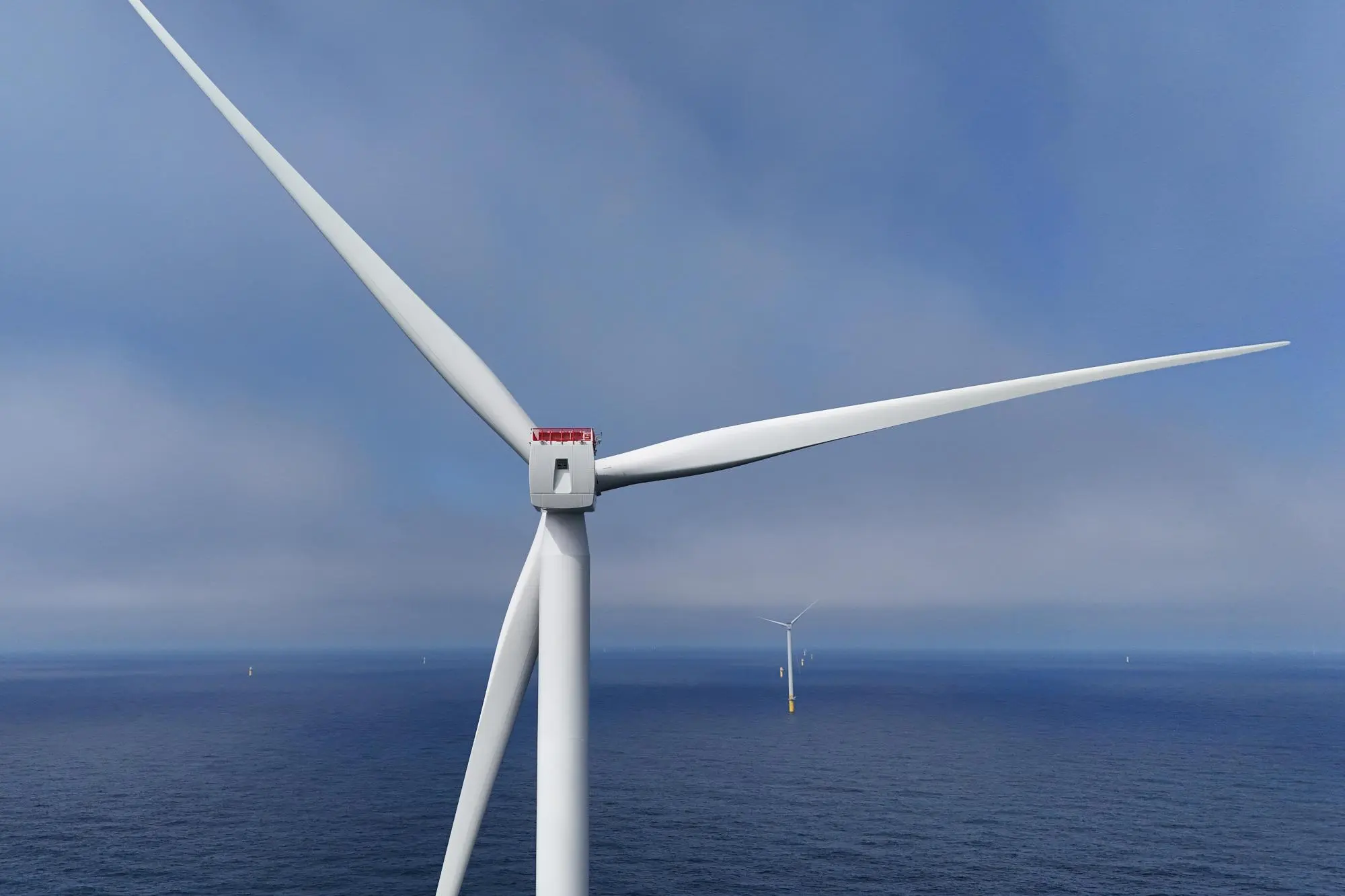
California’s ambitious plans to build multiple offshore wind farms suffered a further blow Thursday after another company struck a deal with the Trump administration to redirect investments to other projects.
Read more Louisiana school board and federal government end 61 years of segregation monitoring
RWE, an energy multinational based in Germany, announced it will relinquish the company’s offshore wind leases in New York, Louisiana and California as part of a $1.22 billion settlement with the U.S. Department of the Interior.
One of those projects is the Canopy Offshore Wind Farm in Humboldt Bay in Northern California. RWE had earlier purchased a federal lease of more than 63,000 acres to develop a floating offshore facility 28 miles from the shore, designed to provide 1.6 gigawatts of electricity by the mid-2030s, enough to power 640,000 homes.
The demise of Canopy is the third floating offshore wind project in California to go by the wayside this year.
In June, Invenergy, a Chicago-based power generation company, nixed plans to construct a host of wind farms in the U.S., including the Even Keel Wind project off the coast of Morro Bay that would have covered more than 80,000 acres.
And in April, Golden State Wind LLC agreed “to voluntarily end” its lease for its project, also in Morro Bay.
That leaves just two developers with active offshore wind leases in California — one in Morro Bay and one in Humboldt Bay.
“After careful consideration, it was determined there is no path forward to permit these projects in the U.S. for the foreseeable future,” RWE said, adding that the deal allows the company “to direct resources toward energy projects that can be advanced with certainty.”
RWE did not specifically say where it will steer the $1.22 billion, but made reference to the company’s investments in natural gas and liquefied natural gas (LNG) projects in the U.S.
Interior Secretary Doug Burgum said the agency welcomed the agreement and RWE’s “voluntary investments” to strengthen the nation’s energy security and baseload power.
“Americans deserve an energy system built on common sense, not one dependent on costly subsidies or technologies that can’t meet our country’s current demand,” Burgum said in an email.
Through a spokesperson, Gov. Gavin Newsom blasted the latest U-turn for offshore wind in California.
“The pattern is impossible to ignore,” Anthony Martinez of the governor’s office said in an email. “After getting beaten in court again and again, Trump has stopped trying to win on the merits and continues to make backroom deals to kill clean energy projects — a gift to his fossil fuel industry donors at the expense of America’s economic security.”
California officials have already filed two notices of intent to sue the Department of the Interior regarding the buyouts of the two lease agreements in Morro Bay and, judging by the tone from the governor’s office Thursday, a third one may be coming.
“While China and other global competitors race to dominate the technologies that will power the future, California is building a modern grid, energy independence, and an energy future that Trump is too small to understand,” Martinez said.
Humboldt County is part of the congressional district of Rep. Jared Huffman, D-San Rafael.
“Like a mob boss, Trump tightened the screws on RWE and, shamefully, the company capitulated and went along with this sham deal that robs the American people and makes a mockery of RWE’s stated commitments to clean energy,” Huffman said in a statement.
Read more El Cajon Councilmember Gary Kendrick withdraws from re-election bid
Environmental groups also spoke out, with the Environmental Defense Fund saying the White House is “saddling families and businesses with more expensive, polluting energy” and the Sierra Club accusing the administration of trying “to kneecap offshore wind development in the United States.”
The Department of the Interior defended the reversals, saying offshore wind projects rely on “expensive backup systems” and foreign supply chains.
“Forcing California taxpayers to prop up these wind leases is reckless, expensive and irresponsible,” the Interior Department said in a statement to the Union-Tribune. “Redirecting funds into American oil, gas and LNG infrastructure ensures reliable, affordable, domestically controlled energy instead of doubling down on one of the costliest and least dependable power sources on the market.”
A member of the REACT Alliance, a group based in San Luis Obispo opposed to offshore wind projects, said her organization “is thrilled” by the cancellation of the Canopy wind lease.
“Industrializing the ocean is a bad idea in general,” said Nicole Dorfman, the group’s secretary and one of its board members. “We believe it’s tremendously harmful for the environment, the economy, the communities, so we’re grateful that these companies are stopping their plans.”
California policymakers have committed to derive 100% of the state’s electricity from carbon-free sources by 2045, if not sooner, and energy supplied by offshore wind is considered an essential piece to reach that goal.
But offshore wind projects in California are different than facilities in other parts of the country. Unlike the East Coast, where turbines can be bolted into the seabed, the continental shelf off the Pacific coast plunges steeply.
That means offshore wind farms in California must float on the water’s surface, tethered or moored by cables to the ocean floor. Electricity generated by turbines will be transmitted to a floating substation and carried to a power plant onshore via buried cables.
There are no plans to construct floating offshore wind farms in San Diego or Southern California.
That’s in large part due to discussions between military officials and the Bureau of Ocean Management that led to designating Southern California as a “wind exclusion” area because of concerns that offshore wind facilities would interfere with training missions.
In addition, wind speeds in the south are not as strong or steady as those in Central and Northern California.
Despite RWE’s announcement, the trade group representing the state’s offshore wind developers and tech companies expressed confidence that the sector will grow.
“We won’t be deterred by ill-informed and legally dubious attempts to undercut our energy independence,” Adam Stern, executive director of Offshore Wind California, said. “California will find a way to make floating wind a key part of its clean-power future.”
President Donald Trump has long derided wind energy.
His opposition dates back to at least 2006, when he tried to block an 11-turbine facility off the coast of Scotland within sight of a golf course he built. He lost the case and was ordered to pay the equivalent of nearly $300,000 in legal bills.
Upon returning to the White House in January 2025, Trump issued a review of leasing and permitting practices for all wind energy projects in the U.S. and called for a temporary withdrawal of all areas on the outer continental shelf from offshore wind leasing.
In early March of this year, Trump told a group of tech executives to invest in fossil fuels rather than wind energy. “Don’t worry about wind,” he said. “Forget it. It’s worthless.”
Read more FACT FOCUS: A look at Trump’s false and misleading claims about the Reflecting Pool