




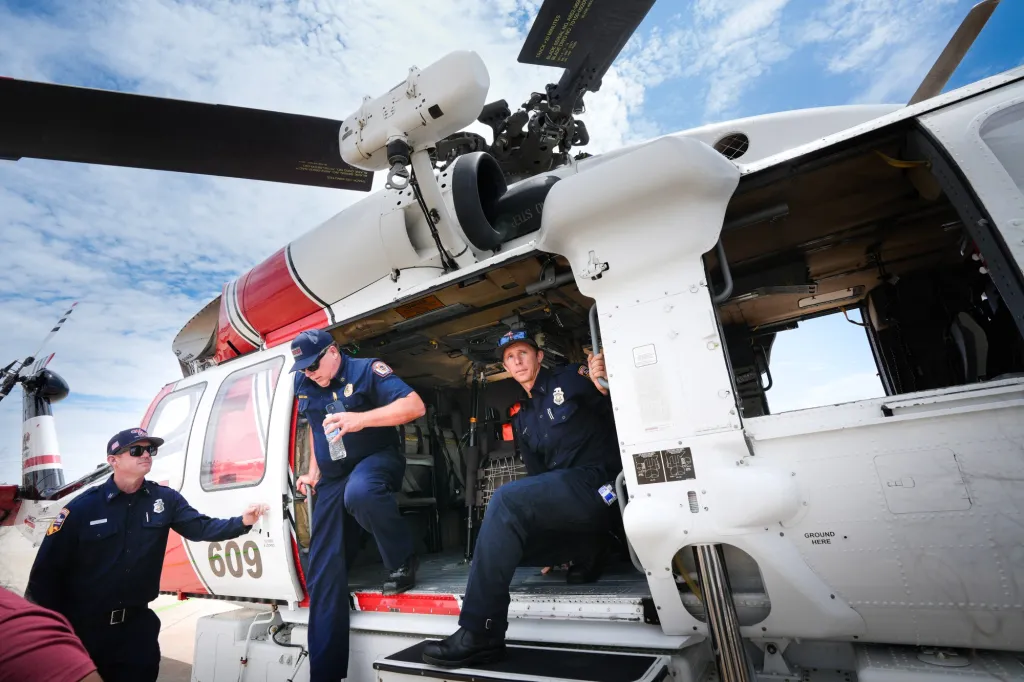
Cal Fire’s Ramona Air Attack Base celebrated its reopening Monday after undergoing construction to redesign its aging facility and improve the efficiency of loading fire retardant onto large air tankers.
Read more 93 motorists ticketed during Escondido traffic operation
The $20 million improvement project began last August and reopened in mid-June. It included the removal and installation of the underground piping system, which hasn’t been updated since the base’s establishment at the airport in 1957, according to Cal Fire Chief Tony Mecham. There are also five new fire retardant tanks and an underground system that allows quicker water reload into aircraft.
The fire retardant reloading bays were redesigned so that larger aircraft could pull off the airport taxiway directly to reload, rather than taking a “90-degree awkward spin” to be hooked up to a hose, Mecham said. The retardant plant can also hold 20,000 gallons, and the area can have six aircraft at any time.
The air base also welcomed two new game-changing aircraft, including a C-130H — a four-engine military aircraft — that was repurposed for firefighting. It was acquired from the U.S. Coast Guard in 2023 and has been in operation in San Diego for about a month, according to John Perry, a Cal Fire firefighter.
Perry said the aircraft is available for initial attacks and can get anywhere in the county within 20 minutes. Compared to S-2s, which can drop 1,200 gallons of retardant, the C-130 can drop 4,000, or do what Perry calls “split attacks” that can drop 1,000 gallons at a time.
“For the future, it means more retardant on the ground and stopping more fires a lot quicker,” Perry said.
It can reload in under 10 minutes and has already been used during the recent Thorn fire near Boulevard and other minor fires in the county, Perry said.
“It’s long overdue,” Cal Fire Director Joe Tyler told reporters during Monday’s open house.
Another big addition to the base, costing around $35 to $38 million, is the S-70 Cal Fire Hawk — a night-flying helicopter. It was acquired at the end of May and is the first night firefighting aircraft in San Diego, according to pilot Cliff Gates.
Read more Photos: Comic-Con wrapped trolleys
It was purchased by Cal Fire in Poland, shipped to Texas, trucked to Colorado, then was flown to Sacramento and made its way to Ramona. Gates said pilots wear night vision goggles attached to their headgear that allow them to see in the dark.
Mitchell Edwards, a Cal Fire engineer, said it can hold 1,000 gallons of water, lift or lower personnel when landing is not possible and transport crews to inaccessible locations.
“This could not come at a more important time,” said county Supervisor Terra Lawson-Remer. “Our days are getting hotter, our nights are getting warmer, the winds are stronger and fields are drier. Wildfire does not stop when the sun goes down.”
The Hawk also helped during the Thorn fire, along with the Palisades and Hughes fires in January 2025 and recent Camp Pendleton fires.
“To continue even after the sun goes down is a game changer,” said county Supervisor Joel Anderson during the event.
A second phase of construction at the air base is anticipated to begin in the fall on 14-person barracks to house pilots, as Cal Fire transitions to a 24-hour operation, Mecham said. He said the work is expected to be completed by next June. Cal Fire will also expand the helipads for helicopter landings.
“It’s not about airplanes and concrete; it’s about pilots,” Mecham said. “It’s about the people that maintain those aircraft; it’s about the firefighters who fly in those aircraft … it’s a total team effort.”
Read more Trump administration opens investigation into Harvard’s financial aid for international students