





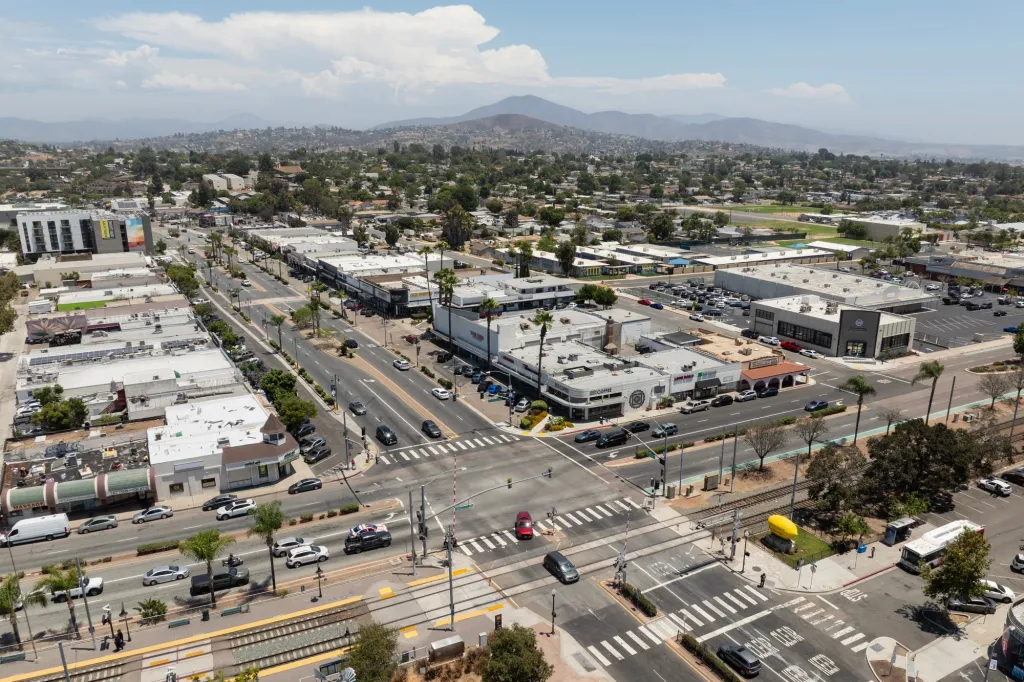
Lemon Grove is advancing a sweeping update to its Downtown Specific Plan that would transform the Broadway corridor into a denser, transit-oriented hub over the next two decades. The plan would add housing in hopes of drawing businesses by leveraging new state laws that encourage higher-density development near transit centers.
Read more Trump celebrates the World Cup as a US victory as he prepares to present trophy to the winning team
The revised blueprint would quadruple the plan area to about 245 acres on Broadway from Massachusetts Avenue to Washington Street. Notably, it would rezone former industrial zones to mixed-use sites for residential use, while increasing walkability and supporting integration of a new trolley-bus station.
“At the end of the day … the downtown specific plan really gives us the ability to have local control over our future,” Interim City Manager Tony Winney said, during an informational meeting held Wednesday by Revitalize Broadway, a local group that focuses on enhancing the city’s business corridor.
City officials plan to build off of a version of the proposal that was shot down by officials in 2018 due to concerns about the project’s scale and high-density development focus.
To streamline the process, officials said they are reviving the same plan because the environmental review was already approved. What remains to be seen is whether residents and city leaders are now more receptive to the idea of high-density development.
“A lot of things have changed here since 2005,” Winney said. “There’s a lot more desire for walkable spaces and we want to continue to see our business community grow here and we also want to create a broader mix of housing options available to the community.”
In recent months, the city has unveiled its new vision to intertwine development goals with new state density laws. The proposal focuses on Senate Bill 79, a recently passed state housing law that overrides local zoning limits by allowing — and sometimes forcing — cities to build denser residential developments near major transit stops.
At the heart of Lemon Grove’s downtown corridor is a trolley station, which officials said is central to their plan to increase walkability and housing availability.
Read more San Diego County confronts fresh round of sex-abuse claims by former youth
“We are proposing an emphasis on mixed-use and residential development,” said Sydney Rankmore, a community planner for RICK Engineering, a consultant brought in by the city for the project.
That largely aligns development plans with state density law by allowing three- to seven-story housing and mixed-use buildings within a quarter-mile of the transit station near the intersection of Broadway and Lemon Grove Avenue.
The plan would also propose an arts and entertainment overlay, as well as a potential community benefits program.
But similar transit-oriented housing developments in neighboring East County cities have begun creating parking supply issues. In La Mesa, many apartment complexes do not supply parking for every resident due to their proximity to transit options; officials are mulling solutions to the supply shortage as development continues.
“Parking is a big part of this analysis,” Rankmore said. “We are trying to find the balance between the two (transit-oriented housing and parking supply).”
In 2025, the city received $300,000 in grant funding from SANDAG to put toward the development plan.
Now, staff are actively holding workshops and meeting with stakeholders to gauge public opinions on the redevelopment proposal., which is expected to go before the city council and planning commission in the late fall.