




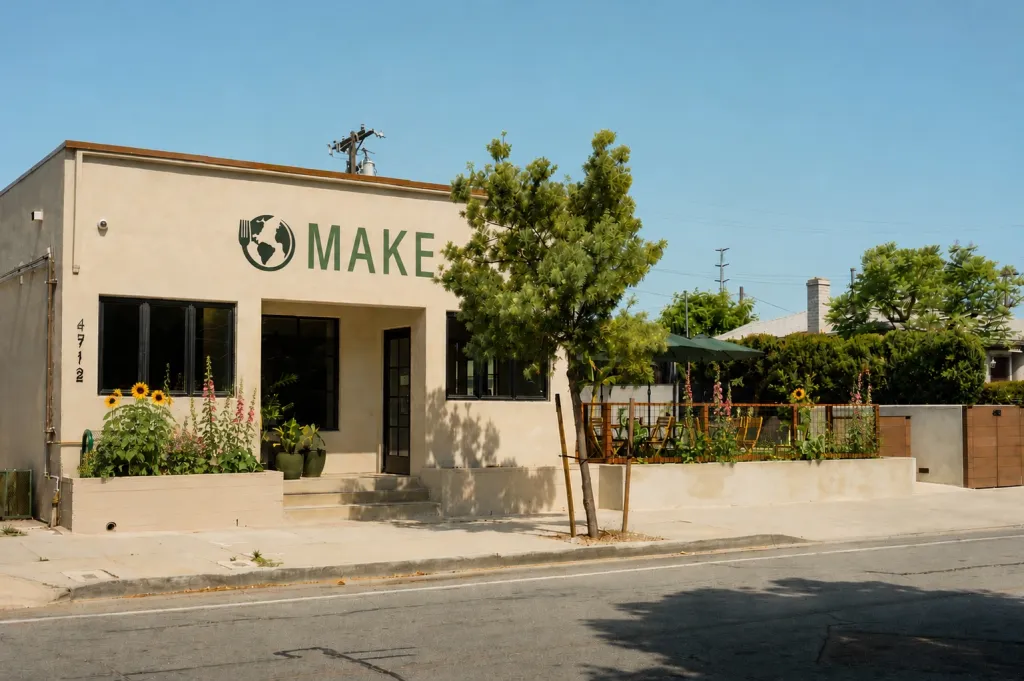
Mandazis, ginger rice congee and crispy lentil kofte can be found in a new cafe, run by the nonprofit organization MAKE Projects, which opened at the end of June with a mission to empower immigrant and refugee women.
Read more Trump posts a doctored photo of the Obamas and Air Force One with graffiti spray-painted on plane
Located in a garden dining environment, MAKE Cafe provides paid workforce training and professional skill development. Participants gain real-world experience in agriculture, hospitality, customer service and food preparation — all while honing their ability to communicate in English with customers and coworkers.
Stephania Louis, an immigrant from Haiti, was drawn to the program as an opportunity to practice speaking English in the workplace before returning to school to pursue nursing.
“My goal is to improve my English,” Louis said. “When I enrolled for this program, they would say, ‘We want you to speak with each other, improve your English and grow your communication in English.’ This sentence made me happy to enroll.”
Founded in 2017, MAKE Projects also runs the MAKE Farm, a hyperlocal urban farm located at San Diego State University. The organization originally piloted MAKE Cafe in July 2021 as an outdoor pop-up cafe in North Park. Now, after five years of pop-up and temporary locations, MAKE Projects has a permanent cafe and headquarters.
The cafe presents a farm-to-table menu, sourcing much of its produce from the MAKE Farm, along with its on-site gardens and other local farms.
MAKE Cafe intends to employ around 40 women per year, onboarding three new participants each month. The program consists of a 12-week paid work experience and job readiness program at the farm and cafe, during which the employment team provides trainings and customized services for participants to find permanent employment after their time with MAKE Projects.
Maria Maximo, who is from the Dominican Republic, said she believes the program is providing her with the experience she needs to achieve her dream of opening her own restaurant.
“I’m so happy to be a part of this project,” Maximo said. “I think this a big opportunity to grow in the United States. We stay together, and then we grow together.”
“Now I can speak with the public,” Maximo added. “I’m more comfortable and confident.”
All participants spend a month working at MAKE Farm, followed by a month working as kitchen assistants at MAKE Cafe. After working in the kitchen, trainees are prepared to talk about the items on the menu, and they spend their final month of the program working as servers and baristas at the cafe.
Read more A new ICE facility could speed up deportations for families and kids
Anli Hagiyama, an immigrant from Japan, currently works as a barista in the final stage of the program. After her time at MAKE Cafe, she will be participating in a culinary apprenticeship program, and, like Maximo, she also hopes to open her own restaurant in the future. Hagiyama said she has gained communication and leadership skills during her time in the program.
“I’ve had a really, really amazing experience from here,” Hagiyama said. “I just want to keep going at what I’m doing, and I’m just grateful for everybody for supporting me.”
When creating the cafe’s menu, Executive Chef Ashley McBrady hoped to reflect the diversity of the trainees, as well as that of the broader San Diego community.
“San Diego is such a melting pot,” McBrady said. “These are places that are already represented in San Diego, and it’s not an uncommon thread to see these flavors, whether it’s in a high end fine dining restaurant or in a small cafe. Bringing them in an affordable and approachable way seemed to make the most sense.”
Founder and Executive Director Anchi Mei explained that, with participants spending only a month in the kitchen, they had to create a menu they could execute. The cafe is starting a daytime business and currently serves breakfast, brunch and lunch.
Mei said that the cafe has shifted away from referring to foods as coming from specific countries. She noted that many of the cafe’s menu items, like flatbread, extend across many different cultures.
“It’s really about bringing everybody together,” Mei said. “What we’re trying to celebrate are the many different ways we’re the same.”
MAKE Projects’ goal is to employ 600 refugee and immigrant women in San Diego County by 2030.
“Our vision is an inclusive San Diego that gathers over a common love of food, flavor and culture,” Mei said. “Especially right now, when we’re asking ourselves, ‘Who is America? What does this 250th birthday mean?’ I feel like MAKE is an answer. It is an answer that affirms that the people we see every day walking these streets in Normal Heights that come are just really awesome humans that share a vision of an inclusive San Diego, where immigrant flavors and immigrant contributions to our economy are not a threat, but an asset, and where we all get along.”
Read more Trump rings Wall Street’s opening bells as he ties his presidency to stock market gains