





Today’s column is the seventh in a series about the birds and animals that visit Secret Spring, a remote waterhole in the oak and pine forest of Palomar Mountain.
There is very little I fear in nature.
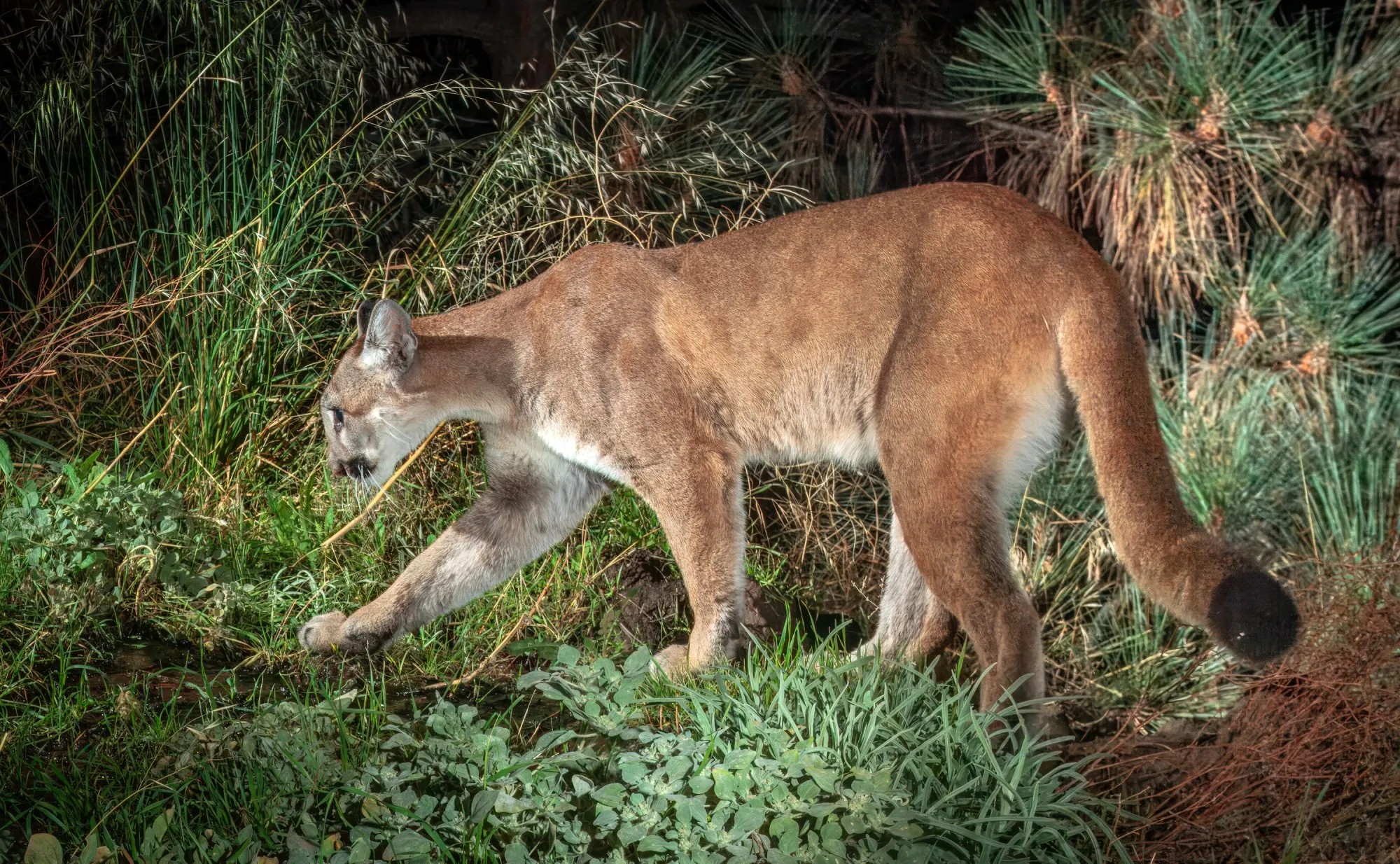
OK, I’m not big on spiders, but the hair on the back of my neck bristled when the image of a powerful mountain lion popped up on my camera’s viewing screen.
The long shadows of early morning still dappled the silent forest, and the time stamp on the image showed the cat had been here less than an hour earlier.
It could very likely be nearby, crouched in the shadows watching me.
In the blink of an eye, this animal is the only thing in the woods with the speed, strength and power to strike prey like a bolt of lightning.
But my fear was soon replaced with celebration because capturing this image of the most powerful animal in the woods made me feel like a high school football player who had just scored his first touchdown.
For nearly three years I had been deploying sophisticated, motion-triggered cameras in San Diego’s wild places in hopes of photographing a mountain lion.
There had been some success with pictures from behind of a passing puma, or just the legs as they walked too close to the camera.
But this was the money shot at last, as the apex predator gazed fearlessly into the camera.
Now, a year later, my camera at Secret Spring has successfully captured passing lions several times, recording nearly 200 images as they paused to drink from the tiny pool of clear water.
Unlike the smaller animals like skunks, foxes, bobcats and opossums, the mountain lion has a vast range of several hundred square miles and might not return to Secret Spring for several weeks.
Male lions can range an area of up to 250 squares miles, while females occupy smaller ranges of 50 to 100 square miles, depending on food availability, water and habitats that are not fragmented by highways or human population.
For a year now, I have had a remote, motion-triggered camera at the tiny waterhole, tucked into a grove of oaks and pines on Palomar Mountain.
The camera has captured nearly nightly visits of smaller animals like skunks, opossums, owls, foxes and bobcats. Daytime visitors included flocks of acorn woodpeckers, scrub jays, Steller’s jays, juncos, mountain quail, hawks and wrens.
But it was the mountain lion, cougar, or puma, that I was most interested in capturing photographically.
The mountain lion’s reputation as ghostly and elusive is well earned.
Even the most devoted outdoor enthusiasts have rarely seen more than the palm-sized tracks of the cougar, or at best a rare glimpse as they slip away into dense woods in early-morning light.
In more than a half-century outdoors, I have seen two in the wild.
One was crouched in summer grass along the Azalea Glen Trail in Cuyamaca Rancho State Park. The big cat just watched as I passed.
The second encounter was during a predawn hike when my headlamp illuminated two green objects reflecting about 30 yards ahead of me.
Suddenly the reflectors “blinked,” and I realized they were the eyes of an animal.
I stopped and could clearly see the ghostlike form as the large cat turned to leave the trail and melt into the thick brush.
A good mountain lion photo became an obsession.
For several years I had set up high-resolution digital cameras and motion-triggered flashes along animal trails, near ponds or approaches to livestock water troughs.
Lots of wildlife images were captured, but the lions remained elusive.
Then I found Secret Spring.
It’s a small wetland created by overflow from nearby, spring-fed water storage tanks.
The perennial pool is only about the size of a manhole cover but provides a dependable source of clear, fresh groundwater tucked into an intimate grove of forest trees and a thicket of reeds.
Access is by a narrow trail, providing an excellent focus point for the camera.
The mountain lions began showing up more frequently as summer heat shrank other available water sources.
These powerful creatures are masters of their domain at the top of the food chain and have no natural predators.
These are carnivores that feed entirely on meat, primarily deer, bighorn sheep and livestock.
When these food sources are not available, they will feed on smaller game, such as raccoons, rabbits, coyotes and rodents.
With an estimated population of around 100 in San Diego County, their numbers are more concentrated in forested areas such as Palomar Mountain, due to the availability of deer and water.
Their range extends to the eastern desert and to the inland foothills.
As hunters, the mountain lion relies on cover and stealth, stalking prey to within a few yards.
Their large, muscular rear legs allow them to leap up to 40 feet horizontally in a single bound and kill prey instantly with a powerful bite to the neck.
Fortunately, we are not a natural food source for mountain lions and attacks on humans are extremely rare.
In the Kumeyaay culture, this powerful creature called nyemetaay is admired for its agility, stealth and strength as a hunter.
They are recognized as sacred animals because of their environmental stewardship, strong spiritual energy and as guardians of native ancestral lands.
Consider yourself lucky if you are fortunate enough to see one in the wild.
Cowan is a freelance columnist. Email [email protected] or visit erniecowan.substack.com.
Read more ‘We have to be proactive.’ El Cajon leaders revive plan to potentially acquire Parkway Plaza.