






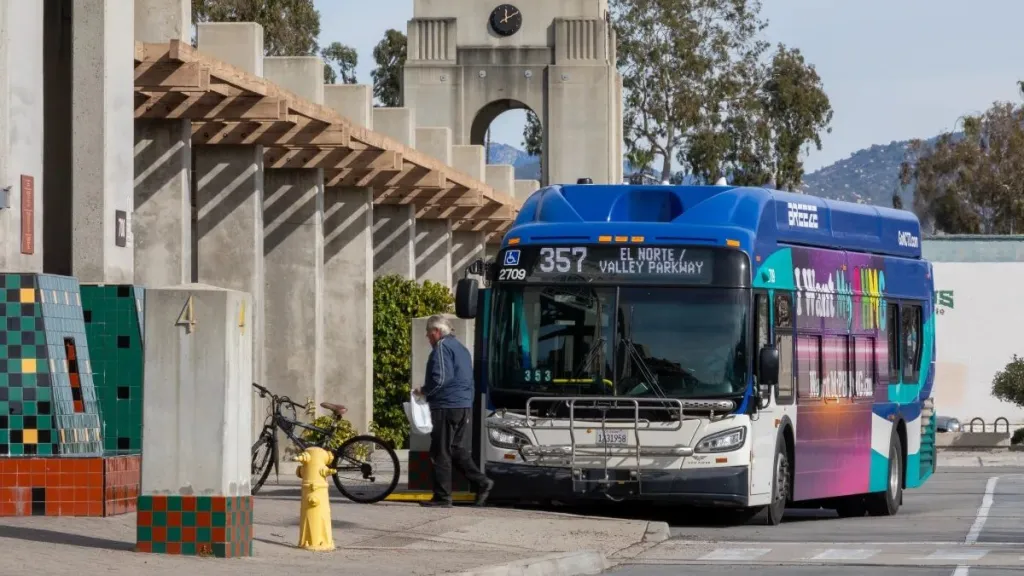
North County Transit District could reduce train service and cut or consolidate bus routes in the next few years as the agency faces a growing budget deficit, despite higher fares to take effect this fall.
“Transit agencies nationwide are experiencing budget shortfalls, in part due to declining sales tax revenue, inflation, rising costs in general, and uncertain state and federal funding sources, among other factors,” Chief of Staff Mary Dover told the NCTD board at its monthly meeting Thursday.
The district’s budget is balanced for fiscal 2026-27, Dover said. However, it faces a possible deficit of $7.7 million in fiscal 2027-28, gradually increasing to more than $33 million in fiscal 2030-31 without significant changes in operations or revenue.
“We have a plan involving SB 125 funding to help cover that gap for the next few fiscal years,” she said.
Senate Bill 125 approved by the Legislature in 2023 provided $4 billion statewide for transit and intercity rail programs. NCTD could get millions of dollars of that for maintenance and capital projects such as double-tracking, railroad bridge replacement and new passenger platforms.
A long-anticipated fare increase approved by the San Diego Association of Governments Transportation Committee on Friday, a day after the NCTD board meeting, is unlikely to have much effect on the budget.
Fares provide a fraction of the district’s revenue, about 8%, with the rest largely from state and federal sources, officials said. Also, when fares increase, ridership usually decreases and initially offsets the uptick in revenue.
If ratified by the full SANDAG board on July 24, the new fares will be implemented over a two-year period to lessen the initial impact on riders. The first increase will take effect on Oct. 1, and the second will begin Oct. 1, 2027.
Monthly passes for the Metropolitan Transit System, which serves the city of San Diego, and NCTD’s Breeze buses will increase from $72 to $85 for adults and from $23 to $28 for senior, disabled, and Medicare recipient (SDM) riders, according to a SANDAG news release.
NCTD Coaster passes will transition from a zone model to a flat fare model. All Coaster one-way fares will reflect the current Zone 3 price of $6.50 for adults and $3.25 for SDM riders. Monthly Coaster passes will increase to $185 for adults and $60 for SDM riders.
With the second increase, in fall 2027, monthly MTS and NCTD passes will increase to $95 for adults and $30 for SDM riders.
Read more Stalled Oceanside luxury home project faces steep water board penalty
The fare changes will not affect the youth opportunity pass for riders age 18 and younger. Also, fares will not change for adult riders enrolled in CalFresh, Medi-Cal, or CalWORKs programs.
The NCTD board should be ready to consider other solutions that could be needed to balance the budget, Dover said.
The $7.7 million deficit forecast for the fiscal 2027-28 budget could be closed by reducing all modes of service to hourly frequencies on weekends and eliminating the on-demand NCTD+ service on weekends, she said. NCTD+ provides shared rides in a van accommodating up to eight people for a short distance within a community.
The $23 million deficit anticipated for the 2028-29 budget could be closed by eliminating all Breeze bus service, NCTD+ and Flex, an on-demand, flexible route service, on the weekends and discontinue Sunday Sprinter and Coaster train service.
And for fiscal 2030-31, which the deficit could reach $33.6 million, she said, the budget could be balanced by reducing all weekday services to hourly frequencies and eliminating NCTD+ entirely.
“Those are obviously very drastic changes,” Dover said.
Other changes could be made to achieve the savings, she said. For example, NCTD+ service could be eliminated in Vista and San Marcos, and replaced by a less expensive bus route to achieve the $1.7 million savings to balance the budget next year.
“We are always looking at trying to improve the productivity and efficiency of our services so that we can stave off some of these drastic service changes,” Dover said.
District planners are constantly evaluating ridership and travel patterns to be sure bus routes continue to match the places people need to go, she said. Also, there are places where multiple bus routes unnecessarily overlap.
“There are glaring locations in our grid where we have overlap,” said District CEO Shawn Donaghy. “When I go to a bus stop and I see three (signs) for three different routes, that is significantly unproductive. Those are the things that we are trying to solve.”
Another possibility being considered is whether communities like Vista and San Marcos are willing to pay some of the costs to provide services such as NCTD+ to their residents, he said.
Read more Will vaccine boosters be necessary as measles spreads nationwide?