






Hundreds of thousands of voters in eight San Diego County school districts and one community college district will decide a slate of facilities bonds on November ballots — and for one district, the stakes are particularly high this year.
Bond measures for decades have been California districts’ preferred means of improving their facilities, and to pass, they face an unusual threshold, requiring approval from 55% of voters.
When voters approve a bond, they temporarily raise property taxes so a school district can borrow money specifically to fund school facility needs. This year’s bonds would raise property taxes by between $13 and $58 per $100,000 of assessed value, depending on the district.
This year, San Diego Unified School District, the state’s second-largest school district, is pursuing the region’s largest school bond, at $3.5 billion, while the one-school Julian Union High School District seeks the smallest, at $9 million.
In San Diego County this fall, the measures would generally address districts’ aging infrastructure, as their schools have approached — or flown past — their lifespan.
But for one sprawling rural school district on the county’s eastern and southern edge, there’s an opportunity to make a generational upgrade.
Mountain Empire Unified School District this year got $2.2 million from the state for its elementary schools and has been securing state money for a redesign of its high school. But to get started building the new high school, it needs voters to pass a $23 million bond effort, Measure L.
The district will apply to be in “facilities hardship,” a state that sets aside 50% of the replacement cost but still requires a community match. In order to access that money, Mountain Empire needs to be able to match it — which means asking voters to pass a bond measure.
Indebtedness from a bond would allow the district to apply for financial hardship — which counterintuitively would unlock more state funding, letting the district improve its elementary schools.
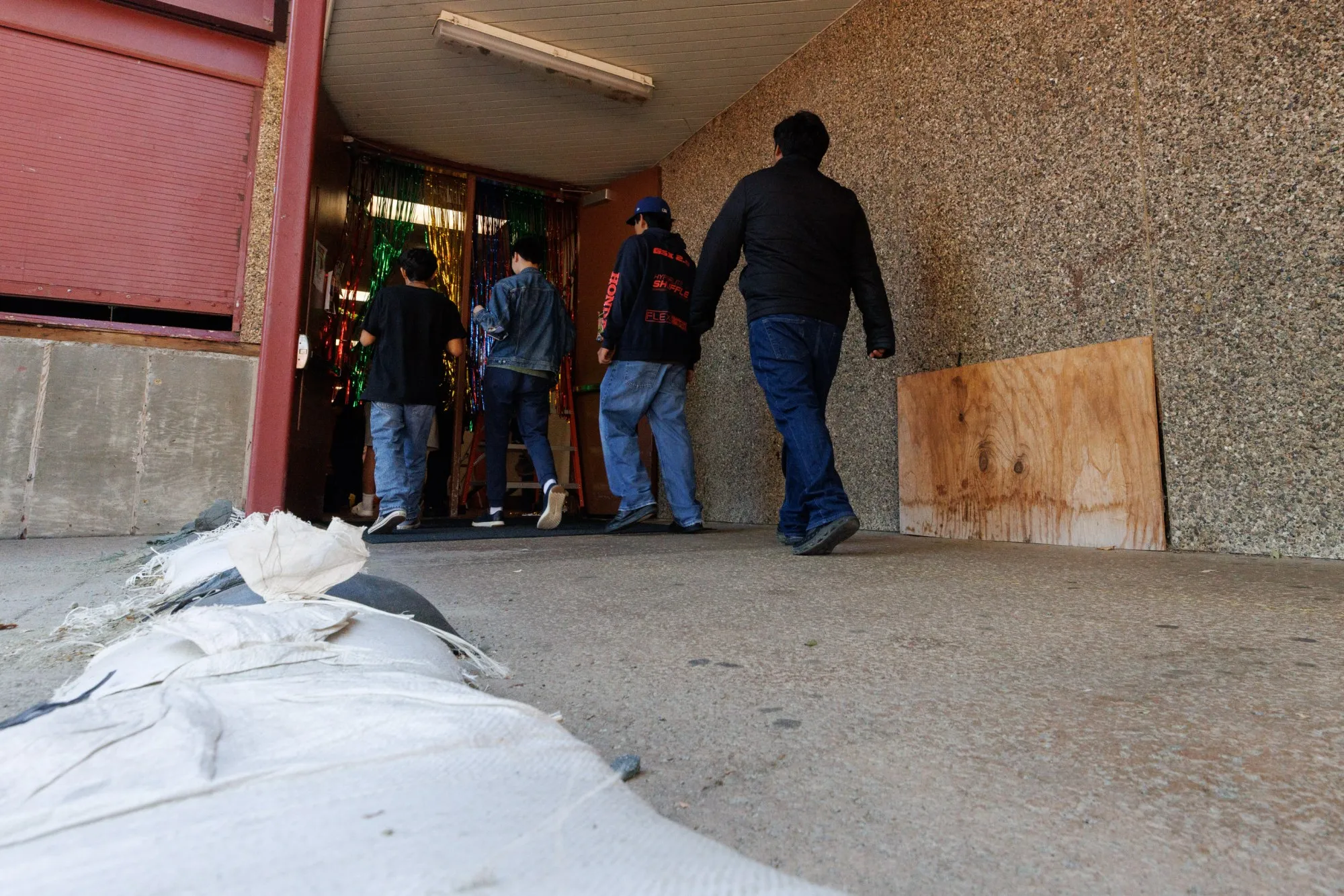
The issue is less a lack of maintenance than major structural issues, some stemming from what its superintendent called “interesting” design choices when the schools were built in the 1970s — among them the use of concrete studded with rocks for building facades.
During an interview this summer at one campus, Superintendent Patrick Keeley ran his hand along one such outside wall, knocking rocks off of it. “You’ve got this aggregate rock wall in the mountains that just blows off in the wind,” he said. “Like, what was that?”
Aside from having more at stake in potential state funding, Mountain Empire has other financial considerations that few of San Diego County’s more urban and suburban districts share.
An unusually large chunk of its budget goes to student transportation, a necessity in such a sprawling rural area.
Despite its huge size, the district doesn’t have much commercial real estate within its boundaries — which makes it harder to raise enough revenue, since school bonds are based on a district’s assessed real estate value.
And the district’s schools rely on well water, requiring expensive system maintenance. Not all of its schools even have potable water.
“How is that even justifiable as a society?” Keeley said. “We shouldn’t be OK that children don’t have clean drinking water in their schools and it’s taken us nine years. We’re, like, on year nine trying to get the wells fixed.”
He worries about what the disrepair signals to his students, who he says are aware of the disparities between what they have and what other kids around the county do.
“When children go to a nicer environment or they go to a school that is in good repair, their self-perceived value increases,” he said. “The kids here have the same dreams as the kids sitting on the coast — the same dreams. And they matter.”
The San Diego Union-Tribune reached out to all of the districts pursuing bond measures this fall and interviewed officials in most of them about the projects they aim to fund.
In Grossmont-Cuyamaca Community College District, a $624 million bond known as Measure G would fund upgrades to fire safety and other work at both Grossmont and Cuyamaca colleges, including possibly replacing child development centers and academic buildings.
Lynn Ceresino Neault, the district’s chancellor, said some of that work is too urgent to wait for a bond to pass.
Grossmont College sits at the edge of canyons, vulnerable to potential wildfire. Already, the college doesn’t have enough water tanks — or enough water pressure — to be prepared for a massive fire. The fire marshal has told them they need enough for four hours, and a permanent solution would involve new plumbing work.
Neault said she didn’t want to think about what might happen if a major fire threatened before the district could complete upgrades.
“We can fight a fire,” she said. “But when you saw what happened in L.A., who could have anticipated that? So it’s really a major wildfire that we’re worried about.”
In La Mesa-Spring Valley schools, Measure AA, if passed, would provide $131 million to upgrade aging infrastructure. Most of the district’s schools were built 60 years ago, and there have been no major efforts since to rebuild them.
Read more ‘The adult Disneyland’: The Miramar Air Show wows a throng of thousands
Air conditioning in particular would get an upgrade. All of the district’s classrooms have air conditioning, but during a recent heat wave, maintenance and operations staff had to work overtime to keep it running.
“Most of our HVAC systems are now past their useful life and are in need of repair or replacement,” said Superintendent David Feliciano. “The need is great, and the state of California does not provide facilities dollars unless districts can provide matching funds.”
Voters in Santee School District will decide on Measure BB — a $30 million bond measure that would fund less than half of the upgrades the district says it needs.
Two years ago, the district used a different bond measure to seek a continuation and extend the then-current tax rate, but it didn’t pass.
“Of course we were disappointed, because we have projects to work on,” said Superintendent Kristin Baranski. She said the district needs more than $70 million in improvements.
If this year’s measure passes, all of the schools in the district would get some improvements. But certain schools — Pepper Drive School, Cajon Park School and Carlton Hills School — have serious roofing and plumbing needs.
This time around, most of the bonds appearing on San Diego County voters’ ballots have been endorsed by the San Diego County Taxpayers Association.
The organization typically starts hearing from school districts seeking its endorsement early in an election year, said Mark Kersey, the group’s president and CEO. It sends out an application that asks districts how big a bond they’re proposing, whether it would raise tax rates and how it would be spent.
“We take those applications, which are fairly detailed, and we review them and put together a report for our board — and then our board makes the determination after it goes through a couple of different committees,” he said.
This year, the only bond the group didn’t endorse was in Jamul-Dulzura Union School District. It was the district’s first effort in decades, and Kersey said his group didn’t think the facilities needed as much money as proposed.
“It might pass,” he said of Measure H. “And if not, then we’re happy to sit down with them again.”
In Vista Unified, where voters will consider a $543 million bond measure, district officials are pointing to one recently reopened school as an example of what the future of their district could look like — if it’s fully funded.
Bobier Elementary School is about 90% off the grid. The hallways are wider than most schools’. Natural sunlight illuminates the classrooms. Shade structures cover the playground. The cafeteria sources food from farms within 50 miles of home.
“What Measure N really is able to do is to give us enough capital to start to reimagine, rebuild our school district, with this (Bobier) being the initial promise,” said Shawn Loescher, the district’s assistant superintendent of business and operations support services.
Next, the district’s top priority is to get rid of the trailers that host classrooms on many campuses — Visual and Performing Arts Academy, Monte Vista Elementary School and Rancho Buena Vista High School in particular have a lot. But the district hasn’t yet decided whether to try to modernize or fully replace those campuses; the board is still in an early exploration phase.
“We live in California, and we have one of the biggest GDPs in the nation — but our schools don’t demonstrate that amount of potential,” said trustee Martha Alvarado. “Without the taxpayers investing in a bond measure, we’re basically putting Band-Aids on modernization and facilities problems.”
Nearby, Fallbrook Union Elementary School District is pursuing a $76 million bond with Measure K. Trustee Frank Golbeck said in an interview that it has been almost 25 years since their last bond, and they have major facility issues, with teams assessing over $400 million in projects.
“Just last year, we had a water pipe at a school break, and we excavated it and repaired it, and then a week later it broke about 10 feet down the road,” he said.
All campuses would get some updates, but the 77-year-old facilities of Fallbrook STEM Academy and Potter Junior High School would get the bulk of them. Potter is where every non-base student in the district goes to middle school; the district also operates two schools on Camp Pendleton.
“There’s asbestos we need to get rid of,” he said. “There’s roofs that need to be redone. There’s electrical that needs to be updated.”
Superintendents aren’t allowed to campaign for bonds, and in an interview, Keeley stressed that voters in Mountain Empire should vote in whatever way is best for them.
But if Measure L doesn’t pass, it’s not clear when his district might get another opportunity for this kind of overhaul. Mountain Empire is in line for state funding, and if it needs to start over, it will be sent to the back of the line. “There’s no guarantee,” he said.
Still, he’s hopeful this year.
The last time the district succeeded with a bond was in 2018. It passed by fewer than 20 votes.