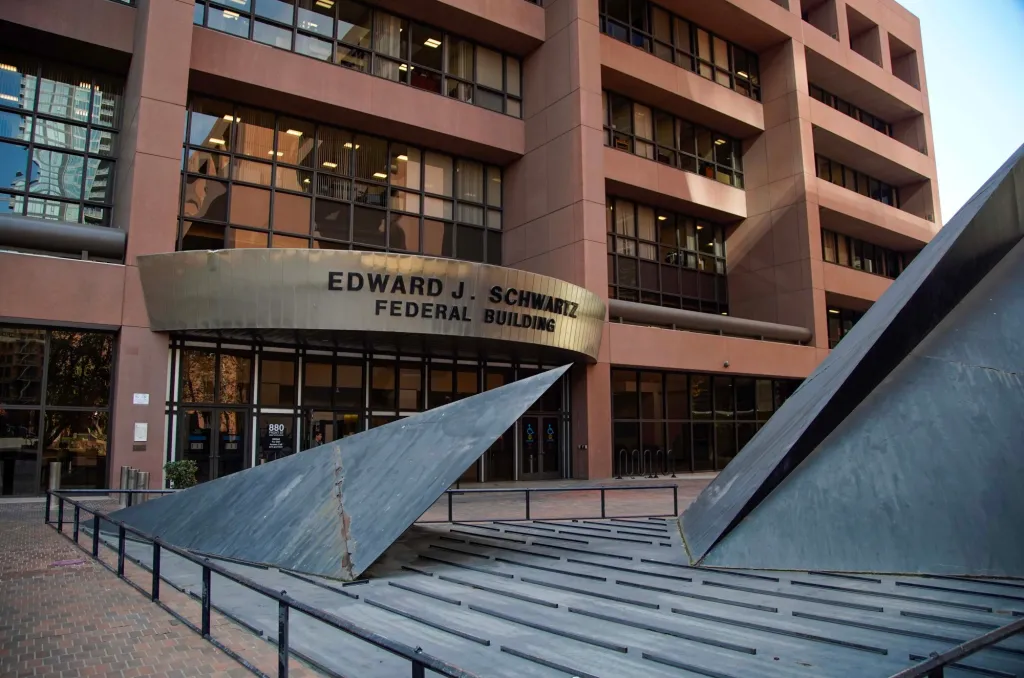









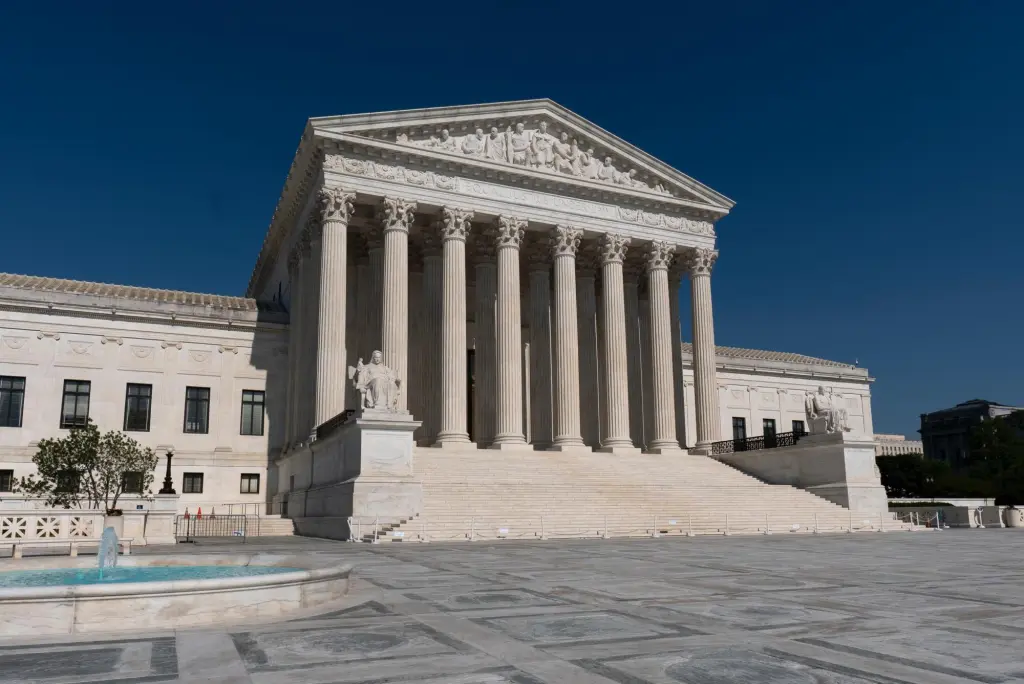
The Supreme Court ruled 6-3 on Thursday in a case originating in San Diego that the Trump administration can block asylum-seeking hopefuls on the Mexican side of the border, thus preventing them from reaching the U.S. to seek asylum.
Read more Arrest made in 2021 fatal Chula Vista shooting
The ruling, though it applies to a policy the government has rescinded, is expected to embolden the Trump administration’s continued efforts to restrict immigration and asylum in the U.S. The Federation for American Immigration Reform, a conservative organization that supports strict immigration policies, called the decision “a big win for immigration enforcement” in a social media post.
Immigrant-rights groups said the court’s ruling violated international law, went against the intent of Congress and will endanger the lives of vulnerable, persecuted people seeking refuge in the U.S.
“This decision has destroyed the United States’ position as a global leader in promoting the rights of refugees and threatens to serve as a dangerous justification for other countries that unlawfully prevent refugees from crossing borders in search of safety,” Erika Pinheiro, executive director of Al Otro Lado, the organization that challenged the law, said in a statement. “In a world of increasing conflict and climate disaster, this hardening of borders to keep out the most vulnerable is sure to result in many more lives lost.”
The case was centered on a policy that the federal government described as “metering,” in which immigration officers systematically blocked and turned away asylum seekers beginning in 2016 at ports of entry in San Diego and elsewhere along the U.S.-Mexico border when the officers deemed a port to be at capacity.
Al Otro Lado, which challenged the law along with would-be asylum seekers who’d been blocked, argued the practice amounted to an illegal turnback policy. The organization argued such a policy violated both federal law and international treaty obligations that were agreed to in the wake of World War II, when Jewish refugees who were denied safe harbor in the U.S. and elsewhere were subsequently killed in the Holocaust.
The case came down to what it meant for an asylum seeker to arrive in the U.S. and thus be eligible to ask for protection. The government argued the phrase “arrives in” must be defined literally as setting foot on U.S. soil. Al Otro Lado argued that an immigrant who arrives at a port of entry has met the legal standard even if he or she hasn’t technically stepped across the international boundary.
The 9th U.S. Circuit Court of Appeals had upheld a San Diego federal judge’s ruling and sided with Al Otro Lado. The Supreme Court on Thursday overturned the 9th Circuit’s ruling and sided with the Trump administration.
“This case presents a straightforward question: whether an alien who seeks to enter the United States from Mexico ‘arrives in the United States’ when he or she is still in Mexico,” Justice Samuel Alito wrote in the majority opinion. “The United States Court of Appeals for the Ninth Circuit answered ‘yes.’ That is wrong. In ordinary speech, no one would say that a person ‘arrives in’ a place — for example, a house, a city, or a country — before the person enters that place. The context in which the phrase ‘arrives in the United States’ is used in the immigration statutes at issue here supports an ordinary-meaning reading.”
Thursday’s ruling comes at a time when the situation at the border looks vastly different than 10 years ago, when the “metering” or turnback policy was first enacted. Due to stricter policies that have been implemented since then, immigrant arrivals at the U.S.-Mexico border fell sharply at the end of the Biden administration and continued through the first year of President Donald Trump’s second term.
But the case dealt with issues that remain relevant — Al Otro Lado filed a new lawsuit last year alleging that even without “metering,” Trump’s anti-immigration policies have made it nearly impossible for individuals to seek asylum.
Read more Supreme Court clears way for Trump administration to revive restrictive policy for asylum seekers
Al Otro Lado and its supporters argued that the ruling, despite being narrowly focused on a single policy and the definition of a few simple words, will have a wide-ranging impact.
“Cruelty is not a substitute for real solutions,” Rebecca Cassler, senior litigation attorney at the American Immigration Council, said in a statement. “Blocking people from seeking asylum at official ports of entry will do nothing to fix our broken immigration system; it only makes things more chaotic and dangerous for vulnerable families. What we need is an asylum system that is fair, efficient, accountable, and treats people with dignity. Unfortunately, today’s decision validates an approach that treats people seeking safety as a problem to shut out instead of creating an orderly system that actually works.”
The policy at the center of the case began as an informal practice at the tail end of the Obama administration, when immigration officers at the San Ysidro Port of Entry dealt with a large number of Haitian asylum seekers by turning them away when the officers deemed the port to be at capacity. The practice later spread to other U.S.-Mexico ports and was made official policy by the first Trump administration.
The Biden administration eventually ended the policy, but not before Al Otro Lado and several individual asylum seekers had challenged it in court. The federal laws in question state, in relevant part, that any immigrant “who is physically present in the United States or who arrives in the United States … at a designated port of arrival … may apply for asylum.”
After the 9th Circuit ruled 2-1 in favor of Al Otro Lado, the Trump administration asked the Supreme Court to overturn the ruling. “Administrations of both parties, since 2016, have consistently said this is an important tool in the government’s toolbox for dealing with border surges when they occur,” Assistant to the Solicitor General Vivek Suri told the court during oral arguments in March.
“I can’t predict when the next border surge occurs, but I can say when it does occur, this is a tool that (the Department of Homeland Security) will want in its toolbox,” Suri said, arguing that the phrase “arrives in” must be defined very narrowly by its plain-English meaning.
The court’s majority agreed.
“Everyday examples confirm that understanding,” Alito wrote. “A running back does not arrive in the end zone when he reaches the 1-yard line. A guest does not arrive in a house when he knocks on the front door. An army does not arrive in a city by encamping outside its walls. And a letter does not arrive in a mailbox while it remains in the mail carrier’s hand just inches away.”
In a dissenting opinion, Justice Sonia Sotomayor wrote that the majority opinion “blesses the Executive Branch’s decision to slam the door shut on all who are fleeing persecution” by fixating on the word “in” and ignoring the intent of the laws in question.
“Words … must be read in context and with attention to how they fit into the statute as a whole,” Sotomayor wrote. “The majority ignores the statutory context and history, not to mention the longstanding position of the Executive Branch, all of which show that any noncitizen arriving at our doorstep and seeking admission must be inspected and allowed to apply for asylum, regardless of whether her foot has crossed the threshold.”
Chief Justice John Roberts and Justices Clarence Thomas, Neil Gorsuch, Brett Kavanaugh and Amy Coney Barrett joined Alito’s opinion, while Thomas also wrote a concurring opinion. Justices Ketanji Brown Jackson and Elena Kagan joined Sotomayor’s dissent. Jackson also filed her own dissent.
Read more US Senator warns of administration plan to hastily remove over 500 unaccompanied migrant children