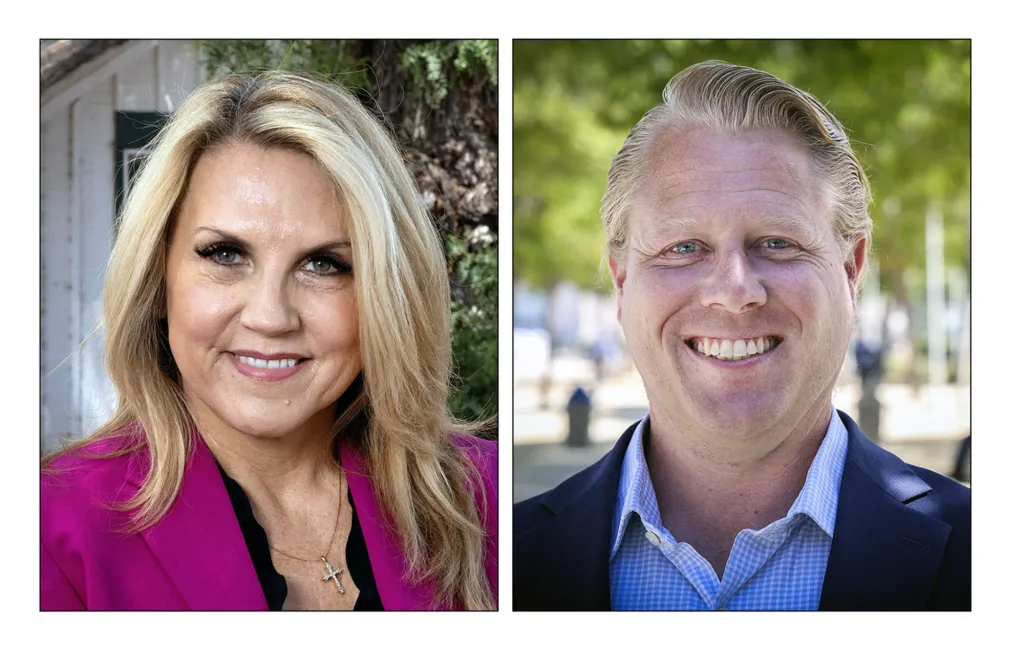










Richard Barrera is the prohibitive favorite to be elected California superintendent of public instruction in November.
Read more Democrats want a supermajority on the Board of Supervisors. They have a North County problem.
That’s the good news for the San Diego Unified School District board president, a Democrat who advanced out of the primary in June. The other news is that the job he’s running for essentially will no longer exist.
He’s not happy about it, and neither is his opponent, Republican Sonja Shaw of the Chino Valley Unified school board.
The state superintendent of public instruction will be stripped of its key duty of managing the California Department of Education under a recent agreement between Gov. Gavin Newsom and legislators, which makes other sweeping changes to the state’s education bureaucracy.
The current system has long come under criticism because disparate entities have roles in education policy and implementation, resulting in inefficiency, confusion and a lack of accountability. The governor, the State Board of Education — which is appointed by the governor — the elected superintendent and the Legislature all have a hand in governing education at the state level.
Governors, the board and lawmakers create programs but do not have the authority to implement and monitor them. That’s the job of the independent state superintendent, whose ideas about how to shape the policies may conflict with the others.
It’s unclear exactly what the superintendent’s duties will be under the shift. The job in part will be shaped by a new education commissioner, appointed by and answerable to the governor, who will take over the education department.
The bill enacting the changes envisions the superintendent’s role morphing into an independent evaluator of education programs for the Legislature and an unofficial ombudsman on the public’s behalf, according to EdSource.
Barrera concurs that reforms are needed to improve coordination and accountability.
“Not only is that correct, it’s necessary,” he said. “I agree with all of that.”
But not with the overhaul of the superintendent’s job, which has considerable but not universal support among education groups.
“That actually creates more division and more confusion,” Barrera said of the job change.
Nevertheless, Barrera will have the full support of the Democratic establishment in a very blue state, along with many education interest groups. That includes the politically powerful California Teachers Association, which backs Barrera and also opposed the bill.
If elected, Barrera said he would insert himself into the discussions of how to carry out the reforms, define his job and maintain a high profile.
He believes he can still be effective in pursuing the mandate of the voters, which he described as based on “the idea that all of our students can achieve so much more.”
He specifically talked about improving college and career readiness, where he said San Diego Unified has outpaced the state as a whole. He added that he would continue the superintendent’s role as a more direct connection with local school districts than other state education governing entities.
“The real power of the state superintendent has always come from the bully pulpit,” Barrera said. “The superintendent has always had a role beyond the bureaucracy.
“It’s all about the way you work.”
The legislation came together as part of late budget negotiations, a move Barrera called a “backdoor attempt to take away responsibility from the superintendent.”
Read more Photos: Big Bay Boom
Shaw may be a long-shot in November, but that didn’t stop her from issuing a fiery condemnation of the agreement.
“Voters elect their State Superintendent to serve as an independent voice for California education, not as a figurehead,” she said in a statement. “This bill strips that office of its core duties and hands them to a political appointee. It removes critical checks and balances, and tells parents their votes no longer matter.”
If elected, she said she would attempt to focus “resources on proven reading and math instruction, increasing transparency, fostering increased parental involvement, protecting fairness and safety for girls in sports,” according to The Los Angeles Times.
The appointment of the new commissioner won’t happen until sometime next year, after a new governor has replaced the termed-out Newsom.
The changes combine a plan by Newsom, who talked about such reforms in his state of the state address in January, and legislation carried by San Diego County Democratic Assemblymembers David Alverez and Darshana Patel. Commenting on the changes as they worked their way through the Legislature, the two lawmakers lauded the reforms and suggested they were long overdue.
“Governance of the state’s public schools has been debated by policymakers since our state was formed,” said Patel, chair of the Assembly Education Committee, adding legislation will lead to changes “so that our students and schools can have the leadership and accountability they deserve.”
The reform agreement may have seemed sudden, but it was more than a century in the making. In 1920, the state’s first systematic study of education governance was published, according to the state Legislative Analyst’s Office. That report criticized the “two-headed” governing structure between the State Board of Education and superintendent.
Six major studies over the last 30 years essentially agreed changes are needed to address core problems: unclear lines of accountability, blurred responsibilities and mixed signals to schools. The analyst’s office said key recommendations were consistent among the research — making the governor the head of administrative functions and reducing or eliminating the superintendent’s independent administrative role.
California is only one of nine states that has an elected schools chief, according to CalMatters. In most states, either the governor or the state board of education appoints the top education official.
“California can no longer postpone reforms that have been recommended regularly for a century,” Newsom said in January. “These critical reforms will bring greater accountability, clarity and coherence to how we serve our students and schools.”
Newsom’s proposal mirrored recommendations in a December report by Policy Analysis for California Education headquartered at Stanford University.
“The need for stronger, more coherent governance has never been greater. Schools are grappling with fiscal challenges alongside deepening inequities, persistent opportunity gaps, and the lasting impacts of the COVID-19 pandemic on student learning and well-being,” the report’s authors wrote
The superintendent’s job has been in the crosshairs for a long time. Constitutional amendments to get rid of the position were rejected by voters four times — in 1928, 1934, 1958 and 1968, according to the legislative analyst.
Barrera noted that Newsom and like-minded legislators apparently learned a lesson from that.
“They intentionally avoided going to the voters,” he said.
Matt Rexroad (@MattRexroad), California political consultant.
“The 2034 World Cup will be in Saudi Arabia. They will not have beer. No Scotland, No Party.”