




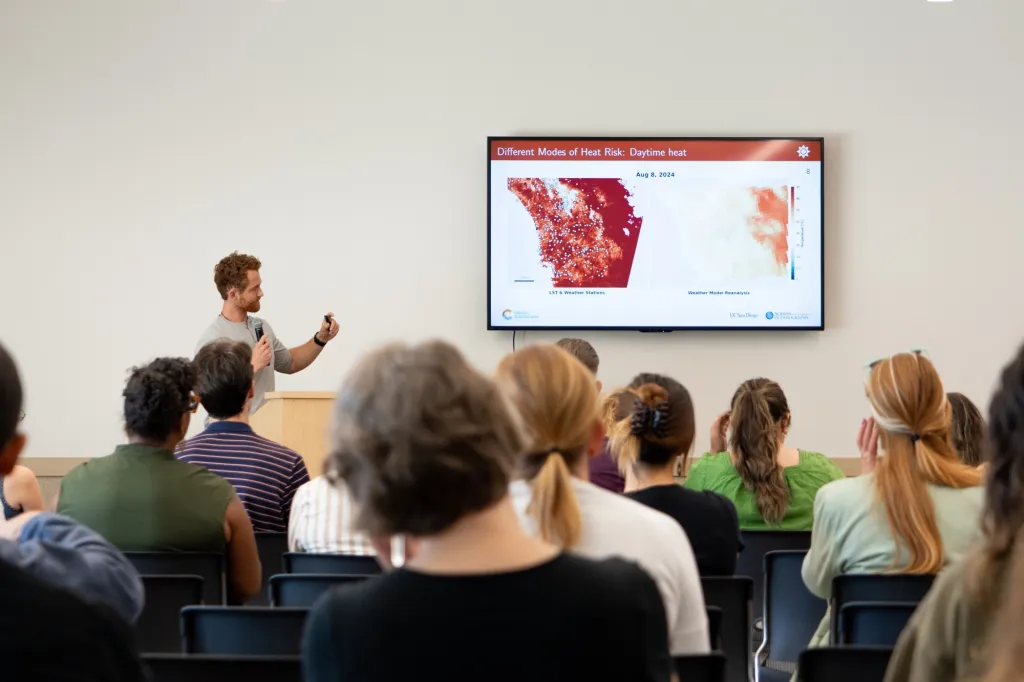
San Diego County residents can now understand their risk of extreme heat exposure and prepare for heat waves with the San Diego Heat Risk Explorer, a tool scientists are describing as the first interactive localized heat risk map of the county.
Read more The 2 earthquakes that struck Venezuela are known as a ‘doublet.’ Here’s how they happen
The San Diego Regional Climate Collaborative at the University of San Diego and the Scripps Institution of Oceanography’s Center for Climate Change Impacts and Adaptation collaborated to create the Heat Risk Explorer. Introduced to the public earlier this month, it uses census data and factors such as income levels and green space proximity to inform which communities are most vulnerable to extreme heat and would benefit from increased support. Users of the Heat Risk Explorer can toggle variables under heat risk exposure, population sensitivity and access to resources to build their own composite risk map.
Climate Collaborative Director Darbi Berry said that the elements of the Explorer are fun to play with and that she also hopes the interactive nature of the Explorer will encourage San Diego County residents to take agency in advocating for climate solutions.
“That interactive component creates space for people to ask questions that are meaningful to them in their communities,” Berry said. “Even if the data is showing that their community is at risk, I think feeling armed with that information in a way that then you can go advocate, talk to your city elected officials, talk to your community members, to me, is really important.”
The Explorer also provides options to model the present day as well as projected climate scenarios for the years 2050 and 2080 based on varying levels of future emissions and climate action. UC San Diego Ph.D. candidate Connor Mack, who worked on the creation of the Explorer, said the goal is to give people an opportunity to think about different climate futures.
“It’s a pointer toward the future for the users of the tool to think about both where we are and also where we’re going,” Mack said.
The Heat Risk Explorer builds on the work of an urban heat risk vulnerability index created by the city of San Diego and NASA’s Jet Propulsion Laboratory, which modeled heat risk for the city. The Explorer integrates and visualizes data from the Centers for Disease Control and Prevention, other government agencies and local weather stations.
Read more The man who set a Virginia city council member on fire gets 40 years in prison
Although all of the data used to create the Explorer is publicly available, the process of synthesizing and visualizing it required technical expertise. Mack described the goal of the Explorer as democratizing the data by making it accessible and understandable to all San Diego County residents.
Berry said she hopes the tool will not only identify risks in communities but also lead to solutions. She expressed the importance of heat risk planning, which she said is currently a gap in the region. Across San Diego County, only Escondido has a stand-alone comprehensive heat action plan, Berry said.
The Climate Collaborative is working in partnership with the cities of San Diego, Chula Vista and La Mesa to draft solution-focused heat action plans using the data from the Heat Risk Explorer. Potential heat risk adaptation projects could include subsidies to purchase air conditioning units, planting trees and increasing access to green space.
The Climate Collaborative is also training and sharing the Explorer’s information with other government agencies, including San Diego Gas & Electric Co., the Port of San Diego and the San Diego International Airport.
Moving forward, the Climate Collaborative aims to share it with the public through partnerships with nonprofits serving K-12 students and elderly adults, as well as at public events. It plans to share the resource at Litter Free La Mesa Saturday and other events throughout the summer.
The map is available online to the public at cccia-sio.github.io/socal-heat-hub/main/heat_risk_map.html.
Read more A rifle-toting war reporter died with Custer at Little Bighorn 150 years ago