




Recent court rulings have forced San Diego to halt a city crackdown on street vendors that has been hailed for restoring order to Balboa Park, the Gaslamp Quarter, city beaches and other popular spots.
Read more Michael Smolens: Barrera, opponent Shaw are not happy about gutted superintendent job
Leaders of merchant groups say they’re frustrated by the city’s retreat, which was triggered by a state appeals court ruling in January that the city was illegally impounding the carts and other property of scofflaw vendors.
The ruling, which vindicated the complaints of a vendor who had operated for many years outside Petco Park, also declared as “overly restrictive” the city’s geographic no-vendor zones and limitations on vending hours.
Since the court defeat, chaos and problems have slowly returned to many areas where vendors had been most conspicuous before the city’s street vendor law took effect in 2023.
“It’s a disaster,” Denny Knox, executive director of the Ocean Beach Main Street Association, said last week.
Knox said it’s highly disappointing to have zero enforcement by the city after politicians, community leaders and vendor advocates spent many years crafting and re-crafting San Diego’s street vendor law.
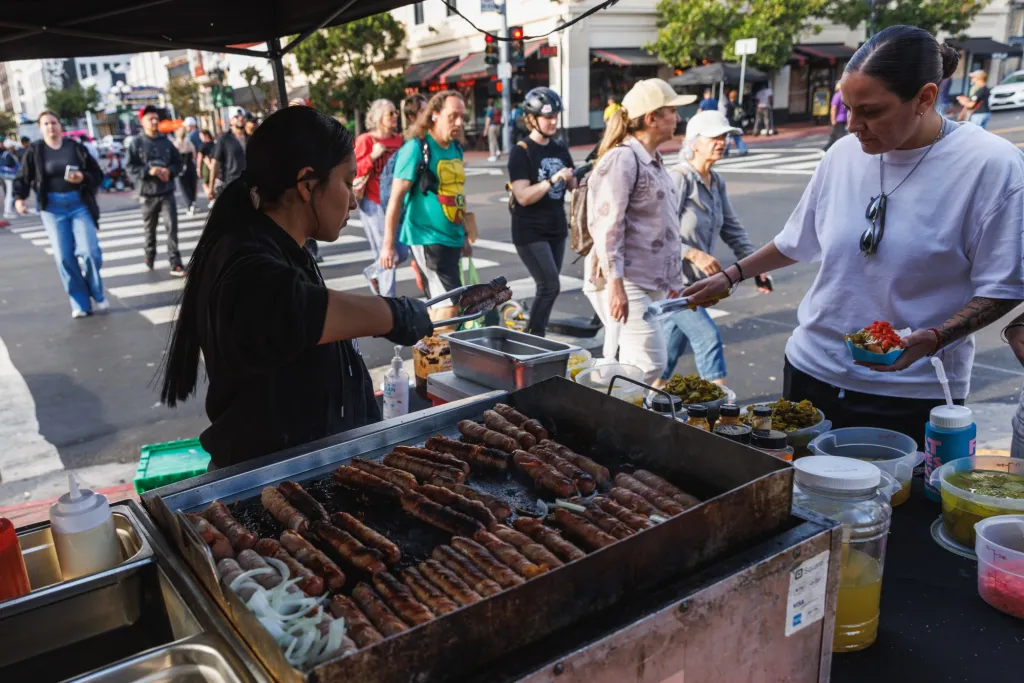
In the Gaslamp Quarter, organized groups of hot dog vendors are again arriving together in trucks every weekend. Those vendors have been accused of threatening merchants, starting fires and pouring grease into storm drains.
“Businesses are struggling as sidewalks are blocked, unpermitted vendors operate without oversight and enforcement is visibly absent,” said Michael Trimble of the Gaslamp Quarter Association. “The lack of action has also led to an escalation of activity, including new vendors setting up tents and selling goods without permits, health approvals or accountability.”
The court defeat, which the city chose not to appeal, essentially returns San Diego to square one in its longtime effort to grapple with a 2018 state law that decriminalized many aspects of street vending.
The city’s stated goal has consistently been to balance fostering vendors as a new class of entrepreneurs against preventing them from damaging the character and safety of parks, beach areas and business districts.
But the city has suffered setback after setback.
Controversial efforts to craft a vendor law began under then-Mayor Kevin Faulconer in 2019, shifted to Mayor Todd Gloria in 2021, and eventually fell into the hands of Councilmember Jennifer Campbell, who represents some beach areas.
Campbell and her aides, primarily chief of staff Venus Molina, crafted a complex law that the City Council approved in an 8-1 vote in May 2022.
A key part of the law was banning vendors during the busy summer months in Balboa Park and many of the city’s beach areas. It also banned vendors in large parts of some business districts, such as Little Italy and Ocean Beach.
But the law almost immediately ran into problems. Merchant groups complained about lack of enforcement and many vendors claimed the law violated their free speech rights under the First Amendment.
With help from then-City Attorney Mara Elliott, San Diego officials rewrote the law and got council approval for the revised version in early 2024.
The revisions fundamentally changed the law, making it easier to impound the carts of rule-breaking vendors and limiting where free-speech vendors can operate.
The revisions carefully define which kinds of vendor activities have free-speech protections, such as political efforts, selling art a person made themselves, fortune telling, face painting and making balloon sculptures.
Activities that lack free-speech protections include selling food and leading yoga classes on city beaches.
But declaring yoga unprotected turned out to be another blunder by the city — one that was successfully challenged in court.
In June 2025, a federal appeals court ruled that it’s unconstitutional to apply the vendor law to yoga classes, forcing the city to immediately allow such classes to resume.
The ruling said teaching yoga is protected speech under the First Amendment, and that city officials failed to show how the classes threaten public safety or prevent enjoyment of the city’s shoreline parks.
The 2024 revisions also overstepped when they made it easier for the city to impound vendor carts and other possessions.
After city police impounded the cart of Imhotep Mustaqeem, a licensed sidewalk vendor who had sold packaged snacks outside Petco Park since 2009, Mustaqeem sued the city.
Read more Democrats want a supermajority on the Board of Supervisors. They have a North County problem.
His lawsuit argued that impounding carts went beyond protecting health and safety. The suit also challenged the city’s no-vendor zones, which include Petco Park and the Gaslamp Quarter.
A Superior Court judge ruled against Mustaqeem, but the Fourth District Court of Appeal ruled in January that San Diego’s street vendor rules directly conflict with state law.
“We conclude that at least two of the city’s sidewalk vending regulations — namely regulations that purport to allow the impoundment of Mustaqeem’s items and that restrict vending operating hours beyond those of other area businesses — are in direct conflict with the state law on their face,” Justice Julia Kelety wrote.
Mustaqeem’s case was supported by the Inland Coalition for Immigrant Rights.
“California’s streets are vibrant and more alive because of street vendors, immigrant and working-class entrepreneurs who turn sidewalks into spaces of connection, culture, and opportunity,” Javier Hernandez, the coalition’s executive director, said last year.
Mustaqeem’s attorney, Jeremiah Daniel Graham, did not return a phone call last week.
A spokesperson for City Attorney Heather Ferbert declined last week to discuss why the city chose not to appeal or precisely why the city has instructed police and park rangers to completely halt enforcement of the street vendor law.
Ashley Nicholes, a spokesperson for the Police Department, provided the Union-Tribune the following statement last week:
“Recent court rulings involving the city’s street vending ordinance have limited what police officers can do to enforce street vending laws. For example, officers currently cannot impound vending equipment, and enforcement in the Ballpark District is restricted.”
But Nicholes said there are other factors in the decision to halt enforcement.
“Those legal limits come on top of ongoing staffing shortages, limited overtime resources and the need to prioritize emergency calls and violent crime,” she said. “Together, these factors have reduced the Police Department’s ability to proactively enforce street vending regulations.”
Police handle enforcement in the Gaslamp, primarily because of previous difficulty controlling the hot dog vendors who arrive in trucks. Park rangers handle enforcement elsewhere.
Nicole Darling, the city’s lead spokesperson, said last week that there is essentially no enforcement at all.
“At this time, the Parks and Recreation Department is not engaging in enforcement of the sidewalk vending ordinance,” she said.
Knox, the leader of the OB merchants group, said it seems unfair for the city to charge her group $28,000 for police support during the annual OB street fair and not have those police enforce the vendor ordinance.
Knox said the return of the vendors created many problems during the street fair, which took place June 27.
Trimble, who leads the Gaslamp merchants, said he thinks the city is being too timid. He contends the Mustaqeem ruling doesn’t prevent enforcement.
“It reinforces that enforcement must be clear, consistent and grounded in safety,” he said. “The city already has that framework in place.”
Trimble said police retreated long before Mustaqeem, contending they only engaged in proactive enforcement for about six months in 2023 and 2024.
He said it was too expensive to pay officers overtime and secure large trucks to impound vendor carts — especially with the city in the middle of its worst budget crisis in many years.
While the Padres haven’t complained about the city’s halt to enforcement, the team expressed concern last week.
“Our concern continues to be public safety and unregulated vending, particularly open flames and sidewalk accessibility,” Craig Hughner, senior vice president of communications, said by email.
In the past, team officials have complained about hazardous conditions caused by food vendors near Petco, particularly some explosions and fires.
Read more Photos: Big Bay Boom